Communication Systems Interview Prep
Communication systems interview prep — analog (AM/FM) and digital (BPSK/QAM) modulation, matched filtering, BER analysis, Shannon capacity, and channel coding.
Quick answer
Communication Systems covers the principles of transmitting information over physical channels.
Communication-systems questions are mandatory at every wireless, RF, modem, and DSP interview.
Editorial review
Written by
CompoundLearn editorial team
Wireless / RF / hardware engineering
Reviewed by
CompoundLearn editorial team
Wireless / RF / hardware engineering
Last reviewed
Built from curated topic maps, editorial validation, and subject-matter review so the page stays aligned with the interview intent and the current content pipeline.
What it is
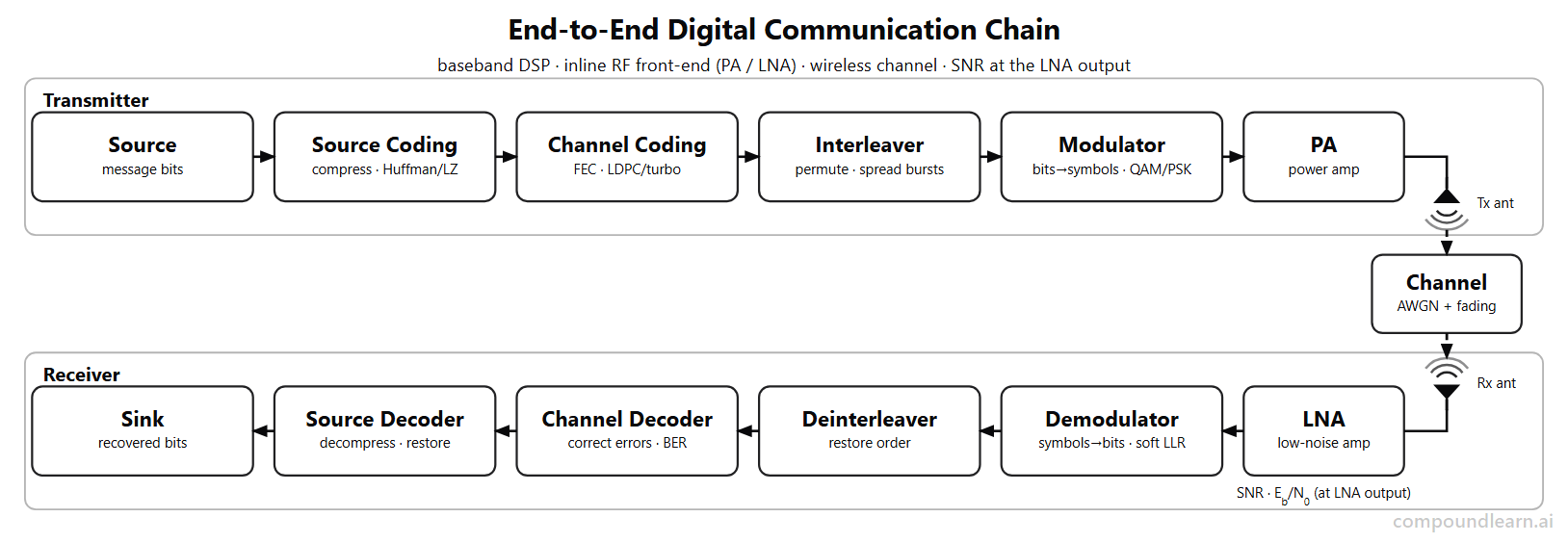
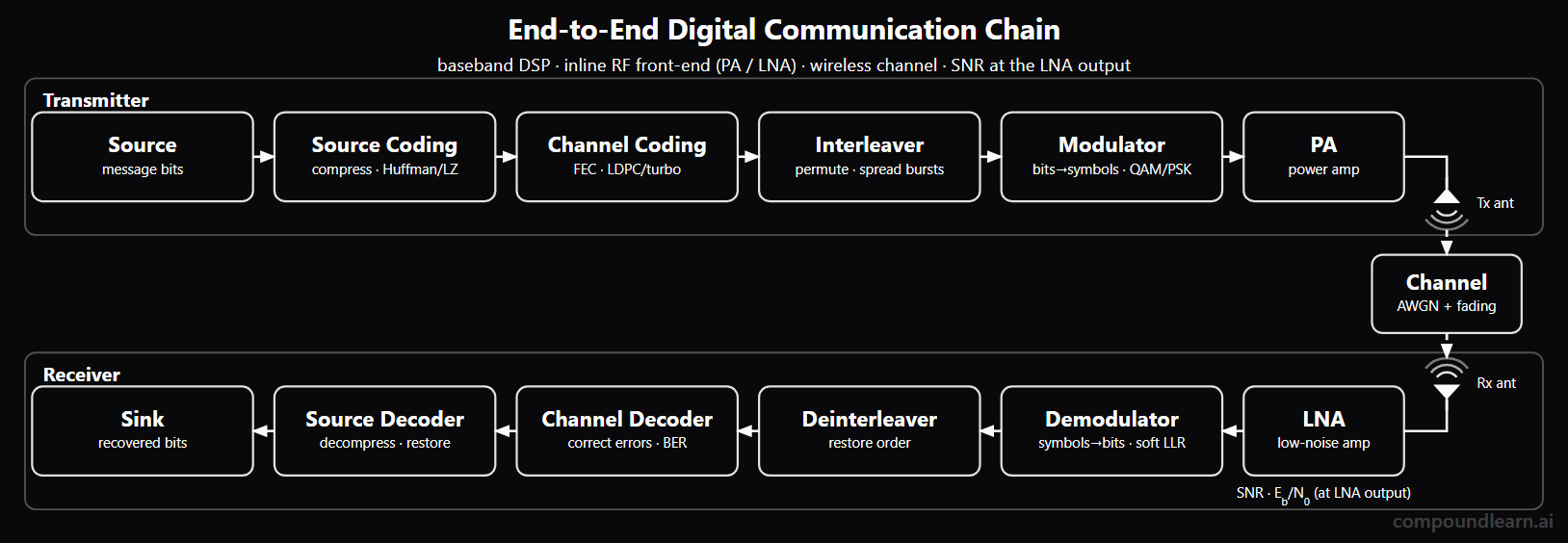
Communication Systems covers the principles of transmitting information over physical channels. Standard topics include analog modulation (AM, DSB-SC, SSB, FM, PM, including envelope detection, coherent demodulation, FM threshold effects), sampling and quantization (Nyquist, aliasing, anti-alias filtering, uniform vs non-uniform quantization, A-law and µ-law companding), pulse modulation (PCM, DPCM, delta modulation), digital baseband transmission (line codes, eye diagrams, intersymbol interference, Nyquist criterion, raised-cosine and square-root-raised-cosine pulse shaping, equalization), passband digital modulation (BPSK, QPSK, M-QAM, M-PSK, FSK, MSK, GMSK, OFDM), the matched filter and maximum-likelihood receivers, BER analysis in AWGN for canonical schemes, performance over fading channels, channel coding (block codes, convolutional codes, Reed-Solomon, turbo codes, LDPC, polar) and the Shannon-Hartley capacity bound, multi-user techniques (TDMA, FDMA, CDMA, OFDMA), and an introduction to multipath, frequency-selective channels, and OFDM as the canonical solution. For engineering candidates, communication systems is the prerequisite layer beneath wireless, RF, and any modem-design role; the analytical machinery transfers directly to 5G NR, Wi-Fi, satellite, optical, and storage channel design.
Why interviewers ask
Communication-systems questions are mandatory at every wireless, RF, modem, and DSP interview. Strong interviewers probe BER analysis with the canonical "BER of BPSK in AWGN" question and watch whether candidates produce Q(√(2·E_b/N_0)) confidently and connect it to the geometric Voronoi-region picture for higher-order constellations. They probe Shannon-Hartley fluency: compute capacity for given B and SNR, identify the ratio of operating data rate to capacity, discuss when channel coding moves you toward the limit. Matched-filter questions test signal-detection theory — derive the optimal linear filter, explain why it equals the time-reversed conjugate of the pulse, connect it to correlation receivers. Pulse-shaping and ISI questions probe the Nyquist criterion and raised-cosine roll-off tradeoffs. Higher-level interviews cover multipath: delay spread, coherence bandwidth, frequency-selective vs flat fading, and why OFDM solves frequency-selectivity by chunking the band into narrowband subcarriers (which connects to the wireless/5G interview track directly). The strongest candidates fluently switch between time-domain pulse pictures, frequency-domain spectrum pictures, signal-space constellation pictures, and information-theoretic capacity pictures. Communication-systems probes also surface mathematical maturity — Q-function manipulations, Gaussian integrals, Fourier-transform relationships — that separate strong candidates from those who memorized formulas.
Common mistakes
The most common mistake is conflating E_b/N_0 with SNR — they differ by spectral efficiency (SNR = (E_b/N_0) · (R_b/B)), and using the wrong one shifts BER calculations by orders of magnitude. A second mistake is on Q-function bookkeeping: candidates use Q where they need erfc/2, or apply the wrong scaling factor for the Gaussian variance, producing BER plots offset by dB. A third mistake on Shannon capacity is to ignore that it is a per-bandwidth quantity — comparing rates across systems with different bandwidths requires normalization to spectral efficiency (b/s/Hz). A fourth mistake on matched filtering is to claim the matched filter "removes noise" — it maximizes SNR at the sampling instant under additive white Gaussian assumptions, but it does not change input-noise variance or bandwidth in any general sense. A fifth mistake on pulse shaping is to confuse RC with SQRT-RC: the cascade of TX SQRT-RC and RX SQRT-RC gives an RC pulse that is ISI-free at sample times. A sixth mistake on QAM is to assume linear amplifier behavior — high-PAPR signals like high-order QAM force PA back-off, which dominates RF design tradeoffs. A seventh mistake on coherent detection is to ignore the carrier-recovery loop — phase-locked loop dynamics, jitter, and acquisition time are real-world constraints that get ignored in textbook analysis. An eighth mistake on FSK is to confuse coherent FSK SNR with non-coherent FSK SNR — they differ by 3 dB, with coherent better, and getting the relationship wrong is a textbook trap. A ninth mistake on multipath is to apply AWGN BER formulas to fading channels — fading produces deep nulls that average BER above the AWGN value, sometimes by orders of magnitude, and diversity (multipath, frequency, antenna, time) is the standard fix. Finally, candidates frequently miss the role of synchronization — symbol timing, frame timing, carrier phase, carrier frequency — which dominates real-world system design but rarely appears in textbook problems.
Frequently asked questions
- What is the difference between AM, FM, and PM, and why does FM have better noise performance?
- AM encodes information in carrier amplitude — bandwidth ≈ 2·W (W = baseband bandwidth), noise corrupts amplitude directly. FM encodes in instantaneous frequency — Carson's rule gives bandwidth ≈ 2(Δf + W), and the wider deployed bandwidth lets FM trade bandwidth for noise immunity (above threshold, FM SNR improves with the modulation index squared). PM encodes in instantaneous phase, mathematically equivalent to FM with the modulating signal differentiated. FM's noise advantage breaks down below threshold (clicks and pops), which is why limiter-discriminator demodulators dominate broadcast FM.
- What is a matched filter and why is it optimal?
- A matched filter is a linear filter whose impulse response is the time-reversed conjugate of the transmitted pulse. For detection in additive white Gaussian noise, the matched filter maximizes the output SNR at the sampling instant — provably optimal among linear filters. The output equals the cross-correlation of received signal and transmitted pulse, sampled at peak. Nearly all coherent receivers use matched filtering as the front-end after the channel (non-coherent envelope/energy receivers are the exception) — square-root raised cosine pulse shaping at TX and matching SQRT-RC at RX is the canonical design that delivers ISI-free sampling.
- How do you compute the BER of BPSK in AWGN?
- BPSK transmits ±√E_b per bit; the matched-filter output is a Gaussian random variable with mean ±√E_b and variance N_0/2. The decision threshold is 0; BER = Q(√(2·E_b/N_0)) where Q is the Gaussian Q-function. At E_b/N_0 = 9.6 dB, BER ≈ 10^(-5). The same calculation extends to QPSK (same per-bit BER), 16-QAM (different constants, factor of √(4/10) inside the Q function), and so on. Channel coding gives additional E_b/N_0 advantage at the cost of bandwidth — coded modulation moves toward Shannon capacity.
- What does Shannon capacity tell you?
- For an AWGN channel: C = B·log_2(1 + SNR), where B is bandwidth and SNR is signal-to-noise ratio. C is the maximum reliable data rate; rates below C admit arbitrarily low BER with sufficient coding, rates above are impossible. Shannon-Hartley implies the bandwidth-SNR tradeoff: doubling bandwidth lets you halve SNR for the same rate, with the limiting case being -1.6 dB SNR-per-bit (the Shannon limit) at infinite bandwidth. Modern systems (LDPC, polar) operate within fractions of a dB of capacity, which is why channel coding in 5G NR is a tightly-engineered art.
- What is intersymbol interference (ISI) and how does pulse shaping fix it?
- ISI happens when the transmitted pulse has support spanning multiple symbol periods, so consecutive symbols' tails overlap and contaminate each other. Nyquist showed that a bandlimited pulse with zero crossings at every other symbol time is ISI-free — the canonical such pulse is the raised cosine. Practical systems split the raised cosine between TX and RX as square-root raised cosine: the transmit and matched filters cascade to produce a raised cosine, simultaneously achieving ISI-free sampling and maximum-SNR detection. Roll-off factor α trades excess bandwidth for time-domain robustness.
- What is the difference between coherent and non-coherent detection?
- Coherent detection uses an exact replica of the carrier phase at the receiver — typically derived from a phase-locked loop or pilot. It supports BPSK, QPSK, QAM, and gives the best BER performance for a given E_b/N_0. Non-coherent detection avoids phase recovery — DPSK uses differential encoding so adjacent symbols carry the phase information; FSK can be detected by envelope detection on each tone. Non-coherent loses 1-3 dB of BER performance but tolerates phase noise, frequency drift, and short bursts where carrier recovery has not converged. Modern bursty wireless systems often combine coherent payload detection with non-coherent preamble for fast acquisition.
Related topics
Essential AI-Native Skills for Communication Systems
Modern engineering work increasingly uses AI tools for design and code review, debugging, documentation, test and testbench generation, and workflow automation. The goal is not to let AI replace engineering judgment — it is to move faster while keeping verification discipline.
- Use AI to explain unfamiliar code, logs, waveforms, datasheets, or test failures.
- Break large problems into small, reviewable steps you can verify independently.
- Ask AI for hypotheses, then validate them against tests, measurements, simulations, or lab data.
- Version-control your analysis scripts, testbenches, and configs — keep changes small and reviewable.
- Document your assumptions, design tradeoffs, and debugging decisions.
- Verify AI output before trusting it: run the checks that fit the domain — unit tests, linters, simulations, or bench/lab measurements.
- Review AI output for correctness, edge cases, and real-world consequences.
Communication Systems — coming to the question bank
The adaptive practice engine is already live for core wireless, RF, and ML systems. Communication Systems isn't covered in the question bank yet — get notified when it's added.