URLLC in 5G NR: Mini-Slots, Preemption, and Sub-1ms Latency Interview Prep
URLLC in 5G NR — mini-slot scheduling, preemption indication, MCS Table 3, PDSCH/PUSCH repetition, configured grant, and 1 ms latency at 10⁻⁵ reliability.
Quick answer
URLLC (Ultra-Reliable Low-Latency Communication) is the 3GPP service category for applications requiring both very low latency (1-10 ms) and very high reliability (10⁻⁵ to 10⁻⁹ packet error rate).
URLLC is the depth probe in 5G modem and cellular-systems interviews because it integrates every layer — air interface, MAC, PHY, scheduling, QoS, slicing, transport — into one operational service category.
Editorial review
Written by
CompoundLearn editorial team
Wireless / RF / hardware engineering
Reviewed by
CompoundLearn editorial team
Wireless / RF / hardware engineering
Last reviewed
Built from curated topic maps, editorial validation, and subject-matter review so the page stays aligned with the interview intent and the current content pipeline.
What it is
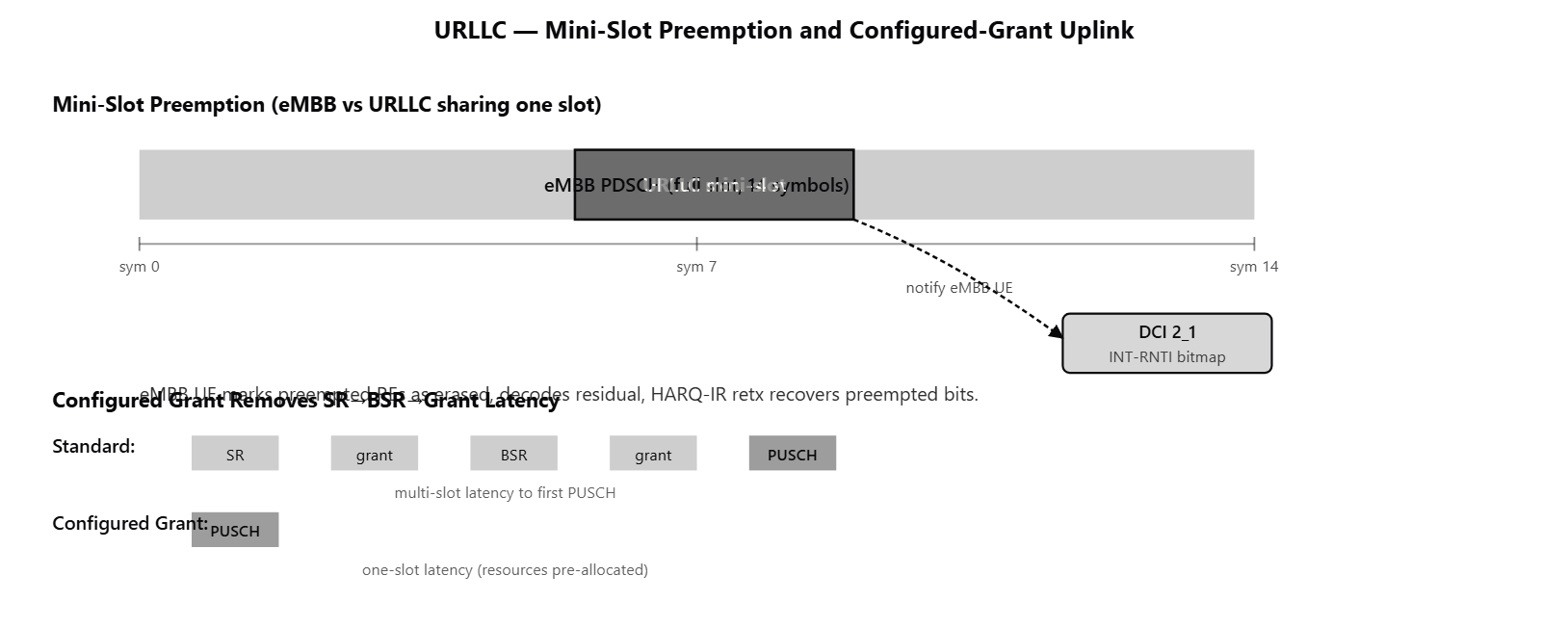
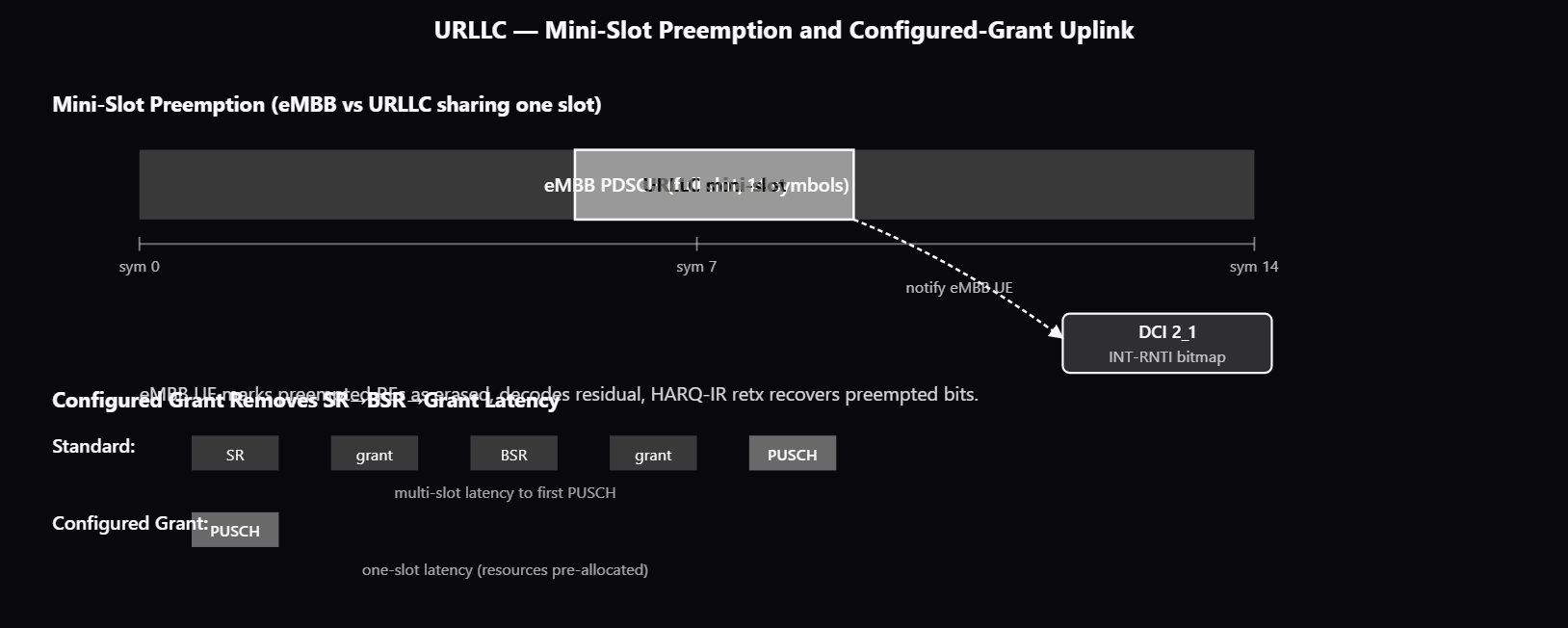
URLLC (Ultra-Reliable Low-Latency Communication) is the 3GPP service category for applications requiring both very low latency (1-10 ms) and very high reliability (10⁻⁵ to 10⁻⁹ packet error rate). Typical applications: industrial automation, vehicle-to-everything (V2X) safety messages, remote control of robotic systems, electricity-grid protection signaling, AR/VR tactile internet. URLLC sits alongside eMBB (enhanced mobile broadband, throughput-focused) and mMTC (massive machine-type communication, scale-focused) as one of the three 5G service categories defined by 3GPP. URLLC delivery requires a layered combination of air-interface mechanisms. No single mechanism is sufficient — each addresses a different latency or reliability component. **Mini-slot scheduling** is the latency lever within a slot. Standard NR slot scheduling uses the full 14-symbol slot as the scheduling unit. Mini-slots are 2, 4, or 7 symbols, letting a transmission start mid-slot without waiting for the next slot boundary. At lower numerologies (μ=0 with 1 ms slot, μ=1 with 0.5 ms slot) mini-slot scheduling is essential for URLLC because the full slot is too long. At higher numerologies (μ=3 with 0.125 ms slot) the full slot is already short enough that mini-slot scheduling matters less. Mini-slot configuration is per-PDSCH/PUSCH via the scheduling DCI. **Preemption indication** is the cross-service-coexistence mechanism. When an urgent URLLC mini-slot needs resources that are currently being used by an ongoing eMBB PDSCH, the gNB preempts — the URLLC transmission overwrites the eMBB transmission on the affected REs, and the gNB sends DCI 2_1 (CRC scrambled by the UE-specific INT-RNTI) to the eMBB UE encoding, at PRB/OFDM-symbol granularity, which resources were preempted. The eMBB UE treats the indicated PRB/symbol resources as not carrying its PDSCH before decoding; HARQ-IR retransmission recovers the lost bits. Preemption is the air-interface mechanism that enables eMBB+URLLC coexistence on the same cell. **MCS Table 3 (qLowSE)** is the reliability lever. The qLowSE table targets 10⁻⁵ BLER (the URLLC reliability target) rather than the 10⁻¹ BLER of standard eMBB MCS tables. Lower-rate code points with more aggressive coding deliver the higher reliability at the cost of reduced peak throughput. MCS table choice is RRC-configurable per UE; the same UE can use Table 1/2 for eMBB bearers and Table 3 for URLLC bearers in the same RRC configuration. See /topics/nr-channel-coding for the MCS-table context. **PDSCH/PUSCH repetition** is the diversity-gain reliability mechanism. The same transport block is transmitted multiple times across consecutive slots or mini-slots, and the receiver combines copies (HARQ-IR-style or simple combining) for diversity gain. Repetition counts of 2, 4, or 8 are typical. For latency-critical URLLC, repetitions occur in consecutive mini-slots to bound total latency. **Configured grant for uplink URLLC** removes the SR→BSR→grant round-trip latency. Pre-allocated periodic uplink resources let the UE transmit immediately when uplink URLLC traffic arrives, without per-transmission scheduling DCI. Type 1 (RRC-configured, always active) is the right choice for always-on URLLC; Type 2 (RRC + DCI(CS-RNTI)-activated) for bursty URLLC. See /topics/nr-mac-scheduling for the configured-grant context. **Higher numerology** (μ=2 or μ=3) gives shorter slot durations (0.25 ms or 0.125 ms), shorter symbol durations, and faster HARQ round-trips. URLLC services typically run on μ=2 or μ=3 BWPs configured for the purpose, with the same UE able to operate on a μ=1 BWP for eMBB traffic and switch BWPs per service. See /topics/nr-bwp-and-numerology for the BWP context. URLLC integrates with 5G slicing at the network level. URLLC services typically run on dedicated slices configured with URLLC-specific 5QIs (5QI=83 for discrete automation, 5QI=85 for electricity distribution — see /topics/5g-qos-and-5qi). The slice provides network-level isolation: own AMF/SMF/UPF, with UPF deployed near the cell edge (MEC / edge compute) to minimize transport-network latency. Per-slice 5QI drives air-interface QoS handling within the slice. Combined: slicing provides network-level URLLC isolation; air-interface mechanisms provide radio-layer latency and reliability. Both layers are required for end-to-end URLLC delivery.
Why interviewers ask
URLLC is the depth probe in 5G modem and cellular-systems interviews because it integrates every layer — air interface, MAC, PHY, scheduling, QoS, slicing, transport — into one operational service category. A candidate who fluently navigates mini-slot scheduling, preemption indication, MCS Table 3, configured grant, and the URLLC-slicing integration is showing the cross-layer understanding that staff URLLC-architect and 5G-systems-engineer roles require. The "three mechanisms for URLLC" question is the diagnostic test. Strong candidates explain that latency requires the combination of higher numerology (shorter slot), mini-slot scheduling (start mid-slot), and preemption (interrupt ongoing transmissions), and that reliability requires MCS Table 3 plus repetition. They explain why no single mechanism is sufficient. Weak candidates name "URLLC mechanisms" generically without explaining which solves latency vs reliability. Preemption indication is the deepest air-interface question. Strong candidates explain that DCI 2_1 scrambled with INT-RNTI carries a bitmap of preempted REs, the eMBB UE applies the bitmap to mark REs as erased before LDPC decoding, and HARQ-IR retransmission recovers the preempted bits. They understand that preemption is the mechanism enabling eMBB+URLLC coexistence on the same cell — without preemption, the cell would have to reserve dedicated URLLC PRBs, wasting capacity. The URLLC-vs-slicing question is the architecture probe. Strong candidates distinguish the network-level slicing (own AMF/SMF/UPF with edge deployment) from the air-interface URLLC mechanisms (mini-slot, preemption, etc.), and explain that both layers are required for end-to-end URLLC delivery. Candidates who treat slicing as the only URLLC mechanism miss the air-interface side. MCS Table 3 / qLowSE is the channel-coding-side URLLC probe. Strong candidates know that Table 3 targets 10⁻⁵ BLER vs the 10⁻¹ of standard eMBB tables, and explain that the MCS table choice is per-bearer (per-RRC-configuration) so the same UE can run eMBB on Tables 1/2 and URLLC on Table 3 simultaneously. Candidates who do not know Table 3 exists miss the URLLC reliability mechanism. The configured-grant URLLC question is the uplink-latency probe. Strong candidates explain that configured grant removes the SR→BSR→grant overhead, that Type 1 is fully RRC-configured while Type 2 is activated by a PDCCH DCI (CS-RNTI), and that both are URLLC-friendly. Candidates who describe URLLC uplink as "just lower MCS" miss the configured-grant lever.
Common mistakes
The most common mistake is treating URLLC as a single feature rather than a layered combination of mechanisms. URLLC requires higher numerology, mini-slot scheduling, preemption indication, MCS Table 3 / qLowSE, and (for uplink) configured grant. No single mechanism delivers the latency-reliability combination; they must work together. A second gap is confusing mini-slot with high numerology. Mini-slot scheduling shortens the wait-for-transmission-start within a slot; higher numerology shortens the slot itself. Both contribute to latency reduction but they are different mechanisms. Candidates who collapse them miss the layered design. A third gap is missing preemption indication. Some candidates know URLLC needs to coexist with eMBB but cannot describe the mechanism — DCI 2_1 with INT-RNTI carrying a preempted-RE bitmap that the eMBB UE applies to mark REs as erased. Without preemption, the cell either reserves dedicated URLLC PRBs (wasted capacity when no URLLC traffic exists) or makes URLLC wait for eMBB to complete (defeats the latency target). A fourth gap is missing MCS Table 3 (qLowSE). Some candidates know URLLC needs higher reliability but think it comes from MIMO or stronger FEC alone. The dedicated MCS table targeting 10⁻⁵ BLER is the specific mechanism — at the same modulation order, more aggressive coding for the higher reliability target. Candidates who do not know Table 3 exists have an incomplete URLLC mental model. A fifth gap is treating URLLC slicing as the air-interface mechanism. Slicing is network-level (own AMF/SMF/UPF) and provides isolation plus edge deployment of UPF. Air-interface URLLC mechanisms (mini-slot, preemption, MCS Table 3, etc.) are separate and operate at the radio layer. Both are required; collapsing them is a layer-confusion. A sixth gap is overstating URLLC achievability. URLLC end-to-end latency targets (1-10 ms) require gNB scheduler tuning, MAC configuration, PHY configuration, slice provisioning, edge UPF deployment, AND well-engineered application-server placement. Candidates who claim "5G has URLLC out of the box" miss the engineering effort required per deployment. See /topics/nr-mac-scheduling for the scheduler context, /topics/nr-channel-coding for the MCS-table context, /topics/nr-bwp-and-numerology for the numerology context, and /topics/5g-qos-and-5qi for the QoS-flow context.
URLLC vs eMBB vs mMTC — Service Category Trade-offs
| Category | Latency Target | Reliability Target | Throughput | Typical 5QI | Air-Interface Mechanisms |
|---|---|---|---|---|---|
| URLLC | 1-10 ms one-way | 10⁻⁵ to 10⁻⁹ PER | Low-moderate | 82, 83, 85 | Mini-slot, preemption, MCS Table 3, repetition, configured grant |
| eMBB | 4-20 ms | 10⁻³ to 10⁻¹ | Very high (Gbps) | 7, 9, 79 | Full slot, MCS Table 1/2, high-order MIMO, CA |
| mMTC | > 100 ms tolerable | 10⁻¹ | Very low (kbps) | NB-IoT specific | Long DRX, narrow BWP, low-power |
Sample interview questions
- A 5G URLLC service requires 1 ms one-way latency with 10⁻⁵ reliability. What three layered mechanisms in NR enable this combination, and why is no single mechanism sufficient?
- A. Higher MCS alone is sufficient for URLLC.
- B. URLLC requires only network slicing; air-interface mechanisms are unnecessary.
- C. URLLC is delivered via a separate dedicated frequency band.
- D. URLLC requires the combination of (1) higher numerology (μ=2 or μ=3 → shorter slot → faster HARQ round-trip), (2) mini-slot scheduling (2/4/7 symbols → transmission can start mid-slot without waiting for slot boundary), and (3) preemption indication (URLLC mini-slot can preempt an ongoing eMBB PDSCH, with the eMBB UE notified via DCI 2_1 / INT-RNTI to erase preempted REs before decoding). Each mechanism addresses a different latency component — numerology shortens the slot, mini-slot shortens the wait for transmission start, preemption removes the wait for in-flight transmissions to complete. ✓
Option D is correct. URLLC's combination of low latency AND high reliability requires multiple layered air-interface mechanisms. No single mechanism delivers both targets: **1. Higher numerology (shorter slot)**: μ=2 (60 kHz SCS) gives 0.25 ms slot; μ=3 (120 kHz SCS) gives 0.125 ms slot. Shorter slots cut the per-slot wait time and the HARQ round-trip latency. See /topics/nr-bwp-and-numerology for the numerology context. Why not enough alone: even a 0.125 ms slot still requires waiting until the next slot boundary to start a transmission — adds 0-125 μs of waiting. **2. Mini-slot scheduling**: 2-symbol, 4-symbol, or 7-symbol scheduling units within a slot. A URLLC transmission can start mid-slot without waiting for the next slot boundary. Why not enough alone: if eMBB is already using the slot, the URLLC transmission has to wait for the eMBB to complete unless we preempt. **3. Preemption indication**: URLLC mini-slot can preempt an ongoing eMBB PDSCH transmission. The gNB sends DCI 2_1 (scrambled with INT-RNTI) to the eMBB UE indicating which REs have been preempted; the eMBB UE erases those REs before LDPC decoding. Why not enough alone: preemption only helps if the URLLC fits in the preempted REs and can start immediately. **Reliability** is a separate dimension: - **MCS Table 3 (qLowSE)** — low-spectral-efficiency MCS targeting 10⁻⁵ BLER (vs 10⁻¹ for eMBB) - **PDSCH/PUSCH repetition** — same transport block transmitted multiple times for diversity - **Configured grant** with HARQ-IR — pre-allocated uplink resources with incremental-redundancy retransmission Together: numerology + mini-slot + preemption + MCS Table 3 + repetition + configured grant deliver the 1 ms latency at 10⁻⁵ reliability that URLLC demands. Option A misses that MCS alone is a reliability lever, not a latency lever. Option B confuses slicing (network-level isolation) with air-interface latency mechanisms. Option C is wrong — URLLC uses normal NR bands with QoS-driven scheduling. Production reality: URLLC requires the gNB scheduler, MAC, and PHY all to be configured together. URLLC services running on a vanilla eMBB-only gNB will not meet their latency and reliability targets.
- eMBB UE_A is mid-PDSCH-reception on 50 PRBs across symbols 5-13 of slot N. A URLLC mini-slot needs to preempt symbols 8-11 on 20 of those PRBs. What signaling does the gNB send to UE_A, and what does UE_A do?
- A. The gNB sends DCI format 2_1 on PDCCH (CRC scrambled by UE_A's configured INT-RNTI) in a subsequent slot (or end of slot N), carrying a 14-bit field that indicates, at the configured PRB/OFDM-symbol granularity, which time-frequency region was preempted. UE_A receives this preemption indication and treats the indicated resources as not carrying its PDSCH, so its decoder does not waste effort on those resources. If decoding fails, normal HARQ retransmission of the transport block follows. ✓
- B. The gNB cannot preempt an in-flight transmission; it must wait for the next slot.
- C. UE_A continues decoding as if no preemption occurred and reports a CRC failure.
- D. UE_A is dropped from the cell.
Option A is correct. The NR preemption mechanism is: - gNB decides to preempt: identifies which REs of UE_A's ongoing PDSCH will be overwritten by an urgent URLLC transmission - gNB transmits the URLLC mini-slot on those REs - gNB sends DCI format 2_1 on PDCCH, with CRC scrambled by the INT-RNTI (Interruption RNTI) configured for UE_A - DCI 2_1 carries a 14-bit field indicating which part of the configured monitoring window was preempted, at OFDM-symbol or PRB-pair granularity (UE-configured) — it flags PRB/symbol resources, not individual REs - UE_A receives the preemption indication (in a subsequent slot or at the end of the current slot) - UE_A treats the indicated PRB/symbol resources as not carrying its PDSCH (LLR handling is implementation-specific) - the decoder operates on the remaining resources without wasting effort on the preempted ones - if decoding fails, HARQ-NACK is sent and HARQ-IR retransmission follows The key design insight: preemption lets URLLC start transmitting NOW without waiting for eMBB to finish. The eMBB UE then learns after the fact which REs were lost and adjusts decoding. The eMBB transport block typically requires HARQ retransmission (the preempted REs carried bits that the LDPC code cannot fully recover), so eMBB pays a latency penalty — but the cell-aggregate latency for the URLLC service is preserved. INT-RNTI configuration is per-UE via RRC; UEs that are not configured for preemption indication do not receive the DCI 2_1 and would experience preemption as unexplained errors. Option B misses that preemption is the explicit mechanism to handle this case. Option C is wrong — without preemption indication, the eMBB UE wastes decoder effort on corrupted REs. Option D is far too pessimistic. Production reality: preemption is the air-interface mechanism that lets eMBB and URLLC coexist on the same cell. Mixed eMBB+URLLC scheduling typically uses preemption rather than reserving dedicated URLLC PRBs.
Frequently asked questions
- What is URLLC?
- URLLC (Ultra-Reliable Low-Latency Communication) is the 3GPP service category targeting applications that require both very low latency (1-10 ms) and very high reliability (10⁻⁵ to 10⁻⁹ packet error rate). Typical applications: industrial automation, vehicle-to-everything (V2X) safety messages, remote control of robotic systems, electricity-grid protection signaling, augmented-reality and tactile internet. URLLC is the 5G "use-case dimension" alongside eMBB (enhanced mobile broadband) and mMTC (massive machine-type communication). NR delivers URLLC through a combination of mechanisms — higher numerology, mini-slot scheduling, preemption, MCS Table 3 (qLowSE), PDSCH/PUSCH repetition, configured grant, and 5QI-driven QoS — that together achieve the latency-reliability targets.
- What is a mini-slot?
- A mini-slot is a sub-slot scheduling unit in 5G NR — typically 2, 4, or 7 OFDM symbols rather than the full 14-symbol slot. Mini-slot scheduling enables a transmission to start mid-slot without waiting for the next slot boundary, cutting the worst-case scheduling latency from one full slot down to a fraction. Mini-slots are essential for URLLC at lower numerologies (μ=0, 1 where the full slot is 1 ms or 0.5 ms — too long for many URLLC targets); at higher numerologies (μ=3 with 0.125 ms slots) the full slot is short enough that mini-slot scheduling matters less. Mini-slot scheduling is signaled per-PDSCH or per-PUSCH via the DCI; the same UE can receive both full-slot and mini-slot transmissions depending on what is being delivered.
- What is preemption indication?
- Preemption indication is the NR mechanism that lets the gNB preempt an ongoing eMBB transmission with an urgent URLLC mini-slot. The gNB sends DCI format 2_1 (CRC scrambled by the UE-specific INT-RNTI) carrying a 14-bit field indicating, at PRB/OFDM-symbol granularity, which part of the indicated monitoring window was preempted by URLLC traffic. The eMBB UE that receives the indication treats those PRB/symbol resources as not carrying its PDSCH and decodes the residual — typically requires HARQ-IR retransmission to recover the preempted bits. Preemption is configured per-UE via RRC; UEs without INT-RNTI configuration experience preemption as unexplained errors. This is the air-interface mechanism that enables eMBB+URLLC coexistence on the same cell.
- What is MCS Table 3 (qLowSE)?
- MCS Table 3 — the qLowSE (Low Spectral Efficiency) table — is a 5G NR MCS table targeting 10⁻⁵ BLER (the URLLC reliability target) rather than the 10⁻¹ BLER target of standard eMBB MCS tables. MCS Table 3 has lower-rate code points and uses more aggressive coding for the same modulation order, trading peak throughput for reliability. URLLC 5QIs are typically configured to use MCS Table 3 so that the BLER target matches the URLLC requirement. The MCS table choice is RRC-configurable per UE; the same UE can use Table 1/2 for eMBB bearers and Table 3 for URLLC bearers in the same RRC configuration. See /topics/nr-channel-coding for the MCS-table context.
- What is PDSCH/PUSCH repetition for URLLC?
- Repetition is the URLLC reliability mechanism where the same transport block is transmitted multiple times across consecutive slots or mini-slots. The receiver combines the multiple copies (HARQ-IR-style combining where each repetition can have a different redundancy version, or simple combining where all repetitions carry the same RV) to achieve diversity gain. Repetition is configured per-UE; typical repetition counts are 2, 4, or 8. The latency-vs-reliability trade-off: more repetitions means more reliability but more time-spent-transmitting. For latency-critical URLLC, the repetitions occur in consecutive mini-slots so the total latency is still bounded.
- What is configured grant for URLLC?
- Configured grant (see /topics/nr-mac-scheduling) is the pre-allocated periodic uplink resource that lets the UE transmit without per-transmission scheduling DCI. For URLLC, configured grant removes the SR→BSR→grant round-trip latency from the uplink path. Combined with mini-slot scheduling and higher numerology, configured grant enables 1 ms uplink latency targets that URLLC services need. Type 1 configured grant (RRC-configured, always active) is the right choice for always-on URLLC traffic; Type 2 (RRC + DCI(CS-RNTI)-activated) for bursty URLLC. The HARQ-IR retransmission mechanism handles failed transmissions of configured-grant PUSCH.
- How does URLLC relate to 5G slicing?
- URLLC services typically run on dedicated network slices configured with URLLC-specific 5QIs (e.g., 5QI=83 for discrete automation, 5QI=85 for electricity distribution — see /topics/5g-qos-and-5qi). The slice provides network-level isolation from eMBB traffic — own AMF, SMF, UPF deployed with low-latency placement (UPF near the cell edge), separate authentication and policy. The per-slice 5QI drives the per-flow QoS treatment within the slice. Combined: slicing provides network-level URLLC isolation, the air-interface mechanisms (mini-slot, preemption, MCS Table 3, etc.) provide the radio-layer latency and reliability. Both layers are required for true URLLC delivery.
- What latency targets does URLLC actually achieve?
- URLLC latency targets in 3GPP specifications: 1 ms one-way air-interface latency for the most demanding cases, 5 ms for typical industrial automation, 10 ms for less-demanding URLLC services. End-to-end latency (application to application) depends on additional factors: 5GC UPF processing, transport network between gNB and UPF, application-server location. With UPF deployed near the cell (edge compute / MEC) and proper air-interface configuration, end-to-end latencies of 5-10 ms are achievable for properly-engineered URLLC services. URLLC is NOT a free-lunch capability — it requires gNB scheduler configuration, MAC tuning, PHY configuration, slice provisioning, and edge-UPF deployment. Operator URLLC deployments are typically engineered per-customer per-service.
Related topics
Siblings
- 5G NR Explained: Numerology, BWP, HARQ, and Frame Structure
- 5G QoS and 5QI: Service Requirements and Network Slices
- NR MAC Scheduling: PDCCH Allocation, BSR, DRX, Configured Grant
- NR BWP and Numerology: How Scalable Subcarrier Spacing Works
- NR Channel Coding: LDPC, Polar, MCS, and Link Adaptation
- 3GPP Release Evolution: Rel-15 → Rel-16 → Rel-17 → Rel-18
- 3GPP Release 19
Practice
Essential AI-Native Skills for URLLC in 5G NR: Mini-Slots, Preemption, and Sub-1ms Latency
Modern engineering work increasingly uses AI tools for design and code review, debugging, documentation, test and testbench generation, and workflow automation. The goal is not to let AI replace engineering judgment — it is to move faster while keeping verification discipline.
- Use AI to explain unfamiliar code, logs, waveforms, datasheets, or test failures.
- Break large problems into small, reviewable steps you can verify independently.
- Ask AI for hypotheses, then validate them against tests, measurements, simulations, or lab data.
- Version-control your analysis scripts, testbenches, and configs — keep changes small and reviewable.
- Document your assumptions, design tradeoffs, and debugging decisions.
- Verify AI output before trusting it: run the checks that fit the domain — unit tests, linters, simulations, or bench/lab measurements.
- Review AI output for correctness, edge cases, and real-world consequences.
URLLC in 5G NR: Mini-Slots, Preemption, and Sub-1ms Latency — coming to the question bank
The adaptive practice engine is already live for core wireless, RF, and ML systems. URLLC in 5G NR: Mini-Slots, Preemption, and Sub-1ms Latency isn't covered in the question bank yet — get notified when it's added.