3GPP Release Evolution: Rel-15 → Rel-16 → Rel-17 → Rel-18 Interview Prep
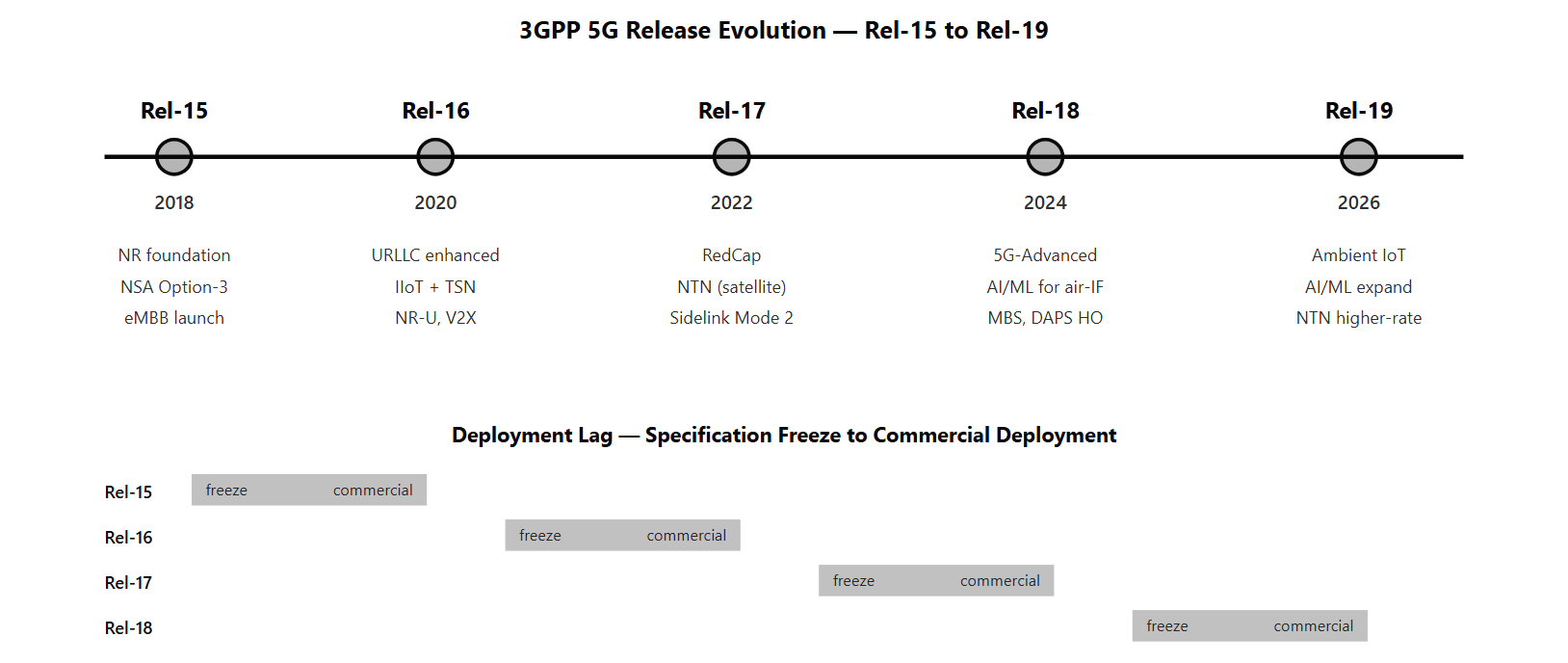
3GPP 5G release evolution — Rel-15 NR foundation, Rel-16 URLLC and IIoT, Rel-17 RedCap and NTN, Rel-18 5G-Advanced with AI/ML and MBS.
Quick answer
5G is not a single technology released in 2018 — it is a multi-release evolution that has been adding features continuously since Rel-15.
3GPP release evolution is the timeline-knowledge probe in cellular interviews.
Editorial review
Written by
CompoundLearn editorial team
Wireless / RF / hardware engineering
Reviewed by
CompoundLearn editorial team
Wireless / RF / hardware engineering
Last reviewed
Built from curated topic maps, editorial validation, and subject-matter review so the page stays aligned with the interview intent and the current content pipeline.
What it is
5G is not a single technology released in 2018 — it is a multi-release evolution that has been adding features continuously since Rel-15. Each 3GPP release adds new capabilities while maintaining backward compatibility, and operator deployments typically run a release-mix where different network elements sit at different release levels. A cellular engineer must navigate the release timeline to understand which features are available in which deployment generation. **Rel-15 (frozen mid-2018)** was the first 5G release. It defined the NR (New Radio) PHY, MAC, and RRC layers (see /topics/5g-nr); the NSA Option-3 architecture (EN-DC where LTE eNB anchors and gNB carries high-throughput data via dual connectivity — see /topics/nr-architecture-nsa-sa-cu-du); and the initial SA Option-2 framework (gNB + 5GC). Rel-15 was eMBB-focused — it delivered the gigabit-class data services that defined "5G" in marketing during 2019-2020 commercial launches. URLLC and mMTC were defined at the framework level but the optimizations that made them genuinely deployable came in Rel-16 and later. Most early 5G commercial deployments were NSA Option-3 based on Rel-15 capabilities. **Rel-16 (frozen July 2020)** was the first major enhancement release. URLLC enhancements (mini-slot improvements, preemption refinements, MCS Table 3 / qLowSE for 10⁻⁵ BLER — see /topics/nr-urllc-mini-slot-preemption) made URLLC genuinely deployable. IIoT (industrial IoT with TSN — Time-Sensitive Networking integration) added the deterministic-networking features industrial automation needs. NR-U brought NR to unlicensed spectrum (5 GHz and 6 GHz bands). SA Option-2 maturation completed the full 5GC feature set. V2X (vehicle-to-everything sidelink) enabled direct UE-to-UE communications for automotive safety. NR positioning provided the initial location-services framework. 2-step RACH added the latency-optimized random-access variant. **Rel-17 (frozen March 2022)** was the major capability expansion release. RedCap (Reduced Capability) defined a new UE category for low-cost low-power IoT devices — wearables, smart-home, industrial sensors, low-end cameras. RedCap fills the gap between LTE-M/NB-IoT (kbps-class) and full NR (Gbps-class) with 10-150 Mbps peak rate at significantly lower cost than full NR chipsets. NTN (Non-Terrestrial Networks) integrated satellite-based connectivity, enabling device-to-satellite text messaging on standard phones (deployed commercially in iPhone 14+, Galaxy S24+, etc.). Sidelink Mode 2 expanded V2X with UE-autonomous resource selection. NR Positioning Phase 2 delivered cm-level accuracy for industrial use. 1024QAM was added for downlink, enabling higher peak rates in excellent channels. Rel-17 also added many SA/NSA migration tools and refinements. **Rel-18 (frozen mid-2024)** is the first "5G-Advanced" release — the brand evolution from "5G" to "5G-Advanced" that signals the second phase of 5G evolution. AI/ML for air-interface (model-based CSI feedback, beam management, mobility prediction — see /topics/beamforming) is the headline feature. Network energy savings adds smarter sleep modes and traffic-aware power-down (see /topics/o-ran-energy-saving-ai-ml). NR Multicast/Broadcast Services (MBS) provides efficient one-to-many delivery for content distribution. Expanded XR (extended reality) support adds lower-latency rendering and tactile-internet features. Dual-active-protocol-stack (DAPS) handover enables make-before-break mobility for service-critical applications. NTN expansion to higher-rate services. Many smaller enhancements across positioning, sidelink, RedCap, and energy efficiency. **Rel-19 (frozen 2025-2026)** continues the 5G-Advanced evolution. AI/ML expansion to more air-interface use cases. Ambient IoT — NR support for energy-harvesting battery-less IoT devices, the deepest-IoT category yet. Enhanced positioning with sub-meter accuracy. NTN expansion to higher-rate satellite services. Sidelink relay enhancements. See /topics/3gpp-release-19 for the dedicated Rel-19 content. The cumulative effect: a Rel-18-compliant UE on a Rel-18 gNB has access to all Rel-15 through Rel-18 features. A Rel-15 UE on a Rel-18 gNB has access only to Rel-15 features but works seamlessly via backward-compatible signaling. Operators run release-mix deployments where the 5GC core is typically at the latest release (cloud-native easier to update), gNB software lags by 6-12 months, and UE chipsets follow gNB capability roughly.
Why interviewers ask
3GPP release evolution is the timeline-knowledge probe in cellular interviews. Hiring teams use it to test whether a candidate has been tracking the standard versus learned 5G at one point and assumed it had not changed. A candidate who fluently navigates the Rel-15 through Rel-19 timeline, naming key features per release, is showing the continuing-engagement that staff cellular roles require. The "what did each release add" question is the diagnostic test. Strong candidates know Rel-15 = foundation, Rel-16 = URLLC/IIoT/NR-U, Rel-17 = RedCap/NTN/Sidelink Mode 2, Rel-18 = 5G-Advanced with AI/ML/MBS. They can name several features per release and explain the deployment impact. Weak candidates know "5G" generically without distinguishing release-specific features. RedCap is the modern-IoT probe. Strong candidates explain that RedCap fills the gap between LTE-M/NB-IoT and full NR for wearables, industrial sensors, and low-end cameras, with reduced peak rate, bandwidth, and antenna count. They understand that RedCap is the cost-competitive option for IoT compared to full NR chipsets. Candidates who do not know RedCap exists miss a major Rel-17 capability. NTN is the satellite-cellular probe. Strong candidates explain that NTN integrates satellites (GEO/MEO/LEO) into 3GPP standards with adaptations for high Doppler, propagation delay, and large cell coverage. They name the commercial deployments (iPhone 14+ device-to-satellite text via Qualcomm, Samsung S24+, AT&T-AST SpaceMobile partnership). Candidates who do not know NTN exists miss one of the most consequential Rel-17 additions. 5G-Advanced vs 5G distinction is the brand-evolution probe. Strong candidates know 5G-Advanced is the marketing brand for Rel-18 and Rel-19+, with AI/ML for air-interface as the headline. They understand it is not a fundamental architecture change but a feature-set evolution that will lead toward 6G in Rel-20-21 timeframe. Candidates who treat 5G-Advanced as either marketing-only or as a completely different technology miss the nuance. The release-cycle question is the standards-process probe. Strong candidates know that 3GPP releases run ~2 years from study-item to freeze, that vendor implementation adds 12-24 months, and that operators run release-mix deployments. Candidates who think 5G features deploy immediately upon spec freeze miss the standardization-to-deployment lag.
Common mistakes
The most common mistake is treating "5G" as a single feature set defined in Rel-15. 5G is a multi-release evolution — Rel-15 foundation, Rel-16 enhancements, Rel-17 expansion, Rel-18 5G-Advanced, Rel-19 continued evolution. Each release adds features while maintaining backward compatibility. Candidates who collapse the timeline miss the standardization-process reality. A second gap is missing what was added in which release. URLLC mechanisms (mini-slot, preemption) were defined in Rel-15 but optimized for deployment in Rel-16. RedCap arrived in Rel-17. NTN arrived in Rel-17. AI/ML for air-interface arrived in Rel-18. Candidates who attribute these to the wrong release reveal a timeline-knowledge gap. A third gap is missing RedCap entirely. RedCap is a major UE category for IoT applications and is increasingly deployed in commercial chipsets. Candidates who do not know RedCap exists miss the 5G IoT story — and either claim "5G doesn't support low-end IoT" (wrong) or "LTE-M handles all 5G IoT" (incomplete). A fourth gap is overstating NTN maturity. NTN exists in Rel-17 and is commercially deployed for low-rate services (text messaging via satellite), but higher-rate satellite services are still Rel-18/19 work in progress. Candidates who claim "5G NTN supports broadband everywhere" overstate the current commercial reality. A fifth gap is treating "5G-Advanced" as marketing-only. The 5G-Advanced brand (introduced in Rel-18) signals real architectural additions — AI/ML for air-interface, network energy savings, MBS, DAPS handover. It is the second-phase 5G evolution leading toward 6G. Candidates who dismiss it as branding miss real technical content. A sixth gap is missing the release-to-deployment lag. A 3GPP spec freeze is the start of the deployment cycle, not the end. Vendor implementation, conformance testing, and operator certification add 12-24 months before commercial availability. Operators run release-mix deployments where 5GC is at the latest release while gNB and UE catch up. Candidates who think "Rel-18 features deploy in 2024" miss the multi-year rollout reality. See /topics/3gpp-release-19 for the dedicated Rel-19 content, /topics/nr-architecture-nsa-sa-cu-du for the architecture-evolution context, and /topics/nr-urllc-mini-slot-preemption for the Rel-16 URLLC-mechanism detail.
3GPP 5G Release Timeline — Headliner Features per Release
| Release | Frozen | Headliner Features | Use Cases | Operator Deployment |
|---|---|---|---|---|
| Rel-15 | 2018 | NR PHY/MAC/RRC, NSA Option-3 (EN-DC), SA Option-2 framework | eMBB consumer broadband | Early 5G launches 2019-2020 |
| Rel-16 | 2020 | URLLC enhancements, IIoT+TSN, NR-U, V2X, NR positioning | Industrial automation, V2X | SA maturity 2021-2022 |
| Rel-17 | 2022 | RedCap, NTN (satellite), Sidelink Mode 2, NR Positioning cm-level, 1024QAM | IoT, satellite, sidelink | 2023-2024 commercial |
| Rel-18 (5G-Advanced) | 2024 | AI/ML for air-interface, network energy savings, MBS, expanded XR, DAPS HO | AI-native RAN, energy efficiency, broadcast | 2024-2026 deployment |
| Rel-19 | 2025-2026 | AI/ML expansion, ambient IoT, NTN higher-rate, sub-meter positioning | Battery-less IoT, advanced AI | 2026-2027 (see /topics/3gpp-release-19) |
Sample interview questions
- A candidate claims "5G features were all defined in Rel-15." What's wrong with this statement, and what is the actual feature distribution across Rel-15 through Rel-18?
- A. The claim is correct; Rel-15 is the complete 5G specification.
- B. Rel-15 defined the foundational NR PHY, MAC, RRC, and NSA Option-3 architecture but explicitly left major features for later releases. Rel-16 added URLLC enhancements, IIoT, NR-U (unlicensed), SA Option-2 maturation, V2X. Rel-17 added RedCap (reduced-capability UEs), NTN (non-terrestrial networks), Sidelink Mode 2, NR Positioning, 1024QAM. Rel-18 (the first "5G-Advanced" release) added AI/ML for air-interface, network energy savings, NR Multicast/Broadcast, MBS, expanded XR services. 5G evolution is a multi-release roadmap, not a single-release deliverable. ✓
- C. Only Rel-15 and Rel-19 matter; Rel-16, 17, 18 are minor.
- D. Each release replaces the previous; Rel-18 makes Rel-15 obsolete.
Option B is correct. The 5G technology rollout follows a multi-release pattern where each 3GPP release adds new features while maintaining backward compatibility: **Rel-15 (frozen 2018)**: First 5G release. Defined NR PHY, MAC, RRC, the NSA Option-3 architecture (EN-DC), and the initial SA Option-2 framework. eMBB-focused. URLLC and mMTC were defined at the framework level but lacked the optimizations that later releases added. **Rel-16 (frozen 2020)**: First major enhancement. Added URLLC enhancements (mini-slot improvements, preemption refinements), IIoT (industrial IoT) with TSN integration, NR-U (NR in unlicensed spectrum), SA Option-2 maturation, V2X (vehicle-to-everything), positioning, and improved energy efficiency. This release made URLLC and mMTC genuinely deployable rather than just framework-defined. **Rel-17 (frozen 2022)**: Major capability expansion. Added RedCap (Reduced-Capability UEs — for IoT wearables and industrial sensors, simpler UE category with reduced peak rate), NTN (non-terrestrial networks — satellite integration), Sidelink Mode 2 (UE-to-UE direct communication), NR Positioning (cm-level accuracy), 1024QAM for downlink, and significant SA/NSA migration tools. **Rel-18 (frozen 2024)**: First "5G-Advanced" release. Added AI/ML for air-interface (e.g., model-based CSI feedback), network energy savings, NR Multicast/Broadcast Services (MBS), expanded XR (extended reality) support, dual-active-protocol-stack handover, and many minor enhancements. Marked the brand transition from "5G" to "5G-Advanced." The cumulative effect: a Rel-18-compliant UE has access to all Rel-15 through Rel-18 features, but the gNB must also support them. Operators typically deploy a release-mix where the core (5GC AMF, SMF, UPF) is at the latest release while gNB software lags by 6-12 months. UE chipsets follow the gNB capability roughly. Why backward compatibility matters: a Rel-15 UE must still work on a Rel-18 gNB and vice versa. The specifications maintain this through optional capabilities — newer features are advertised by UE capability signaling, and the gNB activates them only when supported. See /topics/3gpp-release-19 for the just-finished Rel-19 details. Option A misses the multi-release reality. Option C dismisses major releases incorrectly. Option D inverts the compatibility model. Production reality: operator deployments typically run a mix of Rel-15/16 base capabilities with selective Rel-17/18 features enabled per market and per UE type.
- What is RedCap (introduced in Rel-17), and why was it added when normal NR UE categories already existed?
- A. RedCap is a renamed LTE-M feature; it has no 5G-specific value.
- B. RedCap (Reduced-Capability) is a 3GPP-defined UE category targeting low-cost, low-power, low-throughput IoT devices — wearables, smart-home sensors, industrial monitoring, low-end surveillance cameras. RedCap UEs have reduced peak rate (~10-150 Mbps vs 1+ Gbps for normal NR), simpler RF chains (fewer antennas, narrower bandwidth — typically 20 MHz max), and lower power consumption. RedCap fills the gap between LTE-M / NB-IoT (kbps-class) and normal NR UE categories (Gbps-class). Without RedCap, 5G coverage required either expensive full-NR chipsets in low-cost devices or fallback to LTE-M/NB-IoT. ✓
- C. RedCap only works in unlicensed spectrum.
- D. RedCap is a vendor-specific feature, not a 3GPP standard.
Option B is correct. RedCap (Reduced Capability) is a Rel-17 addition defining a new UE category for low-cost, low-power, low-throughput IoT applications. The motivation: **The capability gap before RedCap**: - LTE-M and NB-IoT: kbps-class, very low power, very low cost — suitable for utility meters, asset trackers, simple sensors - Normal NR UE categories: hundreds of Mbps to multiple Gbps, full RF chains, high power consumption — suitable for smartphones, fixed wireless access, high-end IoT - Gap: many IoT applications (smart watches, industrial sensors, low-end cameras, smart-home devices) need 10-150 Mbps with reasonable battery life and low cost — neither LTE-M (too slow) nor full NR (too expensive) fit well **RedCap specifications**: - Peak rate: 10-150 Mbps DL, 10-50 Mbps UL (configurable per UE category) - Reduced max bandwidth: typically 20 MHz vs 100 MHz for normal NR - Reduced antenna count: typically 1-2 RX antennas vs 4 for normal NR - Simpler RF: fewer carrier-aggregation combinations, reduced number of bands - Lower power: simpler PHY processing, lower-rate ADCs, reduced peak processing demands - Coverage similar to normal NR (not narrowband like NB-IoT) **Target applications**: - Wearables (smart watches, fitness trackers with mid-rate data) - Industrial monitoring (sensors with periodic moderate-rate uploads) - Low-end surveillance cameras (live video at limited resolution) - Smart-home devices (smart thermostats, security panels) **Production deployment**: RedCap chipsets started appearing in commercial devices in 2024-2025; pricing is significantly lower than full NR chipsets but higher than LTE-M. The category is filling the IoT-to-eMBB gap that LTE-Cat-1 used to fill in 4G. Option A misses the 5G-specific value of RedCap. Option C is wrong — RedCap works on standard NR licensed bands. Option D is wrong — RedCap is fully 3GPP-standardized in Rel-17. Production reality: RedCap is one of the major capability expansions of Rel-17 and the bridge that lets 5G compete with LTE-Cat-1 IoT chipsets on cost.
Frequently asked questions
- What is 3GPP Rel-15?
- Rel-15 is the first 5G release, frozen in mid-2018. It defined the NR (New Radio) PHY, MAC, RRC, the NSA Option-3 architecture (EN-DC where LTE eNB anchors and gNB carries data via dual connectivity), and the initial SA Option-2 framework (gNB + 5GC). Rel-15 was eMBB-focused — it delivered the high-throughput data services that defined "5G" in marketing during 2019-2020 commercial launches. URLLC and mMTC were defined at the framework level in Rel-15 but the optimizations that made them genuinely deployable came in Rel-16 and later. Most early 5G commercial deployments were NSA Option-3 based on Rel-15 capabilities.
- What did Rel-16 add to 5G?
- Rel-16 (frozen 2020) was the first major enhancement release. Key additions: URLLC enhancements (mini-slot improvements, preemption refinements, MCS Table 3 / qLowSE for 10⁻⁵ BLER), IIoT (industrial IoT with TSN — Time-Sensitive Networking integration), NR-U (NR in unlicensed spectrum at 5 GHz and 6 GHz), SA Option-2 maturation (full 5GC feature set), V2X (vehicle-to-everything sidelink communications), NR positioning (initial location-services framework), 2-step RACH, and energy-efficiency optimizations. Rel-16 is what made URLLC and IIoT genuinely deployable rather than just framework-defined; operators that wanted real URLLC service deployment waited for Rel-16-compliant equipment.
- What is RedCap (Rel-17)?
- RedCap (Reduced Capability) is a Rel-17 UE category targeting low-cost, low-power, low-throughput IoT devices that fall between LTE-M/NB-IoT (kbps-class) and full NR (Gbps-class). RedCap UEs have reduced peak rate (~10-150 Mbps), reduced bandwidth (typically 20 MHz max), reduced antenna count (1-2 RX), and simpler RF chains. Target applications: wearables (smartwatches, fitness trackers), industrial monitoring, low-end surveillance cameras, smart-home devices. RedCap fills the IoT-to-eMBB gap and is one of the major capability expansions of Rel-17 — bridging the cost/performance space that LTE-Cat-1 used to fill in 4G.
- What is NTN (Non-Terrestrial Networks)?
- NTN is the Rel-17 addition that integrates satellite-based connectivity into 3GPP standards. NTN UEs can connect to satellites in GEO (geostationary), MEO (medium-earth-orbit), and LEO (low-earth-orbit, like Starlink) configurations using the same NR or LTE protocols as terrestrial connections, with adaptations for satellite-specific characteristics (high Doppler from LEO, long propagation delay from GEO, large cell coverage). NTN enables device-to-satellite text messaging on standard phones (introduced in iPhone 14 via Qualcomm modems, Samsung Galaxy S24 with Snapdragon, and similar), satellite-IoT for global asset tracking, and continuous connectivity in remote areas. Rel-17 NTN focused on low-rate services; Rel-18 expanded to higher-rate scenarios.
- What is 5G-Advanced (Rel-18)?
- 5G-Advanced is the marketing brand for Rel-18 — the first release in the "second phase" of 5G evolution. Key Rel-18 additions: AI/ML for air-interface (model-based CSI feedback, beam management, mobility prediction), network energy savings (smarter sleep modes, traffic-aware power-down), NR Multicast/Broadcast Services (MBS — efficient one-to-many delivery for content distribution), expanded XR support (lower-latency rendering and tactile-internet features), dual-active-protocol-stack (DAPS) handover for make-before-break mobility, NTN expansion to higher-rate services, and many smaller enhancements. Rel-18 marks the brand transition from "5G" to "5G-Advanced" and started the multi-year roadmap toward "6G" (which 3GPP will start defining around 2027-2028).
- How do operators handle 3GPP release migration?
- Operators run a release-mix deployment where different network elements are at different releases. The 5GC core (AMF, SMF, UPF) typically runs at the latest release because software updates are easier on cloud-native cores. The gNB software lags by 6-12 months — vendor implementation, testing, and field upgrade cycles. UE chipsets follow gNB capability roughly. Backward compatibility is maintained: a Rel-15 UE works on a Rel-18 gNB and vice versa, with newer features activated based on UE capability signaling. Per-market deployment: regulatory approval, spectrum availability, and competitive pressure determine which Rel-17/18 features actually deploy in each country (e.g., NTN deployment requires regulatory frameworks for satellite-cellular spectrum sharing).
- How does Rel-19 fit into the evolution?
- Rel-19 (frozen 2025-2026) continues the 5G-Advanced evolution started in Rel-18. Key Rel-19 focus areas: AI/ML expansion (more air-interface AI use cases — channel prediction, energy-aware AI, model lifecycle management), NR Multicast/Broadcast Services maturation, expanded NTN (higher-rate satellite, more LEO scenarios), ambient IoT (NR support for energy-harvesting battery-less IoT devices), enhanced positioning (sub-meter accuracy for industrial use), Sidelink relay enhancements, network energy savings (deeper sleep modes). Rel-19 is the bridge between Rel-18 ("first 5G-Advanced") and Rel-20-21 which will define the transition toward 6G specifications expected to start in earnest around 2028. See /topics/3gpp-release-19 for the dedicated Rel-19 content.
- Why do 3GPP releases take 2 years each?
- A 3GPP release cycle spans roughly 2 years from study-item phase to specification freeze. Study Item (6-9 months): scope identification, technical evaluation, feasibility studies. Work Item (12-18 months): detailed specification development, contributions, agreements, draft text. Freeze (specification stabilization): final review, stage-3 protocol details, ASN.1 finalization. After freeze, vendors implement (12-24 months), conformance testing happens, and commercial deployment follows. The 2-year release cadence is a balance: long enough to develop and test major features, short enough to keep the technology evolving. Feature timing within a release matters too — early Stage-2 agreements ship faster than late-Stage-3 details. Operators typically plan deployment around expected feature availability ~1-2 years after spec freeze.
Related topics
Siblings
Practice
Essential AI-Native Skills for 3GPP Release Evolution: Rel-15 → Rel-16 → Rel-17 → Rel-18
Modern engineering work increasingly uses AI tools for design and code review, debugging, documentation, test and testbench generation, and workflow automation. The goal is not to let AI replace engineering judgment — it is to move faster while keeping verification discipline.
- Use AI to explain unfamiliar code, logs, waveforms, datasheets, or test failures.
- Break large problems into small, reviewable steps you can verify independently.
- Ask AI for hypotheses, then validate them against tests, measurements, simulations, or lab data.
- Version-control your analysis scripts, testbenches, and configs — keep changes small and reviewable.
- Document your assumptions, design tradeoffs, and debugging decisions.
- Verify AI output before trusting it: run the checks that fit the domain — unit tests, linters, simulations, or bench/lab measurements.
- Review AI output for correctness, edge cases, and real-world consequences.
3GPP Release Evolution: Rel-15 → Rel-16 → Rel-17 → Rel-18 — coming to the question bank
The adaptive practice engine is already live for core wireless, RF, and ML systems. 3GPP Release Evolution: Rel-15 → Rel-16 → Rel-17 → Rel-18 isn't covered in the question bank yet — get notified when it's added.