Open RAN (O-RAN) Explained: Architecture and RIC Interview Prep
Open RAN (O-RAN) interview prep — disaggregated architecture, Near-RT RIC, xApps, rApps, Open Fronthaul, and RAN intelligence for interview questions.
Quick answer
Open RAN (O-RAN) splits the traditional monolithic base station into separate, interoperable functions joined by open interfaces.
O-RAN is now a live procurement reality, not a slideware future.
Editorial review
Written by
CompoundLearn editorial team
Wireless / RF / hardware engineering
Reviewed by
CompoundLearn editorial team
Wireless / RF / hardware engineering
Last reviewed
Built from curated topic maps, editorial validation, and subject-matter review so the page stays aligned with the interview intent and the current content pipeline.
Key points
- O-RAN disaggregates the base station into O-RU, O-DU, and O-CU and joins them with open, conformance-tested interfaces — the interfaces are the product, not the boxes.
- Keep three timescales straight: the O-DU runs the sub-10ms slot scheduler, the Near-RT RIC controls on a 10ms–1s loop, and the Non-RT RIC plans at one second and up. The RIC steers the scheduler via policy; it does not run per-slot MAC.
- The Non-RT RIC lives inside the SMO and hands policy and ML guidance to the Near-RT RIC over A1; the Near-RT RIC then optimizes inside that policy envelope.
- E2 carries the closed loop: E2AP is the protocol, E2SM-KPM reports measurements, and E2SM-RC pushes control actions (control round-trips ~2–5ms once subscribed) (see /topics/o-ran-interfaces-a1-e2-o1-o2).
- Split 7.2x is the Open Fronthaul lower-layer split (O-DU↔O-RU) and is distinct from the 3GPP Option 2 CU/DU split carried on F1 — a frequent interview trap (see /topics/o-ran-fronthaul-split-7-2x). 7.2x further forks into Category A (precoding in the O-DU) and Category B (precoding in the O-RU).
- Multivendor interop is real but unforgiving: timing/clock mismatches across Open Fronthaul or message-definition drift across F1 surface as intermittent, hard-to-diagnose failures, which is why integration testing dominates O-RAN cost early on.
- Map the management plane too: O1 (SMO→every function, FCAPS) and O2 (SMO→O-Cloud) are the interfaces candidates most often forget.
What it is
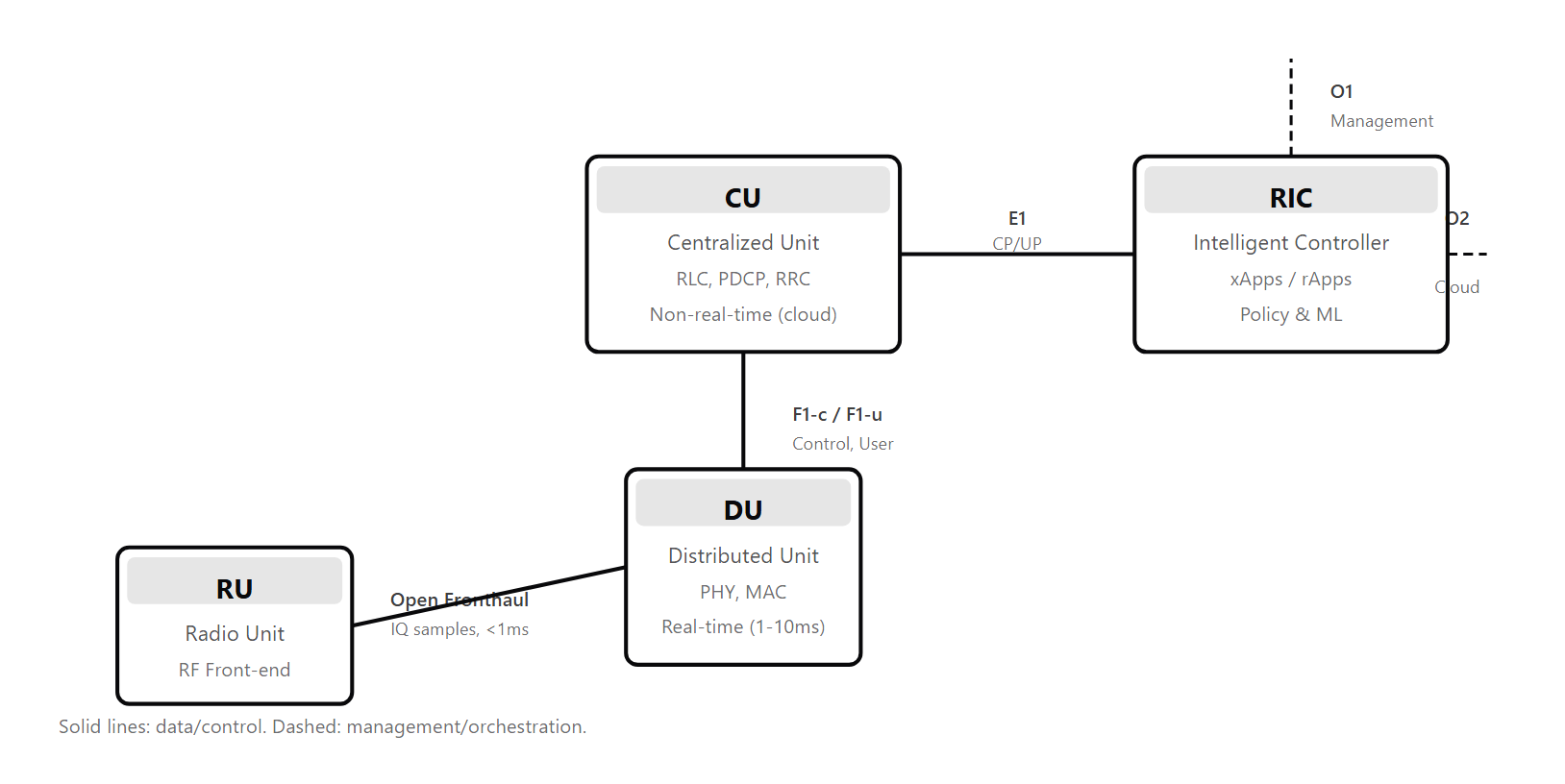
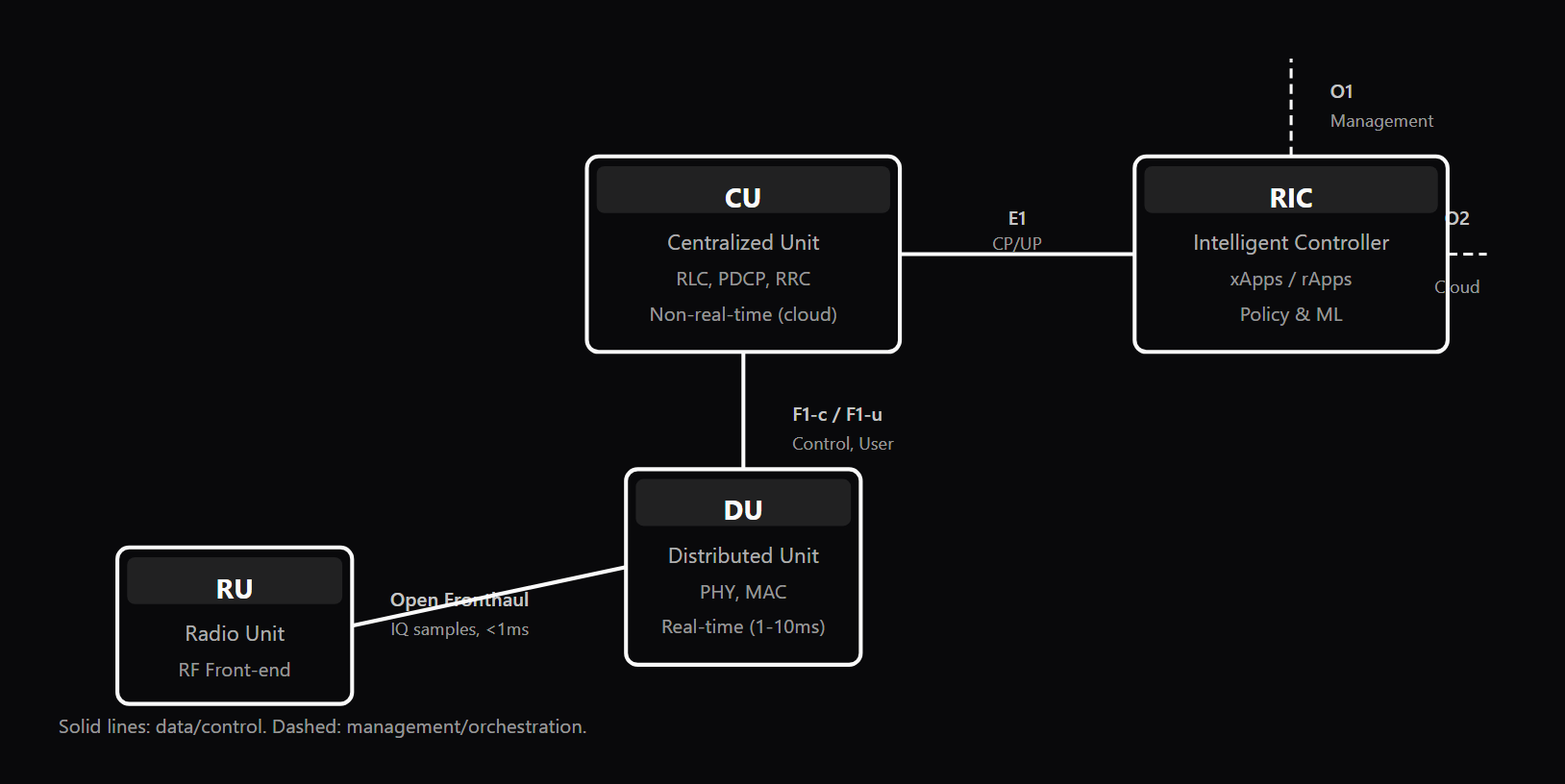
Open RAN (O-RAN) splits the traditional monolithic base station into separate, interoperable functions joined by open interfaces. In one line for an interviewer: it standardizes the contracts between radio components so an operator can mix vendors and program the control loop in software. The functions: - O-RU (Radio Unit): analog/RF and the low PHY — transmit, receive, beamforming. - O-DU (Distributed Unit): real-time high PHY and MAC, including the slot-by-slot scheduler. - O-CU (Centralized Unit): non-real-time RLC, PDCP, and RRC; cloud-friendly. - Near-RT RIC: hosts xApps on a 10ms–1s control loop, reaching the RAN over E2. - Non-RT RIC: hosts rApps at one second and up, sitting inside the SMO. - SMO (Service Management and Orchestration): the management/orchestration frame above all of it. The interfaces are the real product. Open Fronthaul (split 7.2x) joins O-DU to O-RU; F1 joins O-DU to O-CU; A1 carries policy from the Non-RT RIC to the Near-RT RIC; E2 carries measurements (E2SM-KPM) and control (E2SM-RC) between the Near-RT RIC and the RAN; O1 and O2 run management from the SMO to the functions and the O-Cloud. A vendor's O-RU interoperating with another vendor's O-DU is the whole point — and the thing monolithic RAN cannot do.
Why interviewers ask
O-RAN is now a live procurement reality, not a slideware future. AT&T, Vodafone, Rakuten, and others are running multivendor or open deployments at scale, and every major RAN vendor ships O-RAN-conformant equipment. So interviewers screen for engineers who can reason about the architectural shift, the integration tax of multivendor stacks, and where intelligence actually sits. A strong answer keeps the three timescales straight (O-DU sub-10ms scheduler, Near-RT RIC 10ms–1s, Non-RT RIC one second and up), names the interfaces by job (Open Fronthaul, F1, A1, E2, O1, O2), and reaches for the service-model vocabulary — E2AP, E2SM-KPM, E2SM-RC — instead of hand-waving "the RIC talks to the RAN." Bonus signal: locating the Non-RT RIC inside the SMO and explaining why split 7.2x won over the other functional splits.
Common mistakes
The headline error is misquoting the RIC timescales. The Near-RT RIC control loop is 10ms to 1s — not "sub-10ms" (see /topics/near-rt-ric-vs-non-rt-ric). The sub-10ms, slot-by-slot scheduler lives in the O-DU; the RIC steers it through policy rather than replacing the per-slot MAC decision. The Non-RT RIC runs at one second and up. Candidates who flatten all three into "the RIC does real-time scheduling" get caught immediately. The second trap is conflating split 7.2x (the Open Fronthaul lower-layer split, O-DU to O-RU) with the 3GPP Option 2 split (the CU/DU split carried on F1). They sit at different points in the stack with different latency and bandwidth budgets. A related miss: forgetting that 7.2x itself forks into Category A (precoding in the O-DU) and Category B (precoding in the O-RU), which trades O-RU complexity against fronthaul data rate. Two more: treating O-RAN as merely "open software" rather than a set of standardized interfaces and conformance tests, and leaving out the SMO — the orchestration layer that hosts the Non-RT RIC and owns O1 (management to every function) and O2 (to the O-Cloud). Strong answers name the SMO without prompting.
O-RAN stack — function, control-loop timescale, location, and vendor model
| Component | Primary Function | Control-Loop Timescale | Typical Location | Vendor Involvement |
|---|---|---|---|---|
| O-RU (Radio Unit) | Analog/RF plus low PHY: power amplification, A/D conversion, RF beamforming, antenna control | Sample-by-sample (sub-ms phase coherence); Open Fronthaul timing held to ~±sub-µs via PTP/SyncE | Cell site or tower; close to the antenna array | Usually one O-RU per cell; multivendor O-RU pools are emerging but integration-heavy |
| O-DU (Distributed Unit) | High PHY (FFT, equalization, channel estimation) and MAC, including the slot-by-slot scheduler (ARQ/HARQ, MCS, resource allocation) | Sub-10ms scheduler loop (5G NR slots of 0.5–1ms; LTE 1ms TTI) | Edge compute or regional hub; can be pooled across multiple O-RUs | Mix vendors — Vendor A O-RU with Vendor B O-DU over Open Fronthaul (split 7.2x) |
| O-CU (Centralized Unit) | RLC, PDCP, RRC control plane; interfaces to the 5G core (AMF, UPF) | 10ms to ~1s (no hard real-time constraint) | Central or regional cloud data center; highly consolidated | Multivendor pool on shared cloud; F1 to the O-DU, NG to the core |
| Near-RT RIC | Hosts xApps for near-real-time control: mobility, beam selection, scheduling policy via E2SM-RC | 10ms to 1s control loop over E2 (E2AP + E2 Service Models) | Edge cloud, close enough to keep E2 inside the loop budget | Operator- or third-party-supplied; xApps decoupled from RAN vendor |
| Non-RT RIC + SMO | Hosts rApps for ML training and long-horizon policy; SMO adds orchestration and FCAPS management | One second and up (minutes to hours) | Central cloud / management plane | A1 to the Near-RT RIC; O1 to every function; O2 to the O-Cloud |
Sample interview questions
- What is the primary strategic advantage of disaggregating the RAN stack into RU, DU, and CU components?
- A. Disaggregation reduces total cost by eliminating the RIC layer and simplifying vendor management
- B. It allows operators to mix vendors for different components (e.g., Nokia RU with Ericsson DU), reduces vendor lock-in, and enables independent scaling of compute-intensive DU and CU functions from RF hardware ✓
- C. Disaggregation forces all vendors to use the same hardware specifications, making RAN deployment identical across all operators
- D. It increases the complexity of backhaul requirements and makes DU pooling impossible due to strict synchronization constraints
The correct answer is option B. Disaggregation is fundamentally about decoupling vendor constraints and enabling multivendor interoperability. By separating the RU (RF), DU (digital PHY/MAC), and CU (control plane), operators can source these from different vendors and mix them freely. For example, a cost-optimized RU from vendor A can pair with a low-latency DU from vendor B and a cloud-native CU from vendor C—something impossible in monolithic architectures where the entire stack comes from one vendor. This competitive pressure drives down costs and accelerates innovation. Disaggregation also enables geographical pooling: a single DU can serve 5-20 RUs scattered across a region, and a CU can serve dozens of DUs nationwide, amortizing expensive compute resources and enabling better load balancing and maintenance windows. Traditional monolithic architectures tie the DU and RU physically together at each cell site, wasting compute capacity during low-traffic periods. Option A is incorrect because the RIC is not eliminated—it's enhanced. The RIC is the intelligence layer and becomes more valuable in disaggregated networks because it can coordinate policies across multi-vendor RAN elements. Option C misses the point: disaggregation does not mandate identical hardware—it standardizes interfaces while allowing vendors flexibility in implementation. Option D is wrong: disaggregation actually improves backhaul efficiency by pooling traffic and enables asynchronous DU-to-CU links without requiring real-time synchronization.
- A telecom operator is deciding where to place the DU in their O-RAN network. Which placement strategy best balances latency to the RU, compute efficiency, and operational complexity?
- A. Always co-locate the DU at the RU site to minimize fronthaul latency—this is the only guaranteed way to meet <1ms requirements
- B. Place the DU at a regional data center shared by 10-20 RUs in the same city. This trades ~3-5ms additional fronthaul latency for significant DU compute pooling, load balancing benefits, and simplified operations compared to per-cell DUs ✓
- C. Move all DUs to a centralized national cloud data center to maximize compute consolidation and eliminate redundant hardware
- D. The DU placement is irrelevant if the fronthaul fiber is fast enough—latency and bandwidth constraints do not apply
Option B is the pragmatic choice in most real-world deployments. Here's why: Fronthaul latency for split 7.2x (Open Fronthaul) is constrained by the IQ sample transport. A 20 MHz carrier generates roughly 200 Mbps of IQ data; the round-trip latency for DU processing is approximately 5 microseconds internally, but the transport path from RU to DU to CU adds cumulative delay. Regional DU placement keeps this to ~2-5 milliseconds over metro-area fiber (typically <50 km). This is well within the <10ms budget for PHY/MAC processing and allows DU-to-CU links that are completely asynchronous (seconds-scale). Regional pooling delivers massive operational benefits: a single DU serving 15 RUs across a city can balance traffic, handle RU failures by redirecting load, and undergo planned maintenance without affecting all cells. The DU can be virtualized on commodity servers in a controlled data center with proper redundancy, power, and cooling—far cheaper than hardened radio-access equipment at each tower. Option A is too conservative. Modern O-RAN fronthaul design explicitly assumes regional DU placement; fiber links <50 km achieve <5ms latency easily. Option C misses the constraint: national cloud DU placement requires fiber delays <20ms just to the edge of the cloud region, and is typically reserved for the CU or Non-RT RIC. Option D ignores a fundamental reality: fronthaul is a distinct pipe with strict latency and jitter budgets (±1 microsecond tolerance in many designs); it cannot be "solved by fast fiber" alone because even light-speed propagation over long distances accumulates delay.
- In a multivendor O-RAN deployment where the RU is from Vendor A, the DU is from Vendor B, and the CU is from Vendor C, what is the largest risk if the operators do not carefully manage interface specifications and version compatibility?
- A. The RU will not transmit RF power because vendor proprietary algorithms are hardcoded into each component
- B. Subtle incompatibilities across Open Fronthaul, F1, and E1 interfaces can cause intermittent data loss, timing failures (leading to frame misalignment), and undiagnosed multivendor failures that are very difficult to troubleshoot because blame shifts between vendors ✓
- C. Multivendor RAN is impossible—no operator has ever successfully deployed a multivendor stack
- D. The RIC will automatically resolve all interface conflicts through ML-driven self-healing
Option B captures the real operational nightmare of multivendor deployments. The danger is not that multivendor RAN is impossible (it works in several large operator deployments), but that interface mismatches are subtle and hard to debug. Example: Open Fronthaul requires synchronized timestamps for IQ sample alignment. If Vendor A's RU uses a different clock source or precision than Vendor B's DU expects, the DU will see data arriving out of sync, causing frame misalignment, missed packets, and reduced throughput. The symptoms are intermittent (appearing under high load when timing margins tighten), and neither vendor can easily diagnose the other's behavior without access to proprietary internals. F1 interface mismatches are even more dangerous: if Vendor B's DU and Vendor C's CU use different interpretations of the F1-c (control plane) message definitions or timing constraints, the CU may think it has successfully configured the DU when in fact the DU never received or parsed the message. This leads to zombie states where the CU believes it controls a cell but the DU is following different rules. Problems are exacerbated because modern RAN software is complex: the DU and CU run on virtualized platforms (Kubernetes) with varying CPU scheduling, so timing guarantees are difficult. Troubleshooting requires protocol analyzers, hardware probes, or actual vendors providing detailed traces—processes that can take weeks and involve finger-pointing between vendor teams. Option A is wrong: proprietary algorithms do not prevent interop. Standard interfaces (Open Fronthaul, F1) define the external contract, not the internals. Option C is factually incorrect: Verizon, Vodafone, and NTT DoCoMo have operational multivendor O-RAN deployments. Option D is too optimistic: the RIC cannot fix interface incompatibilities at the hardware/transport layer.
- The Near-RT RIC and Non-RT RIC operate on fundamentally different timescales. How does this split enable O-RAN to maintain both real-time control and strategic optimization?
- A. The Near-RT RIC handles all control decisions; the Non-RT RIC is optional and rarely used in practice
- B. The Near-RT RIC runs xApps that make fast decisions (beam steering, scheduling policy, power allocation) on a 10ms–1s control loop; the Non-RT RIC runs rApps that train ML models and set policies on timescales of one second and up (typically minutes to hours). This split keeps the fast loop responsive without blocking on slow ML operations ✓
- C. The Non-RT RIC controls the RAN; the Near-RT RIC is just a monitoring tool with no control authority
- D. Both RICs make identical decisions independently to ensure redundancy; if they disagree, the DU ignores both and operates autonomously
Option B describes the two-tier RIC design. Get the timescales exact—interviewers probe this directly. The Near-RT RIC sits at the edge and runs xApps over a control loop the O-RAN spec defines as 10ms to 1s. xApps react to immediate RAN conditions: adaptive beamforming from current Channel State Information (CSI), load balancing across neighboring cells, or scheduling-policy nudges. Watch the common trap: the sub-10ms, slot-by-slot scheduler lives in the O-DU itself, not the RIC. The RIC steers that scheduler through policy; it does not replace the per-slot MAC decision. The Near-RT RIC reaches the RAN over the E2 interface using the E2AP protocol and E2 Service Models. E2SM-KPM streams measurements up; E2SM-RC pushes control actions down, with control round-trips in the ~2–5ms range once a subscription is live. The Non-RT RIC runs on a loop of one second and up—in practice minutes to hours—and is hosted inside the Service Management and Orchestration (SMO) framework. It runs rApps for traffic prediction, energy optimization (cell-sleep scheduling), and interference management that need historical data or model retraining. It hands trained models and policy intent to the Near-RT RIC over the A1 interface. The coupling is one-directional by design: Non-RT RIC sets the policy envelope over A1, and the Near-RT RIC xApp optimizes inside it. Example: A1 carries "trim power 10% during 02:00–04:00"; the xApp then makes the second-by-second allocation that honors that ceiling. Option A is incomplete—the Non-RT RIC owns strategy and learning. Option C reverses the roles. Option D is wrong: the RICs are coupled via A1, not independent.
- Why does the O-RAN Alliance standardize the RIC as a separate entity from the RAN (RU, DU, CU) rather than embedding control logic inside each vendor's base station, as traditional RAN does?
- A. The RIC separation is purely philosophical and has no practical benefits—it could be embedded in the base station instead
- B. Embedding the RIC in base stations is technically impossible due to RF hardware constraints
- C. Separating the RIC enables operators to deploy a single unified RIC across multiple vendors' RAN equipment, decoupling control policy from hardware vendor choice. This allows multi-vendor RAN to function coherently and enables operators to update control policies without hardware changes ✓
- D. The RIC is separated only for security reasons; all other functions work identically to embedded control
Option C explains the fundamental insight of Open RAN. In traditional monolithic RAN, each base station (RU/DU/CU) from Vendor X includes proprietary control software embedded in the same hardware. The vendor's control loop is closed: the RAN measures KPMs (cell load, interference, fading), executes control decisions (power adjustment, beam steering), and updates state—all within that one base station. If an operator buys equipment from multiple vendors, each vendor's base station operates independently with its own control logic. There is no unified coordination. O-RAN inverts this: the RIC is decoupled from the hardware and runs in the cloud (or at the edge) as software. The RU/DU/CU become "dumb" (in a sense)—they execute whatever policy the RIC sends via the E2 interface, without embedding vendor-specific control logic. The operator now owns a single, unified RIC that can: 1. Coordinate decisions across all RU/DU/CU, regardless of vendor: a policy set in the Non-RT RIC (e.g., "load-balance traffic across cells") applies uniformly to Nokia RUs, Ericsson DUs, and Samsung CUs. 2. Update control policies without hardware changes: want to change the beamforming strategy? Deploy a new xApp or update a policy in the RIC. No firmware updates, no vendor support tickets. 3. Implement new intelligence: the Non-RT RIC can run ML models trained on network-wide data (not just a single cell), enabling system-level optimization impossible in monolithic systems where each vendor's model is siloed. This is why O-RAN enables true multivendor coherence: the RIC is the unified nervous system, and the RAN is the distributed execution engine. Option A misses the business value: decoupling RIC from hardware is revolutionary for operators. Option B is wrong: embedding the RIC in base stations is totally possible—traditional RAN does it. But if you embed RICs from multiple vendors, they operate independently (no coordination). Option D understates the benefit: it's far more than security.
- Consider an operator deploying Open RAN for the first time. They must choose between (A) a conservative "single-vendor-multiple-layers" approach (e.g., Nokia RU, Nokia DU, Nokia RIC) and (B) a true multivendor approach (Nokia RU, Ericsson DU, Samsung CU, separate RIC). What is the primary operational difference?
- A. Option A is cheaper because it avoids multivendor integration overhead
- B. Option B provides true competitive pressure and flexibility but requires significant integration testing, multivendor technical support coordination, and careful interface management. Option A reduces complexity but still uses open interfaces (partially losing vendor lock-in advantage) ✓
- C. Both options are identical in complexity; the choice is purely economic
- D. Option A is technically impossible because the O-RAN standards force multivendor deployment
Option B is pragmatic and honest. Many operators deploying O-RAN do NOT immediately go full multivendor. Some start with option A (e.g., "Nokia build") where they use multiple Nokia components connected via open interfaces, but keep the integration trust boundary low (Nokia owns the whole stack). This gives them: 1. Lower integration and testing burden: Nokia has pre-tested their RU-DU-CU stack and certified it works together. 2. Partial vendor lock-in reduction: they are not locked into a single monolithic Nokia box, but they are somewhat locked into Nokia's product family. 3. Learning curve: they can test O-RAN interfaces and RIC automation without the multivendor complexity. Eventually, they migrate to option B (true multivendor), which gives: 1. Real competitive pressure on price and features: RU vendors compete with each other, DU vendors compete separately, and operators can choose the best value in each category. 2. Flexibility: they can replace an underperforming Ericsson DU with a Nokia DU without touching the RU or CU. 3. Higher integration complexity: they now manage three separate vendor relationships and must carefully validate that Nokia RU + Ericsson DU + Samsung CU actually interoperate across Open Fronthaul and F1 interfaces. The gap between A and B is real: multivendor deployments (like Verizon's) require dedicated integration teams, protocol testing labs, and vendor-independent technical support staff. This is a deliberate choice operators make to gain long-term flexibility. Option A is incorrect because it ignores that option B provides genuine market benefits (competitive pricing, vendor-neutral innovation). Option C misses the massive difference in integration burden. Option D is wrong: the O-RAN standard supports both single-vendor and multivendor deployments within the same interface framework.
- A candidate for an O-RAN engineer role is asked: "Why does Open RAN require tighter interface latency budgets than monolithic RAN?" What is the best answer?
- A. Monolithic RAN does not have latency budgets; O-RAN invented the concept
- B. Open RAN distributes the RU, DU, and CU across a network (possibly different sites), so each interface (Open Fronthaul, F1, E1) adds transport latency. A monolithic base station has everything co-located, so latency is minimal. O-RAN must carefully budget and contract latency per interface to ensure deterministic behavior, whereas a monolithic system has few determinism constraints. ✓
- C. Open RAN always uses wireless backhaul, which is inherently more latency-prone than the fiber used in monolithic systems
- D. Disaggregation eliminates the latency budget requirement entirely, which is why O-RAN is faster than monolithic RAN
Option B nails it. This is a critical insight for candidates to understand. In a monolithic base station from a single vendor, all components (RF front-end, digital PHY, MAC, RLC) run on the same proprietary hardware and software stack, often with custom silicon or ASICs. The vendor tightly couples these functions internally—they might share on-die caches, have zero-latency interconnects, or even run on the same CPU core with task scheduling. The vendor guarantees timing correctness but does not publish explicit latency contracts because the whole system is opaque. In O-RAN, the RU, DU, and CU are separate boxes communicating via packets (Open Fronthaul, F1, E1). These packets traverse network infrastructure (fiber, Ethernet switches, potentially cloud networks) and incur measurable, variable delays. To maintain determinism (e.g., ensuring DU processes an IQ sample within 5 microseconds of receipt), the O-RAN standard must define tight latency and jitter contracts: - Open Fronthaul: ~1-5 milliseconds round-trip, <1 microsecond jitter (tightest) - F1: ~10-50 milliseconds (depends on DU-CU distance), relaxed jitter - E1: ~50-200 milliseconds (CU to RIC), relaxed If the backhaul exceeds these budgets, the RU will miss DU deadlines, or the DU will miss CU deadlines, leading to dropped frames and degraded service. This is NOT a weakness of O-RAN—it's a honest accounting of the physics. Monolithic RAN hides latency by not publishing it; O-RAN makes it visible and contractual. Operators must design their network topology to respect these contracts (e.g., place DU in a regional data center <20 km from the RU cluster). Option A is wrong: monolithic RAN absolutely has latency budgets; the vendor just does not share them. Option C is incorrect because O-RAN supports both fiber and wireless backhaul, but design requires meeting latency contracts regardless of medium. Option D is backwards: disaggregation does NOT eliminate latency requirements; it makes them explicit.
- From a long-term total cost of ownership (TCO) perspective, which statement best explains why operators are investing heavily in Open RAN despite higher initial integration costs?
- A. Open RAN has lower upfront capital costs than traditional RAN, so ROI is immediate
- B. Open RAN enables continuous technology refresh and vendor switching, amortizes RIC software costs across many hardware vendors, and opens the door to in-house RAN software development. Over 5-10 years, the ability to avoid lock-in and adopt best-of-breed components from different vendors typically yields lower TCO than monolithic systems with vendor lock-in and long upgrade cycles ✓
- C. Open RAN does not actually reduce TCO; operators are deploying it for brand prestige only
- D. Once RAN is open, carrier grade software is automatically free and requires no maintenance
Option B reflects real operator economics and is supported by case studies from Verizon, Vodafone, and others. Initial O-RAN deployments are expensive: operators must: 1. Hire or contract integration teams to manage multiple vendors. 2. Build testing labs to validate multivendor interoperability. 3. Negotiate with new RAN vendors who may lack track records. 4. Retrain operations staff to debug multivendor systems. Capital costs can be higher upfront (Option A is partially true but incomplete) because operators often buy multiple vendors's RU and DU hardware to avoid single-vendor dependency. However, over 5-10 years, TCO improves because: 1. **Vendor competition:** RU vendors compete with other RU vendors on price/performance. DU vendors compete separately. Traditional RAN lacks this: you buy Nokia's entire stack or Ericsson's entire stack—no cross-cutting competition. 2. **Technology refresh without full replacement:** Need a faster DU? Swap it out. Keep the RU. Traditional RAN forces you to replace everything together or live with the old version. 3. **RIC software amortization:** The RIC is expensive to build, but one RIC can serve Nokia, Ericsson, and Samsung RU/DU/CU simultaneously. Traditional RAN forces each vendor to build their own control logic—redundant investment. 4. **In-house development:** Operators can build custom xApps and rApps tailored to their network. Monolithic RAN forces them to accept vendor features "as is" or wait for the next vendor release. 5. **Supply chain flexibility:** If a chip shortage impacts one vendor's RU, operators can source from another RU vendor without replacing the DU/CU. Monolithic RAN creates a single-vendor chokepoint. Verizon has published case studies showing that after ~3 years, O-RAN TCO breaks even with monolithic RAN, and by year 5, the multivendor flexibility advantage dominates. Option A is incomplete: initial capex might be higher or similar, depending on negotiation. Option C is dismissive and ignores real operator statements about long-term cost and innovation. Option D is naive: enterprise-grade RAN software requires continuous updates, security patches, and operational support regardless of whether it is "open."
- Which interface in the O-RAN architecture carries real-time KPM (Key Performance Metric) data from the RAN to the RIC, and what are the latency and data-rate trade-offs?
- A. The A1 interface carries KPMs; it is high-bandwidth and low-latency (<1ms)
- B. The E2 interface carries KPM subscriptions and indications from the RAN to the Near-RT RIC. The RAN measures KPMs (cell traffic, interference, fading) and reports them via the E2SM-KPM service model over E2AP. The data rate depends on subscription filters: operators can request a wide KPM set (high bandwidth) or apply granularity/condition filters (lightweight) to bound the telemetry load ✓
- C. The O1 interface is the only mechanism for KPM transport; E2 is used only for policy updates
- D. KPMs are not transported on any standard interface; each vendor implements a proprietary KPM collection mechanism
Option B describes E2's role in the intelligence loop. The naming matters here—an interviewer will expect the service-model vocabulary. The Near-RT RIC needs visibility into RAN conditions to control well. It subscribes to KPMs—per-cell throughput, HARQ retransmission counts, handover success rate, beam utilization, UE signal-strength distributions—and the E2 node (an O-CU or O-DU) reports them. Two pieces carry this: 1. **E2AP (E2 Application Protocol):** the procedural layer. The RIC issues a RIC Subscription naming what it wants and how often; the E2 node returns RIC Indication messages. 2. **E2 Service Models (E2SM):** the semantic layer. E2SM-KPM defines UE-, cell-, and node-level measurements at near-RT periodicity. E2SM-RC (RAN Control) is the companion model the RIC uses to push control actions back, with control round-trips around 2–5ms once the subscription is established. The E2 link typically runs the O-CU/O-DU to a Near-RT RIC at the edge rather than the cloud, which is what keeps the closed loop inside the 10ms–1s budget. Subscription filters bound the cost: an unfiltered, dozens-of-cells, hundreds-of-counters subscription can run to hundreds of Mbps of telemetry, so operators constrain granularity and report conditions to keep it manageable. Contrast the neighbors. A1 (Non-RT RIC to Near-RT RIC) carries policies and ML guidance—low-bandwidth, second-and-up cadence. O1 (SMO to every O-RAN function) carries FCAPS management: faults, configuration, performance files, and software upgrades—not the real-time KPM stream. Option A is wrong: A1 is for policy, not KPMs. Option C misses E2's primary job. Option D is incorrect: E2SM-KPM is the standardized, interoperable mechanism.
Frequently asked questions
- What does O-RAN stand for?
- O-RAN stands for Open Radio Access Network. It's an architecture that disaggregates the traditional monolithic base station into separate, interoperable components (RU, DU, CU) that run open software on commercial hardware instead of proprietary systems.
- Why is Open RAN important?
- Open RAN reduces vendor lock-in, lowers capital costs, enables multivendor deployments, and opens the door to software-defined RAN. It's a strategic shift from proprietary 5G hardware to open, interoperable systems that accelerate innovation.
- What are the main O-RAN components?
- RU (Radio Unit), DU (Distributed Unit), CU (Centralized Unit), and the RIC (RAN Intelligent Controller) which sits above the RAN. The O-RAN Alliance defines standard interfaces between these (Open Fronthaul, F1, E1, O1, O2) to ensure interoperability.
- What is the O-RAN RIC?
- The RAN Intelligent Controller (RIC) is the control-and-intelligence layer that O-RAN factors out of the base station. The Near-RT RIC runs xApps on a 10ms–1s control loop (beam selection, mobility, scheduling policy) and reaches the RAN over the E2 interface. The Non-RT RIC runs rApps on a loop of one second and up (ML training, long-horizon policy) and lives inside the SMO. Note the sub-10ms, per-slot scheduler stays in the O-DU—the RIC steers it, it does not replace it.
- What is the SMO, and how do A1, E2, O1, and O2 differ?
- The SMO (Service Management and Orchestration) is the management and orchestration framework above the RAN; it hosts the Non-RT RIC. Map the interfaces by job: A1 carries policy and ML guidance from the Non-RT RIC down to the Near-RT RIC; E2 carries the near-real-time closed loop between the Near-RT RIC and the RAN (E2SM-KPM reports measurements, E2SM-RC sends control); O1 is the SMO's management link to every O-RAN function for FCAPS (faults, configuration, performance, software); and O2 connects the SMO to the O-Cloud that hosts the virtualized O-DU/O-CU/RIC workloads. Open Fronthaul (O-DU↔O-RU) and F1 (O-DU↔O-CU) carry the user-plane traffic itself.
- How does Open RAN differ from traditional RAN?
- Traditional RAN is a proprietary, monolithic base station from a single vendor. Open RAN disaggregates the architecture, standardizes interfaces, and allows mixing vendors. Open RAN is more flexible but adds integration complexity.
- What are the trade-offs of different DU placement options?
- The DU can be co-located with the RU (cell site), placed at a regional office (edge compute), or moved to a central cloud data center. Co-location minimizes fronthaul latency but increases site footprint and operational complexity. Regional placement balances fronthaul reach with compute consolidation. Cloud placement maximizes compute efficiency and centralized resource pooling but requires very low-latency, high-bandwidth fronthaul (typically fiber). The choice depends on the split type (7.2x vs 7.1x vs 7.3x), available backhaul, and operator cost/performance tradeoffs.
- Why does split 7.2x matter more than other O-RAN splits?
- Split 7.2x (Open Fronthaul, an intra-PHY split) won because it lands the O-DU↔O-RU boundary inside the physical layer — frequency-domain IQ on the fronthaul instead of raw time-domain samples — which slashes fronthaul bandwidth versus older CPRI splits while keeping the O-RU relatively simple and the O-DU functions digital and poolable. It forks into Category A, where precoding stays in the O-DU, and Category B, where the O-RU does precoding (more O-RU complexity, less fronthaul data). It is distinct from the 3GPP Option 2 CU/DU split carried on F1, which is a higher, non-real-time boundary — conflating the two is a classic interview error. 7.2x dominates because eCPRI-over-Ethernet fronthaul is available at scale, its tight latency and ±sub-microsecond timing budgets are met with PTP/SyncE, and O-DU pooling delivers the load-balancing and maintenance-window payoff.
- What intelligence capabilities does the RIC bring that traditional RAN cannot provide?
- The RIC decouples RAN control from vendor-specific base station software. The Near-RT RIC runs xApps (fast, deterministic decisions: beam steering, power allocation) at millisecond granularity; the Non-RT RIC runs rApps (strategic, ML-driven decisions: traffic prediction, interference graphs, load balancing). This separation allows operators to deploy multi-vendor RAN (different RU/DU combinations) while a unified RIC coordinates decisions across cells. Traditional RAN monoliths cannot separate real-time and strategic control; each vendor's closed loop is proprietary and independent.
- What are the cost implications of moving from traditional RAN to O-RAN?
- O-RAN initial costs often exceed traditional RAN because operators must purchase multiple vendors' RU and DU products and integrate them. However, O-RAN amortizes the RIC software investment across multiple vendors' hardware, enabling equipment swap-outs, faster feature deployment (via xApps/rApps), and competitive pricing pressure on RU/DU. Long-term TCO (5-10 years) often favors O-RAN despite higher initial integration burden. Capital savings from commodity RU hardware and multivendor competition typically offset integration costs within 3-5 years of deployment.
Related topics
Essential AI-Native Skills for Open RAN (O-RAN) Explained: Architecture and RIC
Modern engineering work increasingly uses AI tools for design and code review, debugging, documentation, test and testbench generation, and workflow automation. The goal is not to let AI replace engineering judgment — it is to move faster while keeping verification discipline.
- Use AI to explain unfamiliar code, logs, waveforms, datasheets, or test failures.
- Break large problems into small, reviewable steps you can verify independently.
- Ask AI for hypotheses, then validate them against tests, measurements, simulations, or lab data.
- Version-control your analysis scripts, testbenches, and configs — keep changes small and reviewable.
- Document your assumptions, design tradeoffs, and debugging decisions.
- Verify AI output before trusting it: run the checks that fit the domain — unit tests, linters, simulations, or bench/lab measurements.
- Review AI output for correctness, edge cases, and real-world consequences.
Open RAN (O-RAN) Explained: Architecture and RIC — coming to the question bank
The adaptive practice engine is already live for core wireless, RF, and ML systems. Open RAN (O-RAN) Explained: Architecture and RIC isn't covered in the question bank yet — get notified when it's added.