Open RAN vs Traditional RAN Interview Prep
Open RAN vs traditional RAN for interview prep — monolithic vs disaggregated, vendor lock-in, cost, interoperability, and operator strategy.
Quick answer
The difference is where the vendor boundary sits.
Major operators (Vodafone, Telefónica, Rakuten, Verizon) are adopting Open RAN to escape vendor lock-in and reduce costs.
Editorial review
Written by
CompoundLearn editorial team
Wireless / RF / hardware engineering
Reviewed by
CompoundLearn editorial team
Wireless / RF / hardware engineering
Last reviewed
Built from curated topic maps, editorial validation, and subject-matter review so the page stays aligned with the interview intent and the current content pipeline.
Key points
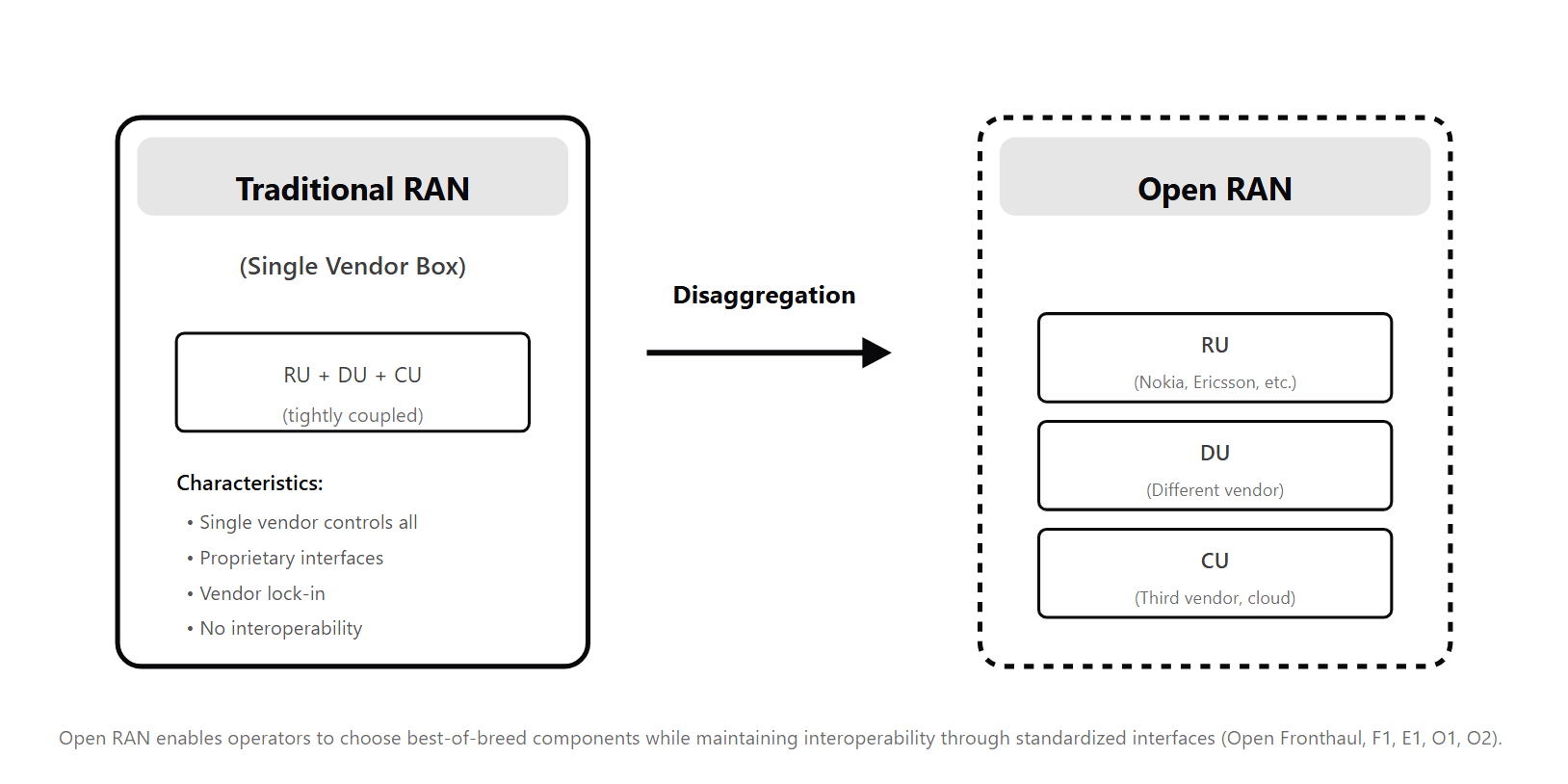
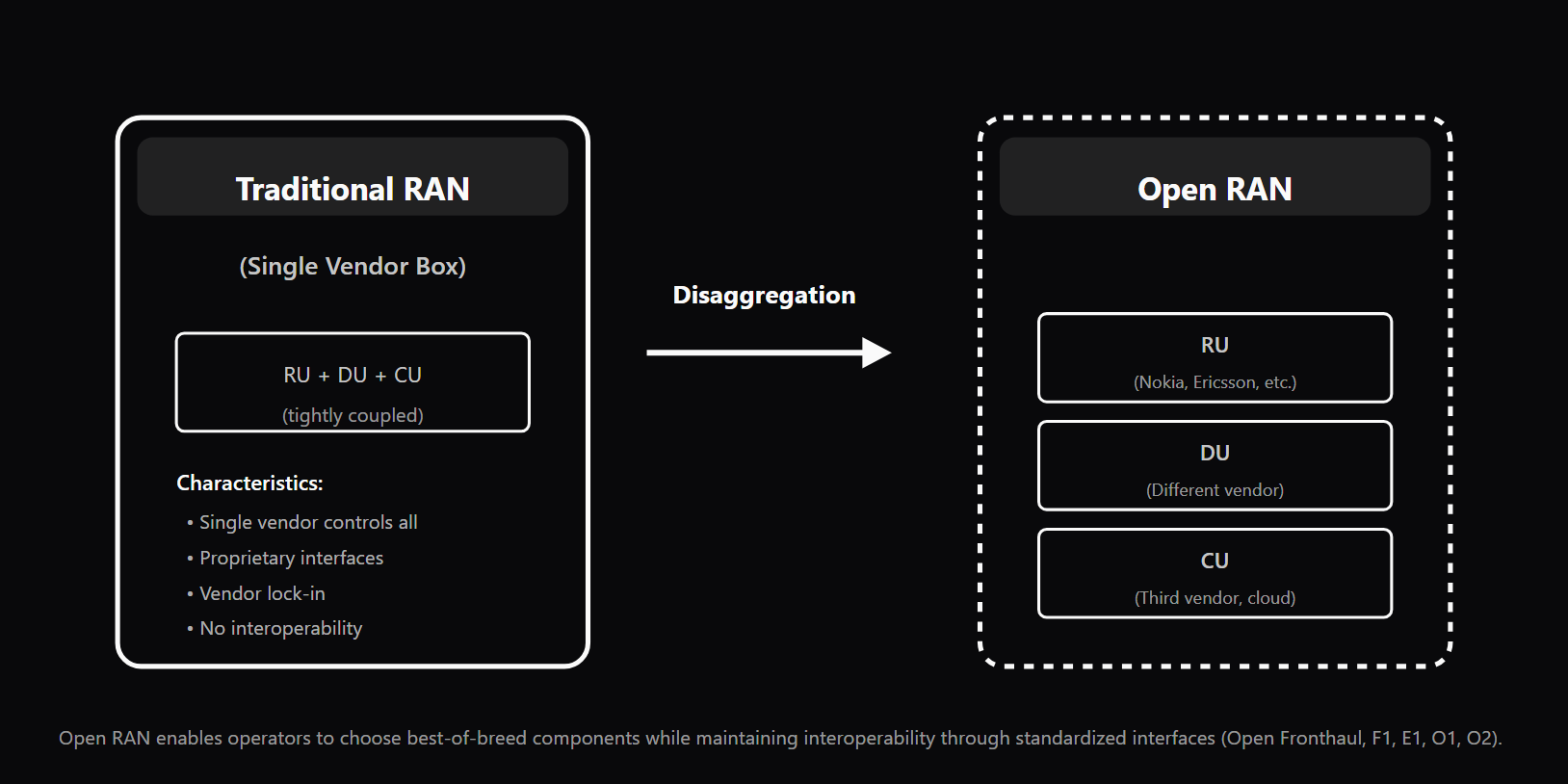
- Traditional RAN is one vendor end to end with proprietary internal interfaces; Open RAN splits the same RU/DU/CU functions at published interfaces so each box can come from a different vendor. The disaggregation is the whole point — everything else follows from it.
- Name the two splits. Option 2 is the CU/DU higher-layer split (RRC/PDCP in the CU, RLC/MAC/high-PHY in the DU) carried over F1 midhaul; Option 7.2x is the DU/RU lower-layer split that O-RAN actually standardized, carrying frequency-domain IQ over the Open Fronthaul interface on eCPRI.
- Option 7.2x is a chosen compromise: split lower toward CPRI and the RU is dumb but fronthaul bit rate explodes; split higher and the RU gets expensive. 7.2x keeps the RU simple while keeping fronthaul bandwidth transportable.
- The RIC has no traditional-RAN equivalent: Near-RT RIC (10 ms–1 s) runs xApps and steers nodes over E2; Non-RT RIC (>1 s, inside the SMO) runs rApps and pushes policies/models down via A1, managing nodes over O1 and cloud over O2.
- Open RAN’s economics favor the operator over a 10-year horizon (component-level refresh, vendor competition, annual renegotiation) but the payoff lands at year 3–5; traditional RAN wins on time-to-market and lower deployment risk in the first 12–18 months.
- The operator becomes the system integrator in Open RAN. That is the real cost most candidates miss — the multivendor validation, DevOps, and an expanded security attack surface that the single vendor used to own.
What it is
The difference is where the vendor boundary sits. Traditional RAN is one vendor's monolithic base station — the radio unit (RU), distributed unit (DU), and centralized unit (CU) ship as a single integrated product on that vendor's proprietary hardware and software, and the internal interfaces between them are not published. You cannot put another vendor's RU in front of it. Open RAN takes the same RU/DU/CU functions and splits them at standardized, published interfaces so an operator can buy each box from a different vendor and have them interoperate. Two splits define the architecture, and interviewers expect you to name both. The CU/DU split (3GPP higher-layer split, Option 2) puts RRC and PDCP in the CU and RLC/MAC/high-PHY in the DU, joined by the F1 midhaul interface (see /topics/nr-architecture-nsa-sa-cu-du). The DU/RU split is the one O-RAN actually opened up: the lower-layer split Option 7.2x (see /topics/o-ran-fronthaul-split-7-2x), which cuts the physical layer into a high-PHY in the DU and a low-PHY in the RU and carries frequency-domain IQ over the Open Fronthaul interface (eCPRI transport, with control/user/synchronization "CUS" planes plus an M-plane for management). Option 7.2x is the deliberate compromise: split lower (toward Option 8/CPRI) and the RU is dumb but the fronthaul bit rate explodes; split higher and the RU gets expensive. 7.2x keeps the RU simple while holding fronthaul bandwidth to something a normal transport network can carry. Above the radio sits the RAN Intelligent Controller (RIC), the part with no traditional-RAN equivalent. The Near-RT RIC runs control loops on a 10 ms–1 s timescale and hosts xApps that steer the DU/CU over the E2 interface; the Non-RT RIC lives in the Service Management and Orchestration (SMO) layer, runs loops slower than 1 s, hosts rApps, and pushes policies and trained models down to the Near-RT RIC over A1 while managing the nodes over O1 (and cloud resources over O2). This is what lets a multivendor RAN be optimized as one system instead of per-vendor silos. The tradeoff is concrete. Traditional RAN is simpler to run — one vendor owns integration, testing, and the support phone number — but that single boundary is also the lock-in. Open RAN trades that simplicity for optionality and vendor competition, and in return the operator inherits the integration, multivendor validation, and a materially larger security attack surface that the single vendor used to absorb.
Why interviewers ask
Major operators (Vodafone, Telefónica, Rakuten, Verizon) are adopting Open RAN to escape vendor lock-in and reduce costs. Understanding the strategic reasons behind this shift is essential for engineers working on RAN systems. Interviewers want candidates who can articulate not just the technical difference, but the business and operational implications. Strong candidates can explain why operators prefer multivendor optionality, describe the hidden integration costs that offset capital savings, and discuss how disaggregation changes the operational model (more vendors, more test/validation, more touch points).
Common mistakes
The most common mistake is treating Open RAN as clearly superior to traditional RAN. It is not. Open RAN reduces vendor lock-in but increases integration risk and operational burden. The right choice depends on operator priorities (cost vs simplicity, flexibility vs operational risk). Other pitfalls: assuming Open RAN is cheaper upfront (capital savings are real, but integration and ongoing costs can offset them), not grasping that operators still need a primary vendor relationship (for support, integration), and missing the fact that the ecosystem is still maturing (not all vendors have equally mature O-RAN stacks yet).
Open RAN vs Traditional RAN vs Pure Software RAN — Cost and Integration Profile
| Architecture | CAPEX Model | OPEX Integration Burden | Vendor Lock-In Risk | Time-to-Market for Innovation | Deployment Risk |
|---|---|---|---|---|---|
| Traditional (Monolithic) | Lower upfront (integrated), per-site licensing | High — single vendor support, proprietary tools, inflexible upgrades | Very high — switching vendors requires full base-station replacement | Slow — depends on single vendor roadmap, 2–3 year release cycles | Low — vendor owns entire integration, full testing before release |
| Open RAN (Disaggregated) | Higher upfront (integration team, testing labs), commodity hardware + software licensing | Medium — manage multiple vendor support contracts, multivendor testing, per-site heterogeneous stacks | Low — switch RU or DU independently, renegotiate annually, preserve existing DU or CU | Faster — multiple vendors innovate in parallel, updates per quarter, faster feature adoption | Higher — operators validate multivendor combinations, integration risk, longer ramp-up (6–12 mo) |
| Pure Software RAN (vRAN/ORAN on x86) | Commodity hardware (x86 servers) + software | Medium — cloud operations (scaling, orchestration), vendor support, energy for compute | Low — software vendor agnostic, run on any cloud (on-premise, AWS, Azure) | Fastest — continuous deployment, weekly updates, carrier-driven roadmap | Medium — software maturity still evolving, performance validation required, integration complexity |
Sample interview questions
- From a 10-year total cost of ownership (TCO) perspective, why do operators invest in Open RAN despite higher upfront integration costs?
- A. Open RAN is always cheaper upfront; integration costs are negligible
- B. Open RAN enables vendor competition (RU vendors compete with each other, DU vendors separately), reducing per-unit costs. Component refresh without full system replacement, and renegotiation of support contracts annually. Upfront integration costs are typically recovered within 3-5 years. Over 10 years, TCO often favors Open RAN ✓
- C. Traditional RAN has lower 10-year TCO because integration is simpler
- D. TCO is identical for both; the choice is purely strategic
Option B reflects real operator economics. Initial integration cost ($5-20M for a national deployment) is significant, but long-term savings compound. Cost drivers over 10 years: 1. **Hardware refresh:** In Open RAN, if a vendor's DU becomes outdated, the operator can replace it without touching the RU/CU. In traditional RAN, you must replace the entire base station—expensive. 2. **Vendor competition:** RU vendors compete on price/performance, DU vendors separately. Traditional RAN forces you to negotiate as a bundle with one vendor, reducing bargaining power. 3. **Software updates:** Open RAN vendors release updates quarterly; traditional RAN vendors release every 2-3 years. Faster updates let operators capitalize on new features (e.g., new beamforming algorithm) without hardware replacement. 4. **Renegotiation:** With multiple vendors, operators can renegotiate support contracts annually. Traditional RAN vendors lock you in for 3-5 year support agreements. Payoff timeline: Verizon and Vodafone case studies show Open RAN ROI at year 3-4. By year 10, Open RAN TCO is 10-20% lower than traditional RAN. Option A misses integration costs. Option C ignores vendor competition. Option D trivializes real financial data.
- An operator is deploying a network using traditional RAN for the first time. What is the primary advantage over Open RAN during the initial 18-month deployment phase?
- A. Traditional RAN costs less overall
- B. Traditional RAN has a single vendor to manage; the vendor owns integration, testing, and deployment risk. The operator can focus on network design, site acquisition, and operations. Open RAN requires the operator to hire integration teams and validate multivendor combinations—adding 6-12 months to deployment timelines ✓
- C. Traditional RAN is more flexible
- D. Traditional RAN has better performance
Option B is correct. In the short term (initial deployment), traditional RAN wins on speed and simplicity. Traditional deployment: operator coordinates with one vendor for RU/DU/CU. The vendor provides pre-tested, pre-integrated components. Installation is mostly plug-and-play. 12-18 month deployment timeline from site acquisition to network activation. Open RAN deployment requires: 1. Integration planning (3 months): choose vendors, plan combinations, design interoperability matrix 2. Lab validation (4-6 months): test RU from vendor A with DU from vendor B, verify interfaces, stress-test 3. Field trial (3-6 months): deploy in production, real-world validation, troubleshoot multivendor issues 4. Full rollout (6-12 months): scale to network Total: 18-36 months. The risk: if multivendor integration fails in field trial, the schedule slips. After 5+ years, Open RAN's flexibility advantages (renegotiation, component refresh) kick in and TCO improves. But during initial deployment, traditional RAN is faster to market. Option A is wrong for long-term. Option C misses that traditional RAN is less flexible. Option D is unsubstantiated.
- In traditional RAN, vendor lock-in creates what kind of long-term cost escalation, and how does Open RAN mitigate it?
- A. Lock-in does not create cost escalation; vendors always price competitively
- B. Once a traditional RAN base station is deployed, replacing it with a different vendor requires replacing RU, DU, CU, and often power systems and antenna configs. Switching cost is $500k-$2M per site, making vendor lock-in expensive. Open RAN allows swapping individual components (DU for $100-200k, RU for $200-300k), reducing switching cost and enabling competition on individual components ✓
- C. Open RAN does not solve lock-in; it just shifts it to software vendors
- D. Lock-in is inevitable regardless of architecture
Option B quantifies the lock-in effect. Traditional RAN creates a high switching cost, which gives the vendor pricing power over the network's lifetime. Lock-in economics: - Traditional: Vendor knows replacing the entire base station costs $500k-$2M. They can raise support fees 10-20% annually, and the operator swallows the cost (replacing is more expensive). Over 10 years, support costs can double. - Open RAN: Replacing a DU costs $100-200k, and there are 5+ competing vendors. If Vendor A raises prices, the operator switches to Vendor B. This competition drives down costs and prevents price escalation. Quantified: Traditional RAN support cost might rise from $10k/year to $15k/year (50% increase). Open RAN support stays flat or declines due to competition. Over 10 years, this difference is $50-100k per site. Open RAN mitigates lock-in by making component switching cheap and enabling vendor competition. Option A ignores real pricing behavior. Option C partially true (software lock-in is a risk) but misses that hardware optionality is the core benefit. Option D is fatalistic and ignores architectural differences.
- What is the integration complexity cost for an operator deploying Open RAN across 1,000 sites, and what hidden costs are often underestimated?
- A. Integration costs are trivial; less than $1M total
- B. Visible costs: integration team ($8-15M), system integrator ($10-20M), lab/tools ($2-5M). Hidden costs: training ($2-3M), rollback/failover procedures ($3-5M), multivendor support contracts (higher than traditional RAN), ongoing DevOps ($5-10M over 5 years), and delayed revenue due to slower deployment (3-6 month slippage). Total hidden costs can equal or exceed visible integration costs ✓
- C. Open RAN has no hidden costs; all costs are upfront
- D. Hidden costs are covered by vendor support
Option B lists realistic, often-underestimated costs. Operators planning Open RAN deployments often budget integration labor but miss the broader operational impact. Visible costs (usually budgeted): - Integration team: 10-15 engineers × $150k/year × 2 years = $3-4.5M - System integrator (SI partner): 5-10% of total CAPEX on 1000 sites × $400k/site = $20-40M - Lab, tools, test equipment: $2-5M Hidden costs (often missed): 1. **Training:** Operators need to train 50-100 engineers on multivendor troubleshooting (cross-vendor debugging, RAN simulation, etc.). External training = $2-3M. 2. **Rollback complexity:** Each vendor has different rollback procedures. Operators develop standardized rollback playbooks = $1-2M in effort. 3. **Support contracts:** Multivendor support is more expensive than single-vendor. Instead of one $2M/year contract, it's now three $1.5M/year contracts = net +$2.5M/year × 5 years = +$12.5M. 4. **Delayed revenue:** Slower deployment (18-36 mo vs 12-18 mo for traditional) delays subscriber activation. 6-month slip = lost revenue from 100k delayed subscribers × $50/month × 6 = $30M impact. 5. **DevOps overhead:** Multivendor environment requires more sophisticated automation and monitoring. Dedicated DevOps team = $5-10M over 5 years. Total hidden: $20-30M. This often exceeds the visible $15-25M. Option A underestimates by 10-20×. Option C is naive. Option D ignores that multivendor support is neither unified nor simple.
- Why is the "dual-deployment" strategy (running a production Open RAN cell alongside a traditional RAN cell for 3-6 months) important for risk mitigation?
- A. Dual deployment is unnecessary; it just wastes resources
- B. Dual deployment allows operators to validate Open RAN reliability in real-world conditions with real traffic before committing the entire network. If Open RAN cell experiences outages or performance issues, traditional RAN cell absorbs the load. After 3-6 months of proven reliability, the operator gains confidence to roll out Open RAN broadly ✓
- C. Dual deployment is required by standards; it has no practical benefit
- D. Traditional RAN and Open RAN cannot coexist in the same network
Option B explains why many operators use dual deployment as a de-risking strategy. Open RAN is operationally different from traditional RAN, and proving reliability with real traffic is prudent. During the 3-6 month trial: - The Open RAN cell handles real subscribers in a real deployment - Metrics are compared: availability (should be >99.5%), latency, handover success rate, throughput - If Open RAN cell has an outage, subscribers auto-handover to traditional RAN cell (no service loss) - If Open RAN discovers a bug (e.g., vendor A RU incompatibility with vendor B DU), it is found and fixed in a low-risk environment - Operators build confidence in multivendor ops: how to troubleshoot, escalate, and roll back After 3-6 months of flawless operation, the operator decides to roll Open RAN to 10-20 sites, then 100 sites, etc. This phased approach spreads risk and builds operational muscle. Option A ignores the risk-reduction value. Option C is false (no standard mandates this). Option D is false (modern networks routinely mix RAN types).
- Which operator role is more critical in Open RAN vs traditional RAN?
- A. Both are identical in importance
- B. In traditional RAN, the vendor is dominant and the operator is passive (receives integrated solution). In Open RAN, the operator becomes the integrator: they choose vendors, validate combinations, manage interop matrix, and own the integration risk. The operator must become skilled in RAN architecture, multivendor orchestration, and DevOps. Vendor becomes a component supplier, not the system architect ✓
- C. Vendors are more important in Open RAN
- D. Operators have no role in either model
Option B captures the fundamental shift in responsibility. Open RAN inverts the power dynamic between operators and vendors. Traditional RAN: - Vendor is the system architect - Vendor owns integration, testing, rollout - Operator specifies requirements and receives a fully integrated solution - Operator is reactive: uses the tools and processes the vendor provides - Vendor has significant power (owns the roadmap, sets pricing) Open RAN: - Operator is the system architect (chooses RU vendor A, DU vendor B, CU vendor C) - Operator owns integration, testing, multivendor validation - Operator is proactive: defines the target architecture, manages vendors as suppliers - Vendors are component suppliers competing on price/features - Operator has leverage: can switch DU vendors next year if unsatisfied This shift requires operators to build internal expertise: RAN engineers (not just radio engineers), cloud/DevOps skills, systems integration experience. Small operators struggle; large operators (Verizon, Vodafone) thrive because they have the talent and scale. Option A misses the architectural shift. Option C is wrong: vendors lose power in Open RAN. Option D is absurd.
Frequently asked questions
- What is traditional RAN?
- Traditional RAN is a monolithic base station from a single vendor (Nokia, Ericsson, Samsung). The RU, DU, and CU are tightly integrated, run proprietary software, and cannot interoperate with other vendors. Upgrading means replacing the entire system.
- What is Open RAN?
- Open RAN disaggregates the base station into RU, DU, CU with standard interfaces (Open Fronthaul, F1, O1, O2). Any vendor's RU can connect to any vendor's DU/CU. Software is vendor-specific but must comply with O-RAN specs (see /topics/open-ran-o-ran-interview-prep).
- What are the advantages of Open RAN?
- Multivendor choice (no lock-in), lower capital cost (commodity hardware), faster innovation (smaller vendors can participate), and flexibility to mix components from different vendors in the same network.
- What are the disadvantages of Open RAN?
- Integration complexity is higher. Operators must manage multivendor supply chains, validate interoperability, and handle more operational touchpoints. Debugging issues across vendor boundaries is harder. Mature ecosystem takes time.
- Why do operators care about this distinction?
- Vendor lock-in is expensive over 10+ year equipment lifecycles. Open RAN gives operators optionality: they can switch vendors for the DU or RU without replacing the entire base station, negotiate better pricing, and avoid being trapped by a single vendor's roadmap.
- What are the CAPEX and OPEX cost trade-offs between Open RAN and traditional RAN?
- Traditional RAN has lower upfront CAPEX (single vendor, integrated system) but higher OPEX (locked into one vendor's support costs, software updates, spare parts). Open RAN has higher initial CAPEX due to integration effort (multivendor testing, custom workflows) but potentially lower long-term OPEX (competition drives down DU/RU prices, operators can renegotiate annually). A 10-year TCO comparison often shows Open RAN ahead, but the payoff takes 3-5 years to materialize.
- What is the typical integration cost and team size for Open RAN deployment?
- A mid-scale Open RAN rollout (500–1000 sites) typically requires: (1) a dedicated integration team of 8–15 engineers (RAN, cloud, DevOps, testing) for 12–18 months; (2) a system integrator partner (major vendor or specialist firm) costing 5–10% of total network CAPEX; (3) joint validation labs to certify multivendor combinations before field deployment. In contrast, traditional RAN deployment is simpler: one vendor handles most integration, teams are smaller. The trade-off: Open RAN requires upfront investment but unlocks long-term flexibility.
- How does risk mitigation and testing differ in Open RAN vs traditional RAN?
- In traditional RAN, the vendor controls the entire testing and release cycle, reducing risk of integration failures. In Open RAN, operators must: (1) validate multivendor combinations in labs (RU from vendor A, DU from vendor B); (2) run end-to-end tests (call setup, handover, QoS) before rolling to production; (3) develop fallback and rollback strategies for each vendor's software; (4) maintain test harnesses for debugging across boundaries. Many operators run a production Open RAN cell in parallel with traditional RAN for 3–6 months to prove reliability before large-scale cutover.
- How do rApps compare with traditional RAN management tools?
- Traditional RAN management is script-driven and vendor-specific: each vendor ships its own EMS/NMS, KPIs are exposed through proprietary APIs, and operators write per-vendor automation that has to be rewritten when the vendor changes. rApps are policy-driven and vendor-agnostic. They run on the Non-RT RIC, consume standard O1 and A1 interfaces, and express optimization intent (e.g., load balancing, energy saving) as policies that any compliant vendor's stack must follow. Where traditional tools manage a single vendor's box, rApps coordinate across a multivendor RAN and push ML-trained policies to xApps on the Near-RT RIC for sub-second execution. The trade-off is the same as Open RAN itself — more flexibility and competition, but operators now own the integration and policy-engineering work that the vendor used to do. See /topics/xapps-rapps-ran-intelligence for the xApp/rApp split in depth.
- What is the difference between the Option 2 and Option 7.2x functional splits?
- They split the base station at different layers. Option 2 is the CU/DU higher-layer split defined by 3GPP: RRC and PDCP run in the centralized unit (CU), RLC/MAC and high-PHY run in the distributed unit (DU), and they connect over the F1 midhaul interface. Option 7.2x is the lower-layer split that the O-RAN Alliance standardized for the DU-to-RU boundary: it cuts the physical layer into a high-PHY (DU) and a low-PHY (RU) and carries frequency-domain IQ samples over the Open Fronthaul interface, transported on eCPRI with control, user, and synchronization (CUS) planes plus an M-plane for management. The split point is a deliberate tradeoff: a lower split (toward Option 8 / CPRI) makes the RU cheap and simple but the fronthaul bit rate scales with antenna count and explodes for massive MIMO; a higher split makes the RU more expensive. 7.2x is the industry's chosen middle ground because it keeps the RU relatively simple while holding fronthaul bandwidth to a level a packet transport network can carry.
- Does Open RAN have a larger security attack surface than traditional RAN?
- Yes, and a strong candidate names why rather than just asserting it. A monolithic base station exposes few external interfaces and the single vendor controls the entire supply chain and software stack. Open RAN deliberately opens interfaces (Open Fronthaul, E2, A1, O1, O2) that were previously internal and proprietary, adds new attack surfaces in the RIC and its xApps/rApps and the SMO, and introduces multiple vendors plus open-source and cloud components into the supply chain. Each opened interface is a boundary that must be authenticated and hardened, and a malicious or buggy xApp/rApp can now influence RAN behavior. The mitigations are zero-trust between components, the O-RAN security specifications, and rigorous interoperability and conformance testing — but the expanded surface is real, and it is a frequent interview probe because it is the clearest counterpoint to the 'Open RAN is strictly better' fallacy.
Related topics
Siblings
- Open RAN (O-RAN) Explained: Architecture and RIC
- Near-RT RIC vs Non-RT RIC
- O-RAN 7.2x Fronthaul Explained: RU-DU Interface
- O-RAN Interfaces Explained: A1, E2, O1, and O2
- xApps vs rApps Explained: O-RAN Intelligence
- O-RAN Energy Saving and AI/ML Optimization
- 5G NR Architecture: NSA vs SA, CU/DU Split, and CA
Essential AI-Native Skills for Open RAN vs Traditional RAN
Modern engineering work increasingly uses AI tools for design and code review, debugging, documentation, test and testbench generation, and workflow automation. The goal is not to let AI replace engineering judgment — it is to move faster while keeping verification discipline.
- Use AI to explain unfamiliar code, logs, waveforms, datasheets, or test failures.
- Break large problems into small, reviewable steps you can verify independently.
- Ask AI for hypotheses, then validate them against tests, measurements, simulations, or lab data.
- Version-control your analysis scripts, testbenches, and configs — keep changes small and reviewable.
- Document your assumptions, design tradeoffs, and debugging decisions.
- Verify AI output before trusting it: run the checks that fit the domain — unit tests, linters, simulations, or bench/lab measurements.
- Review AI output for correctness, edge cases, and real-world consequences.
Open RAN vs Traditional RAN — coming to the question bank
The adaptive practice engine is already live for core wireless, RF, and ML systems. Open RAN vs Traditional RAN isn't covered in the question bank yet — get notified when it's added.