O-RAN 7.2x Fronthaul Explained: RU-DU Interface Interview Prep
O-RAN split 7.2x interview prep — Open Fronthaul, RU-DU interface, latency, bandwidth, IQ sample transport, and deployment trade-offs.
Quick answer
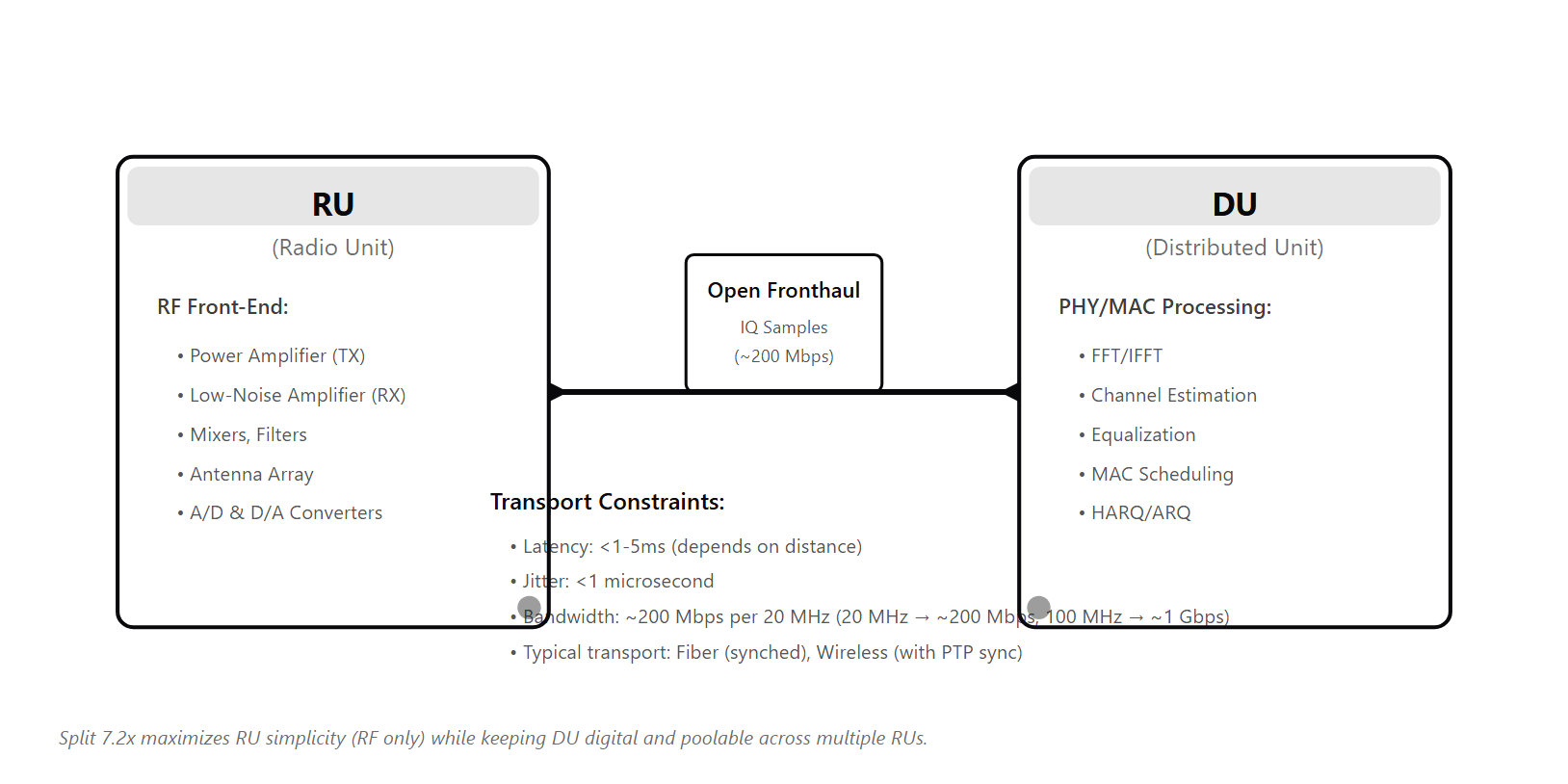
O-RAN split 7.2x (the Open Fronthaul split) divides the RAN at the PHY layer boundary.
Split 7.2x is the industrial standard for Open RAN because it balances flexibility (any RU + DU combination) with feasibility (fiber backhaul is deployable).
Editorial review
Written by
CompoundLearn editorial team
Wireless / RF / hardware engineering
Reviewed by
CompoundLearn editorial team
Wireless / RF / hardware engineering
Last reviewed
Built from curated topic maps, editorial validation, and subject-matter review so the page stays aligned with the interview intent and the current content pipeline.
Key points
- O-RAN split 7.2x divides the RAN at the PHY layer: the Radio Unit (RU) does RF + analog (including beamforming, see /topics/beamforming), the Distributed Unit (DU) does the PHY/MAC/RLC/PDCP digital processing.
- The fronthaul link carries raw IQ samples, so it needs low latency (<1-5 ms RTT), high bandwidth (8-20 Gbps per sector), and tight timing synchronization.
- Split 7.2x is the industry standard for Open RAN because it balances any-RU + any-DU flexibility with deployable fiber-fronthaul feasibility.
- The O-RAN Alliance Open Fronthaul interface standardizes RU-DU interoperability so operators can mix vendors (see /topics/open-ran-o-ran-interview-prep).
What it is
O-RAN split 7.2x (the Open Fronthaul split) divides the RAN at the PHY layer boundary. The RU (Radio Unit) handles analog and RF processing: transmit power amplification, beamforming, receive analog-to-digital conversion. The DU (Distributed Unit) handles everything digital: PHY, MAC, RLC, PDCP layers. The fronthaul link between RU and DU must transport raw IQ samples (the digital representation of the radio signal). This requires: - Low latency: <1-5ms round-trip time, often much tighter - High bandwidth: Gbps for each cell (8-20 Gbps per sector typical) - Tight synchronization: timing accuracy for beamforming and HARQ The O-RAN Alliance standardizes the Open Fronthaul interface to ensure RU-DU interoperability. Deployments use fiber, microwave, or licensed spectrum backhaul to meet these tight constraints.
Why interviewers ask
Split 7.2x is the industrial standard for Open RAN because it balances flexibility (any RU + DU combination) with feasibility (fiber backhaul is deployable). Interviewers want engineers who understand the fronthaul constraints and can reason about deployment trade-offs: Where can you place the DU? How far can the fronthaul reach? What happens to latency when you centralize the DU in the cloud? Strong candidates can explain IQ sample rates and bandwidth calculations, discuss why split 7.2x requires low-latency backhaul, compare it to other splits, and describe how timing synchronization works across the fronthaul.
Common mistakes
The most common mistake is conflating O-RAN split 7.2x with 3GPP's F1 (Option 2) split. They divide at different layers: 7.2x is after RF (RU-DU), Option 2 is after MAC (CU-DU) (see /topics/nr-architecture-nsa-sa-cu-du). Confusing them causes fundamental misunderstandings about latency and bandwidth. Other pitfalls: not accounting for IQ sample rate overhead (compression is often necessary), assuming split 7.2x backhaul can be wireless in all environments (usually requires fiber), and missing the timing/synchronization complexity that arises when DU is distant from RU.
Split Architecture Comparison — 7.2x vs 7.1x vs 3GPP F1
| Split Architecture | RU-DU Boundary | Fronthaul Latency Budget | Bandwidth per Antenna | Deployment Maturity |
|---|---|---|---|---|
| O-RAN Split 7.2x (Open Fronthaul) | After RF front-end; RU handles beamforming, DU handles PHY/MAC | <1-5ms round-trip; strict jitter tolerance <1µs | 1-3 Gbps (compressed IQ samples) | Mature; primary industry standard; deployed by Nokia, Rakuten, Telefónica, Vodafone |
| O-RAN Split 7.1x | After PHY layer; RU includes lower PHY (fading channel estimation), DU has upper PHY/MAC | 10-50ms; more flexible latency; jitter <10µs acceptable | 50-500 Mbps (per-user coded data) | Emerging; reduces fronthaul cost vs 7.2x; preferred for greenfield where fiber unavailable |
| 3GPP Option 2 (F1 Split) | After PDCP layer; RU/DU handle PHY+MAC, CU handles RLC/PDCP | 10-100ms; highly flexible; jitter tolerance loose | 5-50 Mbps (per-user packets); CU-DU only | Mature in traditional gNB deployments; not disaggregated RU; less multivendor flexibility than O-RAN |
Sample interview questions
- In split 7.2x, the RU transmits raw IQ samples to the DU over the fronthaul link. Why are raw IQ samples necessary instead of sending compressed user data (like MAC PDUs)?
- A. Raw IQ samples are unnecessary; some vendors use PDUs instead
- B. IQ samples allow the DU to perform real-time channel estimation, beamforming feedback calculations, and dynamic resource allocation based on instantaneous fading. The DU needs the RF signal, not the decoded user data, to compute PHY-layer decisions ✓
- C. Sending PDUs would violate 3GPP standards
- D. Raw IQ samples are smaller than PDUs, so they reduce bandwidth
Option B is correct. The DU needs visibility into the raw radio environment to do its job. By receiving IQ samples, the DU can perform channel estimation (measuring propagation conditions), compute precoding weights (for beamforming), decide scheduling and power levels, and execute HARQ retransmission logic. All of these PHY-layer operations require the actual signal samples, not decoded bits. In contrast, if the RU sent only decoded MAC PDUs (user data packets), the DU would lose all information about the channel conditions, noise levels, and interference—information critical for making real-time control decisions. The DU would be blind to the radio environment. This is why split 7.2x fronthaul carries IQ samples: the DU must see the raw signal. Option A is incorrect because split 7.2x is standardized and all vendors implement it. Option C ignores that O-RAN and 3GPP splits are independent standards. Option D is wrong: IQ samples are bulkier than PDUs, not smaller.
- A 5G NR cell operating on a single 100 MHz carrier at 2.6 GHz with 4-antenna RU must transport IQ samples via split 7.2x fronthaul. Assuming no compression and 16-bit precision per I and Q component, what is the approximate bandwidth required per antenna element?
- A. 100 Mbps per antenna
- B. 1.6 Gbps per antenna (100 MHz × 2 × 16 bits × complex) ✓
- C. 10 Gbps per antenna
- D. Bandwidth depends only on the number of antennas, not carrier bandwidth
Option B is correct. Here's the calculation: A 100 MHz bandwidth requires sampling at 2× the bandwidth (Nyquist criterion) = 200 million samples/second. Each sample is complex (I + Q components), so 2 samples per Nyquist sample = 400 million complex values/second. Each complex value (I and Q) requires 16 bits = 2 bytes per component = 4 bytes per complex sample. Therefore: 400M samples/sec × 4 bytes/sample = 1.6 Gbps per antenna element. For a 4-antenna RU with one carrier, that's 4 × 1.6 = 6.4 Gbps total. This uncompressed bandwidth is why compression is necessary in real deployments (reducing to 1-3 Gbps through quantization). Without compression, 6.4 Gbps per sector is expensive fiber infrastructure. Option A underestimates by 16×. Option C is too high. Option D ignores the carrier bandwidth, which is fundamental to the sample rate.
- Split 7.2x requires <1 microsecond jitter on the fronthaul link for HARQ timing alignment. Why is jitter tolerance so tight, and what happens if jitter exceeds 1 microsecond?
- A. Jitter tolerance is arbitrary; 1 microsecond is just an engineering guess
- B. HARQ (Hybrid Automatic Repeat reQuest) transmissions must align to exact timing slots. Jitter >1µs causes HARQ retransmissions to land at the wrong timing slot (e.g., 1 slot early or late), leading to undetected collisions and retransmission failure. Additionally, beamforming requires phase coherence across antennas; jitter causes phase drift and beam gain degradation ✓
- C. Jitter only affects RF power and is not critical for digital processing
- D. Only split 7.1x requires tight jitter; split 7.2x is tolerant of jitter
Option B explains both the HARQ and beamforming failure modes. HARQ timing is strict: in 5G NR, HARQ feedback and retransmission windows are measured in slots (125 microseconds to 1 millisecond apart, depending on numerology). If the DU sends a retransmission grant to the RU with 2 microseconds of jitter, the RU might execute the transmission 1 microsecond early or late. If the UE is listening at a specific slot boundary, a 1-slot error causes a collision or miss—the retransmission is lost. For beamforming, multiple antennas must transmit in phase. The RU steers the beam by adjusting the phase on each element. If element A's transmission is delayed by 0.5 microseconds relative to element B, the phase error at 2.6 GHz is Δphase = 2π × 2.6e9 Hz × 0.5e-6 s ≈ 8.2 radians ≈ 1.3 cycles—a massive error that destroys constructive interference. Split 7.2x uses PTP (Precision Time Protocol) with sub-microsecond clocks to maintain synchronization. Option A is wrong: the tight tolerance is physically driven. Option C misses the HARQ critical issue. Option D reverses the requirement: split 7.2x has tighter jitter tolerance than 7.1x because 7.2x carries raw IQ samples (sensitive to timing). Split 7.1x carries encoded PHY data and is more tolerant.
- An operator is deciding between fiber backhaul and licensed wireless microwave (73 GHz) for split 7.2x fronthaul. Fiber has 0.5ms latency and 100 ppm jitter. Wireless microwave has 1.2ms latency and 50 ppm jitter. Which is more suitable for split 7.2x and why?
- A. Wireless is better because it has lower jitter
- B. Fiber is better: it has lower and more predictable latency, meeting the <1-5ms fronthaul budget with margin. The jitter difference (100 vs 50 ppm) is less critical than latency consistency. Wireless 73 GHz is point-to-point; rain fade and multipath can violate latency guarantees ✓
- C. Both are equally suitable; the choice is only economic
- D. Wireless is better because 1.2ms is still <5ms
Option B is correct. Latency consistency matters more than absolute jitter in this context. Fiber: 0.5ms latency leaves 4.5ms margin within the 5ms budget for DU processing. Jitter of 100 ppm (one part per 10,000) on a 0.5ms link is ±0.05 microseconds—negligible. Fiber is immune to weather and provides deterministic propagation. Wireless 73 GHz: 1.2ms latency leaves only 3.8ms margin. However, wireless backhaul is vulnerable to rain fade (causing packet loss and retransmissions, which spike latency), multipath fading (adding variable delay), and interference (reducing SNR and increasing jitter). A rain event can introduce 10-20ms of additional latency, blowing the budget. The 50 ppm jitter is good, but if the link fails during rain, jitter is moot. Split 7.2x requires latency predictability: the DU must guarantee it processes IQ samples within the budget, every sample, every second. Wireless reliability is too variable for fronthaul unless it is a backup link with automatic failover to fiber. Option A focuses on the wrong metric (jitter vs latency consistency). Option C ignores reliability. Option D misses that wireless 1.2ms + occasional 15ms spikes violates the contract.
- Open Fronthaul compression reduces IQ sample bandwidth from 6.4 Gbps to 1.6 Gbps (4× compression). What is the primary trade-off introduced by compression?
- A. Compression increases fronthaul latency in the RU and risks IQ sample precision loss if quantization is aggressive. The RU must compress samples before transmission, and the DU must decompress—both add latency (typically 100-500 microseconds). Aggressive quantization (e.g., 8-bit samples) causes SNR degradation if precision is insufficient for channel estimation ✓
- B. Compression only reduces cost with no downside
- C. Compression is irrelevant to 5G performance
- D. Compression improves latency by reducing packet count
Option A correctly identifies the latency and precision trade-off. Compression is not free. Latency: The RU must compress IQ samples before sending them down the fronthaul. Compression algorithms (block floating-point, scaling, quantization) require computation. On modern hardware, this is 100-500 microseconds per block of samples. The DU decompresses on the other end—another latency increment. While total DU latency (processing + transport + compression overhead) must stay <5ms, every microsecond counts. Aggressive compression algorithms that save bandwidth can consume multiple hundred microseconds, tightening the margin. Precision: A 16-bit IQ sample quantized to 12 bits loses some dynamic range. If the radio signal has components at very different power levels (e.g., a strong desired signal plus weak interference), quantizing to 12 bits might not preserve the weak component (it gets rounded to zero). This causes the DU's channel estimator to miss the interference, degrading interference mitigation. Operators choose compression levels (8, 10, 12, 16 bits) based on performance targets. Option B ignores latency and precision. Option C is wrong: compression affects performance directly. Option D is backwards: adding compression increases packet overhead (headers for scale factors), not decreases it.
- In split 7.2x, the DU is located 15 km away from the RU over a fiber link with 0.1ms/km latency. The DU processing time is 2.5ms. What is the total latency budget consumption, and is this design feasible?
- A. Total latency = 15 km × 0.1ms/km + 2.5ms = 4ms. This is within the 5ms budget, so the design is feasible
- B. Total latency = 1.5ms (fiber) + 2.5ms (DU processing) + 1.5ms (return fiber) = 5.5ms (round-trip), which exceeds the 5ms single-direction budget. This design is marginal or infeasible because the tight margin leaves no room for packet retransmissions or processing variability ✓
- C. Fiber latency is negligible; only DU processing matters
- D. DU processing latency cannot be guaranteed, so this design is always risky
Option B is correct and acknowledges the operational reality. Let's clarify the budget. Split 7.2x fronthaul has a one-way latency budget: the RU transmits IQ samples to the DU, the DU processes them, and sends control decisions back to the RU. The round-trip is: RU → DU (1.5ms) → DU processing (2.5ms) → RU (1.5ms) = 5.5ms. However, the standard latency budget for split 7.2x is <1-5ms one-way, depending on the specific measurement point. If we interpret "5ms budget" as one-way DU processing, then the design is feasible (2.5ms < 5ms). But if we include the round-trip acknowledgment (feedback from DU to RU for HARQ grants, power adjustments, etc.), 5.5ms is tight. In practice, tight margins are risky: packet jitter, DU CPU contention (processing spikes during load), or network congestion can exceed the budget. Operators prefer 2-3ms slack to handle variability. This design is feasible but marginal. Option A oversimplifies by ignoring round-trip. Option C is wrong: fiber latency is a significant portion of the budget. Option D is too pessimistic: modern DU hardware (GPUs, FPGAs) guarantee processing latency within tight bounds via deterministic scheduling.
- Compare split 7.2x (O-RAN fronthaul) to split 7.1x in terms of RU complexity and fronthaul bandwidth. Why would an operator choose one over the other?
- A. Split 7.2x has simpler RU (RF only) but requires 10-50× more fronthaul bandwidth than 7.1x. Operators choose 7.2x when fiber is available and cheap (metro areas); 7.1x in remote areas where fiber is unavailable or expensive ✓
- B. Both splits require identical RU complexity and bandwidth; they are functionally identical
- C. Split 7.1x always requires more bandwidth than 7.2x
- D. The choice is arbitrary and has no performance impact
Option A correctly captures the fundamental trade-off. Split 7.2x moves complexity from RU (RF + PHY) to the DU (everything else), requiring simpler RU hardware but expensive fronthaul. Split 7.1x keeps PHY processing in the RU, reducing fronthaul bandwidth 10-50× but requiring more complex RU hardware (DSP/FPGA for channel estimation, decoding). Operator decision logic: - **Metro/dense urban with fiber:** Fiber infrastructure exists and is relatively cheap per cell. Split 7.2x favors pooling: a single regional DU serves 10-20 RUs, reducing DU deployment costs. Fronthaul cost (fiber) is amortized over many RUs. - **Suburban/rural without fiber:** Fiber is unavailable or costs $100k-$1M to trench. Split 7.1x reduces fronthaul bandwidth to ~100 Mbps (encoded data), which can ride on wireless backhaul or DSL. The RU is more expensive (adds DSP hardware: $5-10k vs $1-2k for 7.2x), but the operator saves fiber costs. Both are "valid" splits; the choice is topology-dependent. Option B is wrong: RU complexity and bandwidth are fundamentally different. Option C reverses the comparison. Option D ignores deployment realities.
- If a split 7.2x deployment uses dynamic (per-block) compression instead of static compression, what additional overhead is introduced?
- A. No additional overhead; dynamic compression has no downside
- B. Dynamic compression adds control overhead: scaling factors (meta-data) must be transmitted with each block of IQ samples so the DU knows how to decompress. This reduces net bandwidth savings (~5-10% overhead) but adapts to varying signal levels, improving SNR compared to static compression ✓
- C. Dynamic compression doubles the bandwidth requirement
- D. Dynamic and static compression use identical overhead
Option B is correct. Dynamic (per-block) compression calculates an optimal scaling factor for each block of samples, maximizing use of the quantized bit width. But the RU must send the scaling factor to the DU so it can decompress correctly. Example: If a block of IQ samples has peak amplitude of 1000 (before quantization), the RU scales down by 1000, quantizes to 12 bits, and sends both the quantized data and the scale factor (1000). The DU reverses this: unquantizes the 12-bit data and scales back up by 1000. Without the scale factor, the DU cannot decompress. This metadata overhead is ~5-10%: a block might have 1024 IQ samples (20.5 KB in 16-bit format), quantized to 12-bit = 15.4 KB. Adding a 32-bit or 64-bit scale factor per block = ~1 KB overhead total = 6% overhead. Net compression is still 4× but with adaptation. Static compression (fixed scale factor for all samples, or no per-block adaptation) has no metadata overhead but risks suboptimal quantization (losing SNR) if signal levels vary widely. Option A misses the metadata cost. Option C is wrong: overhead is <10%. Option D ignores that static has zero overhead.
Frequently asked questions
- What is an O-RAN split?
- An O-RAN split defines where the RAN processing is divided between the RU (Radio Unit) and DU/CU. Different splits move the PHY/MAC/RLC/PDCP boundaries between the radio (RU) and the processing units (DU/CU), trading off latency, bandwidth, and processing complexity.
- What is split 7.2x?
- Split 7.2x (the O-RAN Open Fronthaul split) divides after the RF front-end. The RU handles analog RF (transmit, receive, beamforming). The DU handles everything digital (PHY, MAC, higher layers). This is the most common O-RAN split in commercial deployments.
- Why is split 7.2x called 'Open Fronthaul'?
- The interface between RU and DU (the fronthaul) is standardized by the O-RAN Alliance. 'Open' means any vendor's RU can connect to any vendor's DU over this standard interface, unlike proprietary vendor-specific fronthaul links.
- What are the latency and bandwidth implications of split 7.2x?
- Split 7.2x requires low-latency fronthaul (<1-5ms round trip) and high bandwidth (Gbps) because raw IQ samples must be transported. The DU must process in real time, so both latency and jitter matter. This is why split 7.2x deployments use fiber or licensed spectrum backhaul.
- How does split 7.2x differ from 3GPP Option 2 (F1 split)?
- Split 7.2x is an O-RAN standard (RU-DU boundary after RF). Option 2 (3GPP) splits after the MAC layer (PDCP-RLC boundary), which is higher up the stack and has different latency/bandwidth tradeoffs. They are not compatible; do not confuse them.
- How do you calculate the required IQ sample rate and bandwidth for split 7.2x?
- For a single-band 5G NR carrier at 2.6 GHz with 100 MHz bandwidth, each antenna element must transport raw IQ samples at 2× the carrier frequency sample rate. Using complex samples (I and Q components), one antenna requires ~1.6 Gbps (100 MHz × 2 × 2 × 4 bytes per sample). A 4-antenna RU needs ~6.4 Gbps; an 8-antenna RU needs ~12.8 Gbps per carrier. Multi-band RUs (e.g., two carriers) multiply this. The Open Fronthaul standard specifies compression (scaling/quantization) to reduce bandwidth by 4-6×, but compression adds processing latency in the RU. The interplay between sample rate, quantization, and fronthaul link capacity drives split 7.2x deployment decisions.
- What compression techniques are used in split 7.2x and why are they necessary?
- Open Fronthaul defines multiple compression schemes: 'u-plane' compression quantizes IQ samples to lower bit widths (e.g., 16-bit to 12-bit or 8-bit), scaling them by a common factor. 'block scaling' adapts the scale per block of samples to minimize precision loss. Static compression (fixed factor) is simple but loses quality; dynamic compression (per-block scaling) adapts to signal characteristics but increases control overhead. Some RUs use lossy compression (block floating-point) to reduce bandwidth 4-6×. Compression is necessary because uncompressed fronthaul bandwidth (6-12 Gbps per antenna) is expensive; compressed bandwidth (1-3 Gbps) is deployable over standard fiber. The cost is RU processing latency (compression logic) and potential SNR degradation if quantization is too aggressive.
- What are the trade-offs between fiber and wireless backhaul for split 7.2x fronthaul?
- Fiber backhaul is deterministic: latency is predictable (sub-1ms), bandwidth is high and fixed, jitter is minimal. However, fiber requires trenching, right-of-way coordination, and long deployment timelines (6-18 months in dense urban areas). Wireless backhaul (licensed spectrum, unlicensed microwave) is faster to deploy but introduces latency variability, weather fade, and interference. Split 7.2x is feasible over licensed microwave (e.g., 73 GHz) in point-to-point links with tight line-of-sight. But wireless backhaul cannot match fiber latency consistency, so hybrid deployments often use fiber for core DU pools and wireless for remote RUs. The operator's cost model and site-access constraints determine the choice.
- Why does split 7.2x require sub-microsecond jitter tolerance and how is synchronization achieved?
- Split 7.2x transmit feedback requires the DU to signal the RU's transmit timing with microsecond accuracy for HARQ retransmission alignment. IQ sample timing across antennas must align to a fraction of a sample period (~nanoseconds at GHz rates) for beamforming coherence. Jitter exceeding 1 microsecond causes HARQ misalignment (retransmissions land at wrong timing slots) and phase drift across antenna elements (beamforming gain degradation). Synchronization is achieved via PTP (Precision Time Protocol, IEEE 1588) with GPS discipline at primary sites, or an atomic clock at hubs. DUs and RUs exchange PTP grandmaster advertisements over the fronthaul link; both lock to the same reference. High-precision timing cards in RUs and DUs cost extra ($5k-15k) but are mandatory for split 7.2x.
- What are the primary cost drivers for split 7.2x deployment compared to split 7.1x?
- Split 7.2x moves the RU-DU boundary higher, meaning the RU is simpler (only RF/beamforming) but the fronthaul is more expensive. Split 7.1x (RU includes PHY) reduces fronthaul bandwidth ~1000× because MAC layer data (per-user coded bits) is much smaller than raw IQ. However, split 7.1x RUs are more complex and less poolable. Cost drivers: (1) Fiber vs wireless backhaul (fiber: capex, wireless: opex + latency risk), (2) Compression hardware in RUs (reduces bandwidth, adds latency and cost), (3) PTP timing hardware (mandatory for HARQ alignment), (4) DU pool consolidation (more centralized DU = higher fronthaul cost but lower DU deployment cost). For operators with existing fiber infrastructure, split 7.2x is cost-effective; for greenfield deployments with poor backhaul, split 7.1x or a hybrid approach is preferred.
Related topics
Essential AI-Native Skills for O-RAN 7.2x Fronthaul Explained: RU-DU Interface
Modern engineering work increasingly uses AI tools for design and code review, debugging, documentation, test and testbench generation, and workflow automation. The goal is not to let AI replace engineering judgment — it is to move faster while keeping verification discipline.
- Use AI to explain unfamiliar code, logs, waveforms, datasheets, or test failures.
- Break large problems into small, reviewable steps you can verify independently.
- Ask AI for hypotheses, then validate them against tests, measurements, simulations, or lab data.
- Version-control your analysis scripts, testbenches, and configs — keep changes small and reviewable.
- Document your assumptions, design tradeoffs, and debugging decisions.
- Verify AI output before trusting it: run the checks that fit the domain — unit tests, linters, simulations, or bench/lab measurements.
- Review AI output for correctness, edge cases, and real-world consequences.
O-RAN 7.2x Fronthaul Explained: RU-DU Interface — coming to the question bank
The adaptive practice engine is already live for core wireless, RF, and ML systems. O-RAN 7.2x Fronthaul Explained: RU-DU Interface isn't covered in the question bank yet — get notified when it's added.