PON Evolution: GPON → XGS-PON → TWDM-PON → 50G-PON Interview Prep
PON architectures from GPON to 50G-PON — OLT, ONU, splitter, burst-mode receivers, dynamic bandwidth allocation, TWDM-PON, and the 50G upgrade.
Quick answer
PON (Passive Optical Network) is the fiber-access architecture delivering fiber connectivity from a central OLT (Optical Line Terminal) to multiple ONUs (Optical Network Units) at customer premises through a passive optical splitter.
PON is the access-network probe in optical-engineering interviews — different from long-haul DWDM, with its own engineering challenges around burst-mode reception, TDM scheduling, and per-ONU cost optimization.
Editorial review
Written by
CompoundLearn editorial team
Wireless / RF / hardware engineering
Reviewed by
CompoundLearn editorial team
Wireless / RF / hardware engineering
Last reviewed
Built from curated topic maps, editorial validation, and subject-matter review so the page stays aligned with the interview intent and the current content pipeline.
Key points
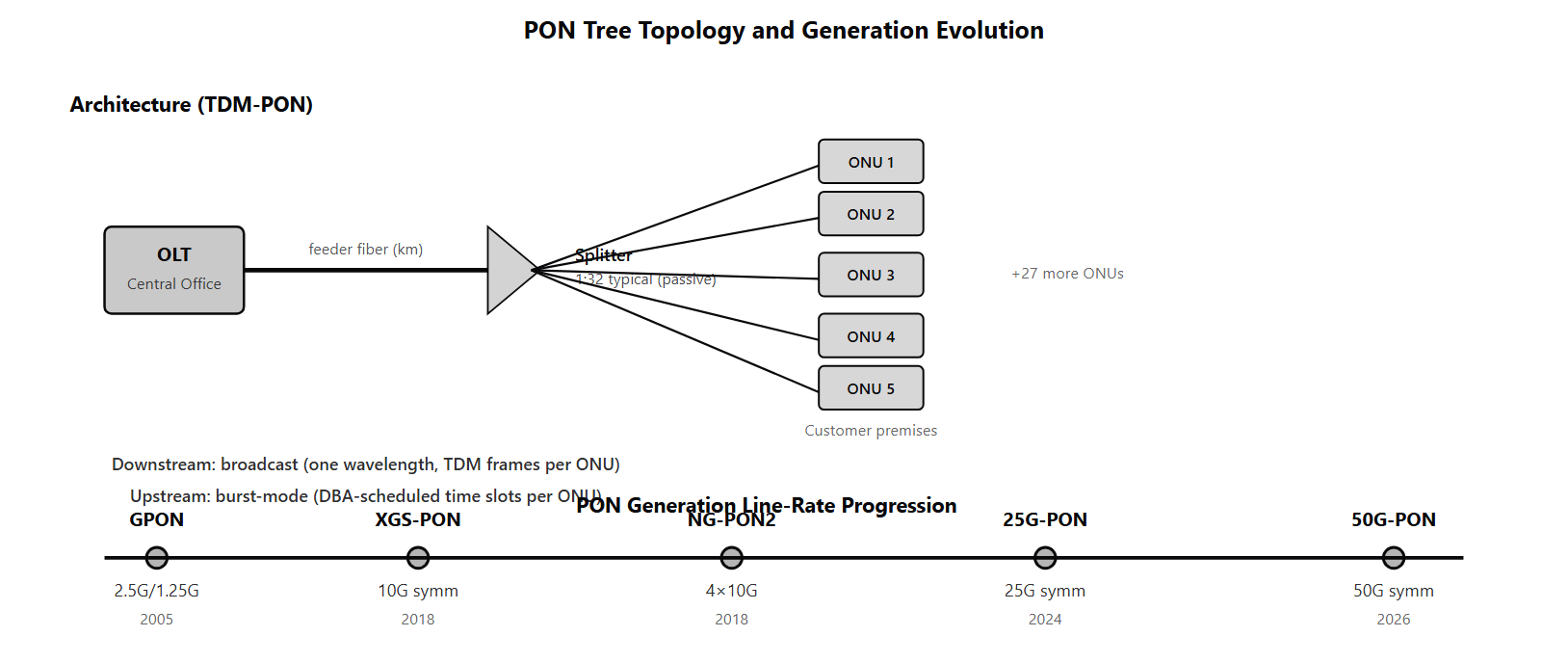
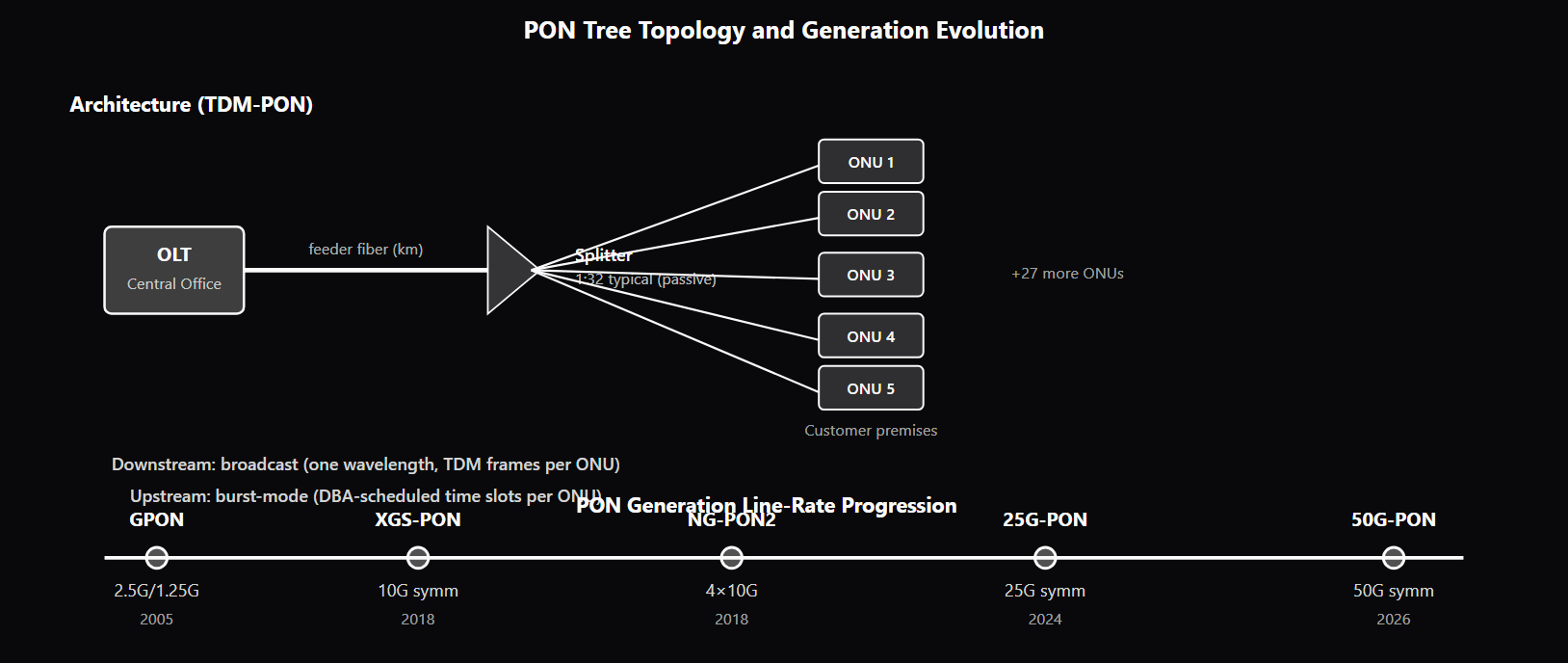
- Each PON generation is its own ITU-T Recommendation: GPON = G.984.x, XG-PON = G.987.x, XGS-PON = G.9807.1 (10G symmetric), NG-PON2/TWDM-PON = G.989.x (40G-capable via 4 × 10G), and 50G-PON = the G.9804.x Higher Speed PON (HSP) series.
- 50G-PON is specified in ITU-T G.9804.3 (PMD layer) at a nominal downstream line rate of 49.7664 Gbit/s, with upstream options of 49.7664, 24.8832, or 12.4416 Gbit/s — so "50G" upstream is one configurable tier, not always symmetric.
- NG-PON2 (G.989) reaches 40 Gbit/s aggregate as four stacked 10 Gbit/s TWDM wavelength pairs, each pair still shared among ONUs by TDM — a hybrid of WDM and TDM, not pure point-to-point WDM-PON.
- XGS-PON (G.9807.1) is designed to coexist on the same optical distribution network (ODN) as G-PON, XG-PON, and NG-PON2 by occupying distinct wavelength bands, which is what lets operators overlay a new generation without re-trenching fiber.
What it is
PON (Passive Optical Network) is the fiber-access architecture delivering fiber connectivity from a central OLT (Optical Line Terminal) to multiple ONUs (Optical Network Units) at customer premises through a passive optical splitter. "Passive" means the splitter contains no active electronics — just optical splitting and combining of light — which dramatically simplifies outside-plant deployment, eliminates outdoor power requirements at the splitter, and reduces ongoing maintenance. PON is the dominant FTTH (Fiber-to-the-Home) architecture worldwide. The PON evolution: **GPON** (2.5G/1.25G, deployed 2005-2015), **XG-PON** (10G/2.5G asymmetric, transitional), **XGS-PON** (10G symmetric, widely deployed 2018+), **TWDM-PON / NG-PON2** (4 × 10G via TDM + WDM, limited deployment due to ONU cost), **25G-PON** (emerging), **50G-PON** (ITU-T G.9804, 2025-2026 deployment starting). Each generation increases bit rate while preserving backward compatibility on the same fiber plant via wavelength multiplexing — operators can run XGS-PON and 50G-PON simultaneously on the same fiber using different wavelength pairs. **OLT** (Optical Line Terminal) is the central equipment serving 64-256 ONUs per PON port via the splitter tree. The OLT performs downstream framing and TDM scheduling for all ONUs, receives upstream bursts from each ONU via burst-mode receivers, and provides the IP/Ethernet interface to the metro network. Modern OLT chassis serve thousands of subscribers across multiple PON ports. **ONU** (Optical Network Unit) is the customer-premise equipment terminating the fiber drop. The ONU demultiplexes downstream frames, transmits upstream bursts during allocated time slots, and provides the customer-side network interface (Ethernet/WiFi/phone). ONU laser transmits only during allocated time slots — the rest of the time it is off, enabling TDM among multiple ONUs sharing the same upstream wavelength. **Burst-mode receiver** at the OLT is one of the central PON engineering challenges. The OLT receives a sequence of upstream bursts from different ONUs at potentially different optical power levels (15-25 dB variation across an ONU population due to varying fiber lengths and splitter losses) and different timing. The receiver must lock to each burst's preamble within tens of nanoseconds, adjust threshold and AGC per burst, perform clock recovery, and demodulate the payload — before the next burst arrives from a different ONU. This is fundamentally different from continuous-mode reception in DWDM and drives significant complexity in OLT optical design. **Dynamic Bandwidth Allocation (DBA)** is the OLT-side algorithm allocating upstream time slots to ONUs based on current bandwidth demand. ONUs periodically report buffer status; the OLT grants time slots proportional to demand, subject to per-ONU bandwidth guarantees and operator priorities. DBA enables statistical multiplexing — when one ONU is idle, its allocated bandwidth redistributes to active ONUs — significantly improving user-experienced throughput compared to fixed bandwidth allocation. **Ranging** is the procedure by which the OLT measures the round-trip propagation delay to each ONU and adjusts ONU transmit timing so upstream bursts arrive at the OLT in their allocated slots without collisions. Each ONU is at a different fiber distance (1-20+ km typical range), so ONU transmit times must be shifted to compensate. Ranging happens during ONU registration and is periodically refined. **TWDM-PON** (NG-PON2) adds wavelength-division on top of TDM: instead of one upstream and one downstream wavelength shared by all ONUs, TWDM uses multiple wavelength pairs (4 in NG-PON2). Each ONU is tunable to one of the available pairs. ONUs on different wavelengths transmit simultaneously without interference, multiplying aggregate per-fiber capacity. Cost: tunable ONU optics and per-wavelength burst-mode receivers. TWDM-PON adoption has been slow due to ONU cost; the recent focus has shifted to 50G-PON (TDM-only at higher rate) for the next-generation rollout. **50G-PON** delivers 50 Gb/s symmetric using the same architectural model as XGS-PON but at 5× the line rate. Key engineering challenges: higher-speed burst-mode receiver at the OLT (50G burst-mode is significantly more complex than 10G), tunable ONU optics for coexistence with XGS-PON, and FEC support for the higher rate. Deployment starts 2025-2026 for higher-tier residential and business services.
Why interviewers ask
PON is the access-network probe in optical-engineering interviews — different from long-haul DWDM, with its own engineering challenges around burst-mode reception, TDM scheduling, and per-ONU cost optimization. A candidate who fluently navigates the PON evolution, burst-mode receivers, DBA, ranging, and the TWDM-vs-50G upgrade path is showing the access-network expertise that staff PON-equipment and FTTH-deployment roles require. The burst-mode receiver question is the deepest technical probe. Strong candidates explain the inter-burst power-level variation (15-25 dB) and timing variability that drive burst-mode receiver complexity, and contrast it with continuous-mode DWDM reception. Weak candidates know PON exists but cannot describe the burst-mode reception mechanism. The DBA + ranging question is the operational probe. Strong candidates explain DBA's statistical-multiplexing benefit and ranging's timing-correction role, and connect them to user-experienced throughput in deployed PONs. Candidates who do not surface DBA miss the central operational mechanism. TWDM-vs-50G is the upgrade-path question. Strong candidates explain that TWDM (NG-PON2) adds wavelength-division for capacity scaling at the cost of tunable ONU optics, but operator adoption has shifted toward 50G-PON for cost reasons. Candidates who treat them as interchangeable upgrade paths miss the operator economics. The PON-vs-active-Ethernet question is the architectural probe. Strong candidates explain that PON's passive splitter eliminates outside-plant power requirements (a major operational cost saving for FTTH at scale), but at the cost of shared-medium upstream bandwidth that DBA must arbitrate. Active Ethernet provides per-customer dedicated bandwidth but requires powered outside-plant equipment.
Common mistakes
The most common mistake is treating PON as "just FTTH" without understanding the TDM-PON shared-medium architecture and the burst-mode reception that distinguishes it from point-to-point fiber. PON's engineering is specifically about efficient sharing of one fiber and one wavelength pair across many ONUs. A second gap is missing burst-mode reception. The 15-25 dB inter-burst power variation and per-burst clock recovery are the central operational challenges in OLT design. Candidates who do not surface burst-mode have not worked at the OLT optical-design level. A third gap is confusing PON wavelengths. GPON uses 1490/1310 nm; XG-PON and XGS-PON use 1577/1270 nm. The wavelength selection matters for coexistence on the same fiber plant — multiple PON generations can share fiber via WDM combiners. Candidates who do not know the wavelength specifics miss the operator-side deployment reality. A fourth gap is overstating TWDM-PON adoption. NG-PON2 was specified and standardized but operator deployment has been limited due to ONU cost concerns. The industry has largely shifted focus to 50G-PON (TDM-only at higher rate) for the next-generation upgrade. Candidates who think TWDM-PON is the dominant FTTH architecture have not tracked operator deployment. A fifth gap is missing the DBA-ranging coordination. DBA decides which ONU transmits next; ranging ensures the ONUs transmit at the right time. Both must work together for collision-free upstream operation. Candidates who treat them as independent miss the operational coordination. See /topics/optical-fiber-standards-itu for the fiber-side context (PON typically uses G.652 fiber with bend-insensitive G.657 in the customer drop), and /topics/dwdm-systems-explained for the DWDM-vs-PON architectural distinction.
PON Generation Comparison
| Generation | Downstream Rate | Upstream Rate | Wavelengths | Architecture | Status |
|---|---|---|---|---|---|
| GPON | 2.5 Gb/s | 1.25 Gb/s | 1490 / 1310 nm | TDM-PON | Legacy, being phased out |
| XG-PON | 10 Gb/s | 2.5 Gb/s | 1577 / 1270 nm | TDM-PON, asymmetric | Some deployment |
| XGS-PON | 10 Gb/s | 10 Gb/s | 1577 / 1270 nm | TDM-PON, symmetric | Widely deployed 2018+ |
| TWDM-PON (NG-PON2) | 4 × 10 Gb/s | 4 × 10 Gb/s | 4 wavelength pairs (~1596-1603 / 1524-1544 nm) | TDM + WDM | Limited deployment |
| 25G-PON | 25 Gb/s | 25 Gb/s | Various | TDM-PON | Emerging |
| 50G-PON | 50 Gb/s | 50 Gb/s | New wavelengths | TDM-PON, ITU-T G.9804 | 2025-2026 deployment |
Sample interview questions
- In a TDM-PON like XGS-PON, multiple ONUs share the same upstream wavelength via time-division. What is the burst-mode receiver problem at the OLT, and why does it matter operationally?
- A. Burst-mode receivers are a marketing distinction; standard receivers work fine.
- B. Each ONU transmits its upstream burst at a different optical power level (varying fiber distances and split ratios produce 15-25 dB power-level differences) and at a different timing. The OLT receiver must lock to each burst's preamble within tens of nanoseconds, adjust its threshold and gain per burst, and demodulate the burst payload — all before the next burst arrives from a different ONU. This is fundamentally different from continuous-mode reception in DWDM. Burst-mode receiver design is one of the central engineering challenges of TDM-PON systems. ✓
- C. Burst-mode reception is only used in upstream FR2 PON systems.
- D. Burst-mode reception is identical to continuous-mode reception.
Option B is correct. TDM-PON architecture multiplexes multiple ONUs onto the same upstream wavelength via time-division — each ONU is allocated specific time slots for its upstream transmission. The OLT receives a sequence of bursts from different ONUs, each with potentially different optical power level and timing offset. Sources of inter-burst variation: - Fiber distance varies per ONU (some ONUs are 1 km from the OLT, others 20 km) — different path loss - Splitter losses can vary by 1-3 dB per split level - ONU laser output power can vary by 1-2 dB between units - Combined: per-burst optical power at the OLT can vary 15-25 dB Burst-mode receiver design challenges: - **Fast threshold acquisition**: the decision threshold must be set per-burst based on the burst's peak/trough levels, typically within the first 32-128 symbols (preamble) - **Fast clock recovery**: the receiver must lock to the burst's clock within similar timing - **Fast AGC**: receiver gain must adjust per burst to handle the wide power range - **Inter-burst guard time**: enough time between bursts for the receiver to reset state Operational implications: - Burst-mode receivers are specialty optical-electronic components — significantly more complex than continuous-mode coherent receivers - Per-burst preamble overhead reduces effective upstream throughput - ONU coordination (ranging — measuring round-trip delay per ONU so the OLT can schedule non-overlapping bursts) is mandatory Option A misses the architectural challenge. Option C is unrelated. Option D collapses real engineering differences.
- What does TWDM-PON (Time-and-Wavelength-Division Multiplexed PON) add beyond TDM-PON like XGS-PON?
- A. TWDM-PON is identical to XGS-PON.
- B. TWDM-PON adds wavelength-division on top of time-division: instead of one upstream and one downstream wavelength shared by all ONUs via TDM, TWDM-PON uses multiple wavelength pairs (typically 4-8) with each ONU tunable to one pair. This multiplies aggregate per-fiber capacity (4× for 4-wavelength TWDM, 8× for 8-wavelength) and provides wavelength-level service differentiation (e.g., business customers on dedicated wavelengths). The cost: tunable ONUs and per-wavelength burst-mode receivers at the OLT. ✓
- C. TWDM-PON uses only continuous-wave transmission.
- D. TWDM-PON is for submarine deployments only.
Option B is correct. TWDM-PON (Time-and-Wavelength-Division Multiplexed PON) is the architectural evolution from pure TDM-PON to combined TDM + WDM: **Pure TDM-PON (XGS-PON, 10G-EPON)**: one upstream wavelength and one downstream wavelength shared by all ONUs via TDM. Aggregate capacity = one wavelength's rate (typically 10 Gb/s). **TWDM-PON**: multiple wavelength pairs (typically 4 pairs in NG-PON2 spec; more in research). Each ONU is tunable to one of the available wavelength pairs. ONUs on different wavelengths transmit simultaneously without interference. Aggregate per-fiber capacity is N × per-wavelength capacity. Benefits: - **Capacity scaling**: 4× to 8× aggregate per-fiber capacity at modest infrastructure cost - **Service differentiation**: dedicate wavelengths to specific service classes (residential vs business) or to specific customer groups - **Smooth migration**: new ONUs can be added on new wavelengths while old XGS-PON ONUs continue on their wavelength Costs: - **Tunable ONU optics**: each ONU has tunable lasers and tunable filter wavelengths, more complex than fixed-wavelength TDM-PON ONUs - **Per-wavelength burst-mode receivers**: OLT needs separate receivers per upstream wavelength - **Operational complexity**: managing per-wavelength scheduling and ONU wavelength assignment NG-PON2 (the ITU-T standardized name for TWDM-PON) was specified for FTTH and business PON applications but adoption has been slow due to ONU cost concerns. The recent focus has shifted to 50G-PON which is TDM-only at higher line rate. Option A misses the architectural addition. Option C is wrong — TWDM uses normal burst-mode TDM-PON transmission per wavelength. Option D is unrelated.
Frequently asked questions
- What is PON?
- PON (Passive Optical Network) is the fiber-access architecture that delivers fiber connectivity from a central OLT (Optical Line Terminal) to multiple ONUs (Optical Network Units) at customer premises via a passive optical splitter. "Passive" means the splitter has no active electronics, just optical splitting/combining of light, dramatically simplifying outside-plant deployment. PON is the dominant FTTH (Fiber-to-the-Home) architecture worldwide. PON generations: GPON (2.5G/1.25G), XG-PON (10G/2.5G), XGS-PON (10G symmetric), TWDM-PON / NG-PON2 (4 × 10G), 25G-PON, 50G-PON (50G symmetric, current ITU-T G.9804 standardization).
- What is XGS-PON?
- XGS-PON (10-Gigabit Symmetric PON) is the TDM-PON standard delivering 10 Gb/s downstream and 10 Gb/s upstream (symmetric). Defined in ITU-T G.9807, XGS-PON is widely deployed since 2018-2020 as the upgrade from GPON (2.5G/1.25G) for FTTH operators. The architecture is the standard PON tree: OLT broadcasts downstream on one wavelength (1577 nm) that all ONUs receive (each selects its destination frames via OLT-allocated time slots); ONUs transmit upstream on a different wavelength (1270 nm) via TDM-assigned time slots that the OLT's burst-mode receiver demodulates. XGS-PON supports up to 256:1 split ratios with reach up to 60 km.
- What is the difference between TDM-PON and WDM-PON?
- TDM-PON multiplexes multiple ONUs on the same wavelength via time-division — each ONU has allocated time slots for upstream transmission and shares one downstream wavelength with all other ONUs in the splitter tree. GPON, XGS-PON, 25G-PON, 50G-PON are all TDM-PON. WDM-PON dedicates a unique wavelength to each ONU — no time-sharing required, providing point-to-point optical connectivity within the PON tree but at the cost of per-ONU tunable optics. WDM-PON has seen limited deployment due to ONU cost. TWDM-PON is the hybrid: multiple wavelength groups, each shared via TDM among multiple ONUs — the NG-PON2 approach.
- What is the OLT and what does it do?
- OLT (Optical Line Terminal) is the central PON equipment at the operator side, typically deployed in a central office or street cabinet. The OLT terminates the fiber from the metro core, performs downstream framing and TDM scheduling for all ONUs in its tree, receives upstream bursts from each ONU via burst-mode receivers, and provides the IP/Ethernet interface to the metro network. A typical OLT serves 64-256 ONUs per PON port via the splitter tree, and a single OLT chassis can serve thousands of subscribers across multiple PON ports. OLT design is sophisticated: it must coordinate upstream timing (ranging and DBA), handle burst-mode reception, and process gigabit-class traffic per port.
- What is the ONU and how does it connect?
- ONU (Optical Network Unit) is the customer-premise equipment at the end of the fiber drop. The ONU terminates the fiber, performs PON downstream demultiplexing (selecting only its destination frames), transmits upstream bursts during its allocated time slots, and provides the Ethernet / WiFi / phone-line interface to the customer's home network. ONUs come in different form factors: indoor wall-mounted boxes for residential FTTH, outdoor enclosures for business or curb deployments, integrated into customer premises gateways. ONU optics include the receiver photodiode for downstream and the burst-mode laser transmitter for upstream — the laser is on only during the ONU's allocated upstream time slot.
- What is dynamic bandwidth allocation (DBA)?
- DBA is the OLT-side algorithm that allocates upstream time slots to ONUs based on their current bandwidth demand. Each ONU reports its upstream buffer status periodically; the OLT runs DBA to grant time slots proportional to demand, subject to per-ONU bandwidth guarantees and operator-configured priorities. DBA enables statistical multiplexing — when one ONU is idle, its allocated bandwidth can be redistributed to active ONUs. DBA is one of the central engineering features of TDM-PON and significantly affects user-experienced throughput, especially during peak hours when many ONUs are active simultaneously. Implementation requires careful coordination with ranging and the burst-mode receiver state machine.
- What is the burst-mode receiver problem?
- In TDM-PON, the OLT receives a sequence of upstream bursts from different ONUs at potentially different optical power levels (15-25 dB variation across an ONU population due to varying fiber lengths and splitter losses) and timing. The burst-mode receiver must lock to each burst's preamble within tens of nanoseconds, adjust its threshold and AGC per burst, perform clock recovery, and demodulate the payload — all before the next burst arrives from a different ONU. This is fundamentally different from continuous-mode reception (e.g., DWDM coherent receivers). Burst-mode receiver design is one of the central engineering challenges of PON systems and a major cost driver in OLT optics.
- What is 50G-PON?
- 50G-PON is the ITU-T G.9804 standardized next-generation TDM-PON delivering 50 Gb/s symmetric (50G downstream + 50G upstream). 50G-PON uses the same architectural model as XGS-PON (TDM-PON with central OLT and split ONUs) but at 5× the line rate. Key engineering challenges: higher-speed burst-mode receiver design at the OLT (50G burst-mode is significantly more complex than 10G), tunable ONU optics for migration scenarios where 50G-PON coexists with XGS-PON on the same fiber (different wavelengths), and FEC support for the higher line rate. 50G-PON deployment is starting in 2025-2026 as operators upgrade from XGS-PON for higher-tier residential and business services.
Related topics
Siblings
- DWDM Systems Explained: C-Band, L-Band, and the 400G/800G Era
- Optical Fiber Standards: G.652 vs G.654 vs G.657 vs Hollow-Core
- Silicon Photonics for Datacenters Explained: 800G+ Links
- CPO vs Pluggable Optics: Density, Power & AI-Cluster Trade-offs
- ROADM & Wavelength Switching Explained: WSS, Degrees, CDC
- Optical Engineer Interview Signals: What Interviewers Probe
Essential AI-Native Skills for PON Evolution: GPON → XGS-PON → TWDM-PON → 50G-PON
Modern engineering work increasingly uses AI tools for design and code review, debugging, documentation, test and testbench generation, and workflow automation. The goal is not to let AI replace engineering judgment — it is to move faster while keeping verification discipline.
- Use AI to explain unfamiliar code, logs, waveforms, datasheets, or test failures.
- Break large problems into small, reviewable steps you can verify independently.
- Ask AI for hypotheses, then validate them against tests, measurements, simulations, or lab data.
- Version-control your analysis scripts, testbenches, and configs — keep changes small and reviewable.
- Document your assumptions, design tradeoffs, and debugging decisions.
- Verify AI output before trusting it: run the checks that fit the domain — unit tests, linters, simulations, or bench/lab measurements.
- Review AI output for correctness, edge cases, and real-world consequences.
PON Evolution: GPON → XGS-PON → TWDM-PON → 50G-PON — coming to the question bank
The adaptive practice engine is already live for core wireless, RF, and ML systems. PON Evolution: GPON → XGS-PON → TWDM-PON → 50G-PON isn't covered in the question bank yet — get notified when it's added.