ROADM & Wavelength Switching Explained: WSS, Degrees, CDC Interview Prep
ROADMs explained: how wavelength-selective switches (WSS) add/drop and route wavelengths, and what "degrees" and colorless-directionless-contentionless (CDC) mean.
Quick answer
A ROADM (Reconfigurable Optical Add-Drop Multiplexer) is the active optical node that sits at each fiber junction in a DWDM network and provides per-wavelength routing under software control.
ROADM architecture is the most-asked operational topic in optical-transport interviews because it integrates the optical-physics layer (WSS, channel filtering, insertion loss) with the network-control layer (SDN, OpenROADM, multi-vendor orchestration).
Editorial review
Written by
CompoundLearn editorial team
Wireless / RF / hardware engineering
Reviewed by
CompoundLearn editorial team
Wireless / RF / hardware engineering
Last reviewed
Built from curated topic maps, editorial validation, and subject-matter review so the page stays aligned with the interview intent and the current content pipeline.
Key points
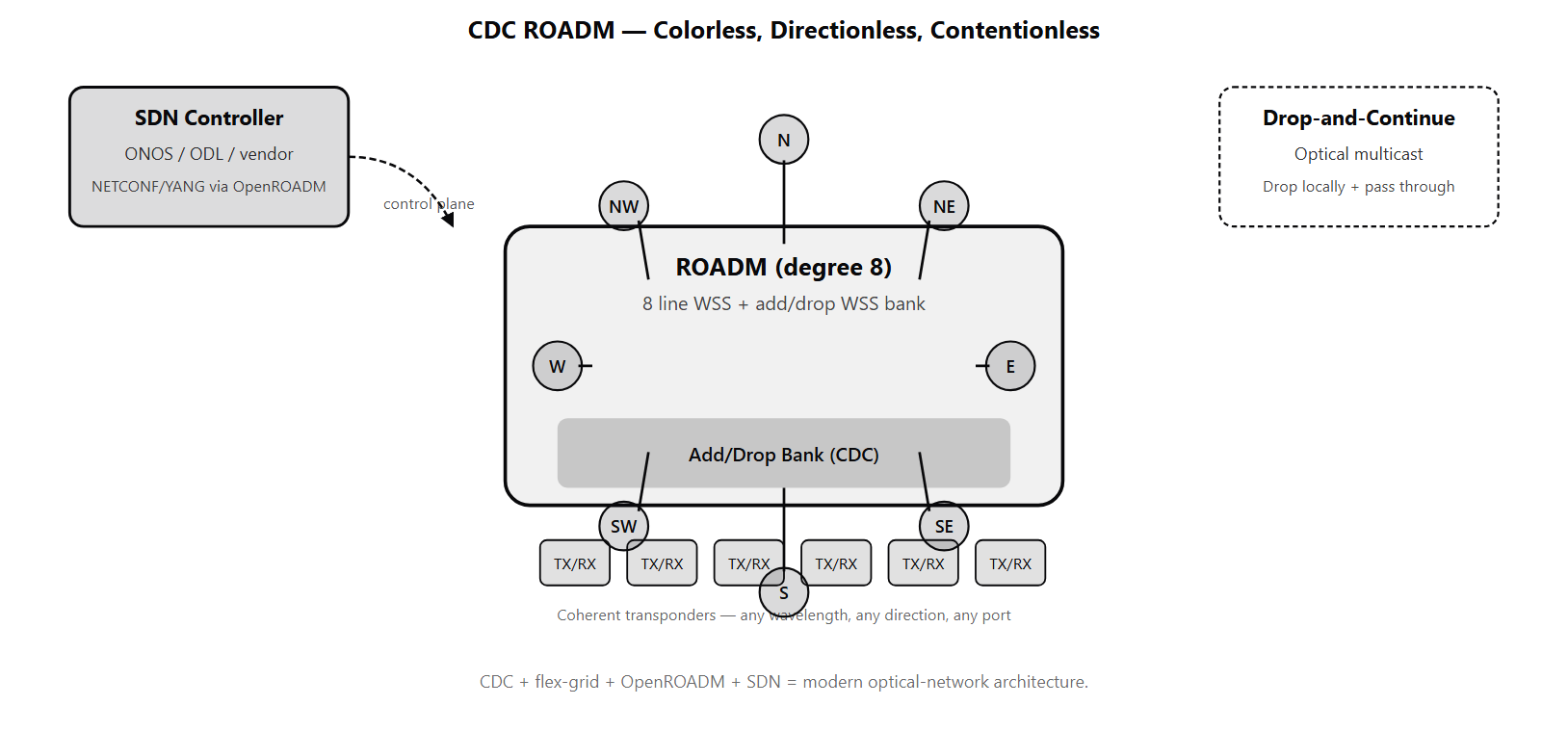
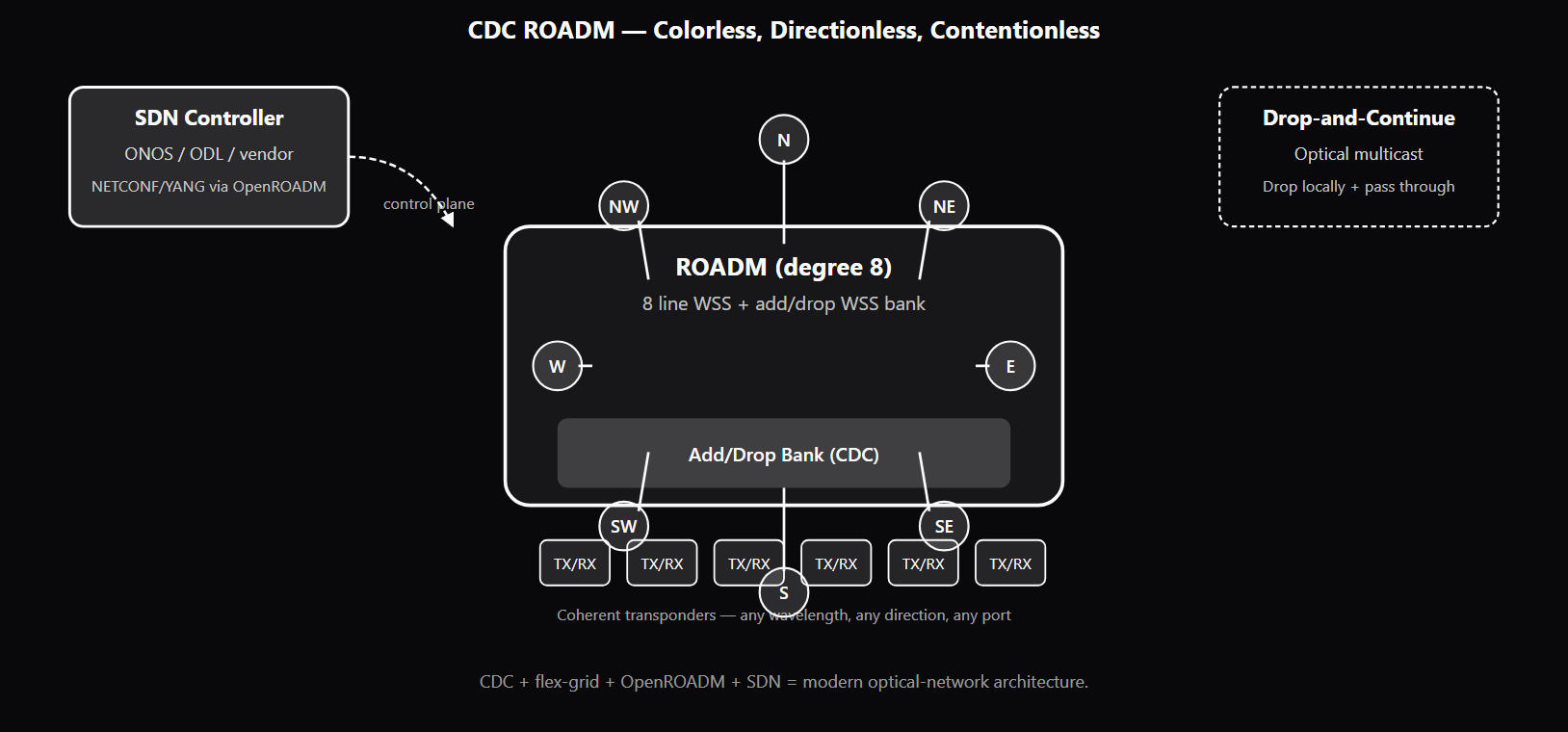
- A ROADM (Reconfigurable Optical Add-Drop Multiplexer) routes individual DWDM wavelengths under software control, with no optical-to-electrical conversion.
- Its core is the Wavelength-Selective Switch (WSS) — an LCoS or MEMS element steering each wavelength to a configurable port (96-200 channels, ~5-7 dB insertion loss).
- CDC (Colorless, Directionless, Contentionless) lets any wavelength route to any port and any direction via software — no truck rolls or re-cabling.
- Flex-grid pairs with CDC to allocate each channel a contiguous block of 12.5 GHz slots sized to its baud rate (e.g. 3 slots for a 32 GBaud DP-16QAM channel).
- OpenROADM standardizes YANG models and NETCONF/RESTCONF interfaces so one SDN controller can manage multi-vendor ROADMs.
What it is
A ROADM (Reconfigurable Optical Add-Drop Multiplexer) is the active optical node that sits at each fiber junction in a DWDM network and provides per-wavelength routing under software control. ROADMs add, drop, and pass through individual wavelengths between fiber directions without optical-to-electrical conversion, preserving the per-channel coherence and minimizing the optical impairments that O-E-O regeneration would introduce. Every modern long-haul, metro, and DCI optical network is built around a ROADM topology, and the evolution of ROADM architecture has tracked the broader shift toward SDN-controlled optical networking. The architecture inside a ROADM is built around the Wavelength-Selective Switch (WSS) — an active optical element implemented with Liquid-Crystal-on-Silicon (LCoS) or MEMS spatial-light modulators that steers each wavelength from an input port to a configurable output port. A typical WSS handles 96-200 channels simultaneously at 12.5 GHz minimum resolution, with 5-7 dB insertion loss and sharp filter roll-off at channel edges. A degree-N ROADM (N line directions) typically uses N WSS modules in the line side plus additional WSS in the add/drop bank — 10-16 WSS in a degree-8 CDC ROADM is typical. The "CDC" architectural shift (Colorless, Directionless, Contentionless) removes three operational constraints that legacy ROADMs imposed. **Colorless**: in older ROADMs each add/drop port was bound to a specific wavelength via per-port WDM filters; CDC allows any wavelength on any port. **Directionless**: each add/drop port was bound to a specific line direction; CDC allows any port to route to any direction. **Contentionless**: only one channel of a given wavelength could be added or dropped per site; CDC allows multiple simultaneous operations of the same wavelength on different ports. Combined, CDC means operators can add or drop any channel at any direction at any port via software — no truck rolls, no physical re-cabling, no per-channel pre-allocation, no manual blocking constraints. Flex-grid (see /topics/dwdm-systems-explained) is the spectrum-planning extension that pairs with CDC. Flex-grid divides the band into 12.5 GHz slots and allocates each channel a contiguous block sized to its spectral width — 3 slots for a 32 GBaud DP-16QAM channel (see /topics/coherent-modulation-formats), 6 slots for a 64 GBaud DP-64QAM channel, 8+ slots for a superchannel. Flex-grid ROADMs use WSS with variable-passband capability and require spectrum-defragmentation procedures to consolidate free spectrum as channels are added and removed. The combination of CDC + flex-grid + SDN-controlled is the modern optical-network architecture; most new deployments specify this combination. OpenROADM is the multi-vendor interoperability framework — an industry consortium effort to standardize YANG data models, optical interfaces, and SDN-controller interfaces across vendors. OpenROADM-compliant devices expose vendor-neutral configuration via NETCONF/RESTCONF, allowing one SDN controller to manage ROADMs and transponders from multiple vendors. The goal is to break the historical vendor-lock-in pattern where a single vendor's line system constrained the operator for the 25+ year fiber-plant lifetime. OpenROADM adoption is concentrated in operators that need multi-vendor flexibility; the broader industry direction is toward open interfaces even when single-vendor stacks are still common. Drop-and-continue is the ROADM capability to drop a wavelength to a local port while also passing it through to a downstream direction — the optical analog of an IP multicast. This is essential for multi-site distribution applications: TV/video broadcast, dual-anchored services, monitoring tap points. Implementation requires multicast-WSS or twin-WSS variants that can split a single input wavelength to multiple outputs. SDN-controlled optical networking is the operational complement to CDC ROADMs and OpenROADM. The control plane centralizes in a controller (ONOS, OpenDaylight, or vendor-specific equivalents) that orchestrates per-channel routing, ROADM configuration, and transponder turn-up via standardized YANG-model interfaces. The controller exposes a higher-level abstraction to applications (network orchestration, traffic engineering, failover) so optical-layer changes can be requested without knowing the underlying hardware specifics. SDN-controlled optical is what lets operators reroute channels in seconds rather than the hours-to-days that traditional NMS-driven workflows required.
Why interviewers ask
ROADM architecture is the most-asked operational topic in optical-transport interviews because it integrates the optical-physics layer (WSS, channel filtering, insertion loss) with the network-control layer (SDN, OpenROADM, multi-vendor orchestration). A candidate who fluently navigates CDC architecture, WSS-based routing, flex-grid spectrum management, and SDN-controlled operations is showing the integrated optical-network understanding that staff optical-transport and senior network-architecture roles (see /topics/optical-engineer-interview-signals) require. The CDC question is the most-diagnostic interview topic. Strong candidates explain colorless, directionless, contentionless individually — what each removes operationally and why it matters at hyperscale (no truck rolls, software-driven add/drop/reroute, SDN-friendly architecture). Weak candidates use CDC as a buzzword without explaining what each property does. The WSS architecture question is the deep-physics probe. Strong candidates explain that WSS is an active optical element (LCoS or MEMS) that steers wavelengths from input to configurable output ports, can quote the channel count and resolution specs, and can estimate the WSS count for a given ROADM degree (10-16 modules for a degree-8 CDC ROADM). Candidates who treat WSS as a passive filter or who do not know the implementation technology have surface knowledge only. OpenROADM is the multi-vendor probe. Strong candidates explain that OpenROADM standardizes YANG data models, optical interfaces, and SDN-controller interfaces for multi-vendor interop, and connect it to the historical vendor-lock-in pattern operators are trying to break. Candidates who do not know OpenROADM exists or who confuse it with O-RAN (different domain, different consortium) reveal gaps in optical-network-architecture exposure. The drop-and-continue feature is the specialized-capability probe. Strong candidates explain that drop-and-continue is the ROADM optical-multicast capability essential for broadcast and dual-anchored services, and that implementation requires multicast-WSS or twin-WSS. Candidates who do not know drop-and-continue exists or who think it requires O-E-O conversion miss a key ROADM capability. The SDN-controlled-optical question is the operational-architecture probe. Strong candidates explain that SDN centralizes per-channel routing, ROADM configuration, and transponder turn-up in a controller using standardized YANG models, and connect it to CDC ROADMs (the hardware substrate) and OpenROADM (the multi-vendor interface). Candidates who do not know optical SDN works fundamentally differently from packet SDN miss a major piece of modern optical-network operations.
Common mistakes
The most common mistake is treating CDC as a single feature rather than three independent properties. Colorless, directionless, contentionless each remove a different operational constraint, and each requires distinct architectural support in the ROADM. Candidates who use CDC as a buzzword without explaining the three properties miss the operational impact. A second gap is misunderstanding WSS. Some candidates treat WSS as a passive filter; it is an active optical switching element implemented with LCoS or MEMS. Some candidates do not understand that the WSS count scales with ROADM degree, leading to "I do not see why higher-degree ROADMs cost more" gaps in the architecture-cost discussion. A third gap is confusing OpenROADM with O-RAN. They are entirely different communities, scopes, and goals. O-RAN is the open RAN-architecture initiative for cellular base stations (see /topics/open-ran-o-ran-interview-prep); OpenROADM is the open optical-network architecture initiative for ROADMs and transponders. The naming similarity trips candidates who do not work in optical networking. A fourth gap is treating drop-and-continue as exotic. It is a routine capability of modern ROADMs and is essential for multi-site distribution applications. Candidates who do not know drop-and-continue exists or who think it requires O-E-O conversion miss a key operational capability. A fifth gap is missing flex-grid's integration with ROADM design. Flex-grid (variable channel widths at 12.5 GHz resolution) requires variable-passband WSS, spectrum-defragmentation procedures, and SDN-coordinated channel allocation. Candidates who treat flex-grid as just "tighter channel spacing" miss the ROADM-side implementation requirements. A sixth gap is missing SDN-controlled optical. The architectural shift from NMS-driven manual ROADM configuration to SDN-controlled software-driven optical operations is the major industry trend of the late 2010s onward. Candidates who describe ROADM operations as if they were still NMS-driven miss the modern operations model. See /topics/dwdm-systems-explained for the spectrum-planning context, /topics/coherent-optical-detection for the per-channel coherent transmission context, and /topics/optical-fiber-impairments for the per-channel impairment context that ROADM-level decisions interact with.
ROADM Generations — From Fixed to CDC + Flex-Grid + SDN
| Generation | Add/Drop | Direction Binding | Spectrum Plan | Control | Typical Deployment |
|---|---|---|---|---|---|
| Fixed-grid OADM | Per-port wavelength | Per-port direction | Fixed 50/100 GHz | Manual | Legacy SDH-era |
| Reconfigurable OADM (colored) | Per-port wavelength | Per-port direction | Fixed 50 GHz | NMS | Early DWDM |
| Colorless ROADM | Any wavelength on any add/drop port | Per-port direction | Fixed 50 GHz | NMS | Mid-2010s upgrade |
| CD ROADM | Any wavelength | Any direction | Fixed 50 GHz | NMS or SDN | Late-2010s |
| CDC ROADM | Any wavelength | Any direction | Fixed or flex-grid | SDN | Modern hyperscale + telco |
| CDC + flex-grid + OpenROADM | Any wavelength, variable width | Any direction | Flex-grid | SDN, multi-vendor | Greenfield 2026 |
Sample interview questions
- A CDC ROADM is described as "colorless, directionless, contentionless." What does each of the three properties mean operationally, and why does CDC matter for hyperscale optical-network operators?
- A. CDC means the ROADM operates without colored optical filters; the three properties are synonyms.
- B. Colorless: any wavelength can be added or dropped at any add/drop port (no per-port wavelength binding). Directionless: any add/drop port can be connected to any line direction (degree) without re-cabling. Contentionless: multiple add/drop operations of the same wavelength can occur simultaneously on different ports without blocking. Combined, CDC means the operator can add or drop any channel at any direction at any port at any time via software — no truck rolls for re-cabling, no per-channel pre-allocation, and no manual blocking constraints. This is the architectural shift that makes SDN-controlled optical networks operationally viable at hyperscale. ✓
- C. CDC is only used in submarine ROADM systems.
- D. CDC is an alternative name for fixed-grid ROADM.
Option B is correct. CDC ROADM is the architectural evolution that decouples add/drop operations from physical wavelength routing in optical networks. Each property removes a different operational constraint: **Colorless**: in older fixed-grid ROADMs, each add/drop port was bound to a specific wavelength — the WDM mux/demux structure at the add/drop side had filters dedicated to each ITU-T grid slot. To add or drop a different wavelength, operators had to physically re-cable. Colorless means the add/drop port can carry any wavelength; the wavelength assignment is software-controlled at the WSS level. **Directionless**: in legacy ROADMs, each add/drop port was bound to a specific line direction (the ROADM "degree"). A 4-degree ROADM had four separate add/drop banks, one per direction. Directionless means any add/drop port can route to any line direction via internal cross-connect switching, again software-controlled. **Contentionless**: in non-contentionless ROADMs, only one channel of a given wavelength could be added or dropped at the entire ROADM site (because the internal switching fabric had per-wavelength conflict points). Contentionless means multiple add/drop operations of the same wavelength can occur simultaneously on different add/drop ports — e.g., the same wavelength can be added going east and dropped coming west without blocking. Combined operational impact: - No truck rolls for ROADM re-cabling when channels are added or rerouted - SDN controllers can re-plan the entire network's wavelength assignment without physical changes - Failover routing is automatic and constraint-free - Spectrum-defragmentation procedures (in flex-grid systems) work without manual coordination Hyperscale impact: at scale, with thousands of channels across a continental backbone, even a small per-change operational cost compounds enormously. CDC ROADMs are the architectural mechanism that lets operators add, drop, and reroute channels via software at the rate the optical network actually changes (hundreds to thousands of changes per day in some operator networks). Option A confuses "colorless" with optical-filter terminology; it is about wavelength binding, not filter color. Option C is unrelated to submarine deployment. Option D is wrong — CDC is an upgrade from fixed-grid, often deployed in flex-grid systems. Production reality: most new ROADM deployments are CDC; older fixed-direction or non-contentionless ROADMs are being upgraded in dense backbones as operators move to SDN-driven optical control.
- A degree-8 ROADM has 8 line directions and 16 add/drop ports. What is a WSS (Wavelength-Selective Switch), and how many WSS modules does this ROADM typically need?
- A. The ROADM needs one WSS; the WSS handles all directions internally.
- B. A WSS is the active optical switching element inside a ROADM that selects which wavelengths from each input port pass to each output port — typically a 1×N or N×N element where N is the degree count. A degree-8 ROADM typically uses 8 WSS modules in the line-side (one per direction, splitting/combining channels to/from the line), plus additional WSS modules in the add/drop bank for CDC routing. Total WSS count for a degree-8 CDC ROADM is typically 10-16 modules depending on architecture variant. ✓
- C. A WSS is a passive filter; no active switching is involved.
- D. A degree-8 ROADM does not need WSS at all.
Option B is correct. The WSS (Wavelength-Selective Switch) is the key active optical element inside a ROADM. Architecturally: - **Input**: a multi-wavelength signal from one direction (the "line" side) - **Output**: separates the signal into multiple output ports based on configurable per-wavelength selection - **Configuration**: each wavelength can be routed to any output port via software command - **Implementation**: typically uses Liquid-Crystal-on-Silicon (LCoS) or MEMS arrays that steer wavelengths in spatial light modulators A typical degree-8 ROADM architecture: - 8 WSS modules in the line side, one per direction. Each handles the input multi-wavelength signal from its line direction and routes per-wavelength to either (a) the line side outputs going to other directions or (b) the add/drop side - 2-8 WSS modules in the add/drop bank, providing the CDC routing among add/drop ports Total count: 10-16 WSS modules for a degree-8 CDC ROADM, depending on architecture variant. Smaller-degree ROADMs (degree 2 or 4) use proportionally fewer WSS but have the same per-direction overhead. WSS specifications matter: - **Channel count**: how many channels the WSS can switch simultaneously (typical 96-200 channels in a flex-grid WSS) - **Resolution**: the smallest spectral slot it can address (12.5 GHz for flex-grid) - **Insertion loss**: 5-7 dB typical; each WSS in the optical path adds insertion loss that the next amplifier must compensate - **Filter shape**: the spectral roll-off at the channel edges; sharper filters allow tighter channel packing in flex-grid ROADM degree expansion is constrained by the WSS port count. A degree-8 ROADM means each WSS must support 8+ output ports; degree-12 or degree-16 ROADMs are at the edge of current commercial WSS capability. Option A misses that each direction needs its own WSS. Option C is wrong — WSS is the active switching element. Option D is wrong; any ROADM with reconfigurable add/drop needs WSS. Production reality: WSS technology is one of the constraints on ROADM scaling; emerging multi-cast WSS, twin-WSS, and contentionless-WSS variants push the degree-and-port limits higher each generation.
- OpenROADM is a multi-vendor interoperability specification. What does it standardize, and how does it relate to SDN-controlled optical networks?
- A. OpenROADM is a proprietary single-vendor system.
- B. OpenROADM is an open-multi-vendor specification (industry consortium led by AT&T) that defines (a) standardized YANG data models for ROADM and transponder configuration, (b) standardized optical interfaces between transponders and line systems (analog of NETCONF for optical), and (c) standardized control-plane interfaces so a single SDN controller can manage ROADMs and transponders from multiple vendors. This decouples the SDN control plane from any single vendor's NMS and enables true multi-vendor optical-network operations. OpenROADM and the Telecom Infra Project (TIP) Open Optical Packet Transport (OOPT) work share the goal of multi-vendor optical interop. ✓
- C. OpenROADM is the same as IETF SDN.
- D. OpenROADM only applies to submarine systems.
Option B is correct. OpenROADM is the multi-vendor interoperability framework for optical-transport networks. It originated in 2016 as an AT&T-led consortium effort to break the vendor-lock-in pattern that traditionally constrained ROADM deployments — historically each operator picked one vendor's line system and was effectively locked in for the 25+ year lifetime of the optical fiber plant. What OpenROADM standardizes: - **YANG data models**: machine-readable schemas for ROADM device configuration, transponder configuration, and operational state. These are vendor-neutral data structures that any compliant device must expose. - **Optical interface specifications**: standardized rate, modulation, FEC, and timing profiles so a transponder from vendor A can be turned up on a line system from vendor B. This includes the OpenROADM W-port (the per-wavelength transponder-to-line interface). - **Control-plane interfaces**: standardized SDN-controller-to-device interfaces (typically NETCONF/RESTCONF over standardized YANG models) so one controller can manage devices from multiple vendors. How it relates to SDN: SDN-controlled optical networks centralize the network control plane in a controller that orchestrates per-channel routing, ROADM configuration, and transponder turn-up. Without OpenROADM, the controller has to support a per-vendor adapter for each device class. With OpenROADM, one set of YANG models works across all compliant devices, simplifying multi-vendor deployments. Comparable / adjacent efforts: - TIP OOPT: similar multi-vendor goals from the Telecom Infra Project - ONF Transport SDN: software-defined-networking framework for optical - TAPI (Transport API): ONF standard for higher-layer transport-network APIs For operators, OpenROADM enables (a) competitive sourcing of transponders and line equipment, (b) consistent SDN control across the optical layer, and (c) lower long-term vendor-lock-in cost. The ecosystem is still maturing; full multi-vendor interop is more achievable in greenfield deployments than retrofit. Option A inverts the meaning. Option C confuses OpenROADM with IETF SDN — they are different communities and different scopes. Option D is wrong; OpenROADM applies to terrestrial and submarine optical alike. Production reality: OpenROADM adoption is concentrated in operators that need multi-vendor flexibility for cost or supply-chain reasons; some operators standardize on single-vendor stacks for simplicity. The architectural direction across the industry is toward open interfaces.
Frequently asked questions
- What is a ROADM?
- A ROADM (Reconfigurable Optical Add-Drop Multiplexer) is the active optical node in a DWDM network that adds, drops, and routes individual wavelengths between fiber directions under software control. A ROADM site sits at each fiber junction or major access point and provides per-wavelength routing without optical-to-electrical conversion. The "reconfigurable" aspect means the wavelength routing is software-controllable rather than hardwired — operators can turn up new channels, reroute existing ones, and rebalance traffic via SDN commands. ROADMs are the architectural building block of every modern long-haul, metro, and DCI optical network.
- What is a CDC ROADM?
- CDC stands for Colorless, Directionless, Contentionless — three properties that together remove operational constraints in modern ROADM architectures. Colorless: any wavelength can be added/dropped at any port (no per-port wavelength binding). Directionless: any add/drop port can route to any line direction without re-cabling. Contentionless: multiple add/drop operations of the same wavelength can occur simultaneously without blocking. Combined, CDC means operators can add or drop any channel at any direction at any port via software, enabling SDN-driven optical-network operations at the rate the network actually changes (hundreds to thousands of changes per day in some operator networks).
- What is a WSS (Wavelength-Selective Switch)?
- WSS is the active optical switching element inside a ROADM that selects which wavelengths from each input port pass to each output port. Implemented as Liquid-Crystal-on-Silicon (LCoS) or MEMS spatial-light modulators, a WSS takes a multi-wavelength input and steers each wavelength to a configurable output port. Typical WSS specs: 96-200 channels simultaneously switchable, 12.5 GHz minimum spectral resolution (flex-grid), 5-7 dB insertion loss, sharp filter roll-off at channel edges. A degree-N ROADM typically uses N WSS modules in the line side (one per direction) plus additional WSS in the add/drop bank, giving 10-16 WSS modules in a degree-8 CDC ROADM. WSS technology is one of the constraints on ROADM degree-scaling.
- What is ROADM degree?
- ROADM "degree" is the number of line directions (fiber pairs going out to other ROADMs) that the site serves. A degree-2 ROADM is a simple inline reroute point with two fiber pairs (east and west). A degree-4 ROADM is a junction with four directions, common in regional backbones. A degree-8 or degree-16 ROADM is a major optical-network hub. Higher degree means more WSS modules and more internal switching complexity; current commercial WSS technology comfortably supports up to degree-8-12, with degree-16+ at the edge of capability. Degree planning is a network-architecture decision — fewer high-degree ROADMs simplify topology but concentrate failure impact; more lower-degree ROADMs distribute risk but cost more sites.
- What is OpenROADM?
- OpenROADM is an open multi-vendor interoperability specification (originally led by an AT&T consortium) that standardizes (1) YANG data models for ROADM and transponder configuration, (2) optical interfaces between transponders and line systems, and (3) SDN-controller interfaces so one controller can manage devices from multiple vendors. The goal is to break the historical vendor-lock-in where a single vendor's line system constrained the optical-network operator for the 25+ year fiber-plant lifetime. OpenROADM-compliant devices expose vendor-neutral configuration and operational state via NETCONF/RESTCONF; SDN controllers can orchestrate per-channel routing, ROADM configuration, and transponder turn-up across multiple vendors via the standardized models.
- What is drop-and-continue routing?
- Drop-and-continue is the ROADM capability to drop a wavelength to a local add/drop port WHILE also continuing the same wavelength to a downstream direction. This is the optical analog of an IP multicast — the same channel serves a local termination plus passes through to another node. Drop-and-continue is essential for multi-site distribution applications (TV/video broadcast, dual-anchored services, monitoring tap points). Implementation-wise, drop-and-continue requires that the WSS can split a single input wavelength to multiple output ports — a capability that older 1×N WSS lacked but modern multicast-WSS and twin-WSS variants support natively.
- How does SDN-controlled optical networking work?
- SDN-controlled optical networking centralizes the optical-network control plane in a controller (typically running ONOS, OpenDaylight, or vendor-specific equivalents) that orchestrates per-channel routing, ROADM configuration, and transponder turn-up via standardized interfaces — typically NETCONF/RESTCONF over OpenROADM or TAPI YANG models. The controller exposes a higher-level abstraction to applications (network-orchestration, traffic-engineering, failover) so they can request optical-layer changes without knowing the underlying hardware specifics. SDN-controlled optical is the architectural shift that lets operators reroute channels in seconds rather than the hours-to-days that traditional NMS-driven workflows required. It is the operational complement to CDC ROADMs and OpenROADM standardization.
- How does flex-grid affect ROADM design?
- Flex-grid (12.5 GHz slot granularity with variable channel widths — see /topics/dwdm-systems-explained) requires WSS that can handle variable passbands rather than fixed 50/100 GHz channels. Flex-grid WSS support per-channel attenuation, per-channel routing, and per-channel filter-shape configuration at 12.5 GHz resolution. The flex-grid ROADM must also handle spectrum-defragmentation procedures — moving existing channels to consolidate spectrum without dropping service — which is an SDN-controlled operation. Most new ROADM deployments are flex-grid-capable; mixed-grid migrations (fixed + flex on the same line system) are common as operators upgrade segment-by-segment. The combination of CDC + flex-grid + SDN-controlled is the modern optical-network architecture.
Related topics
Siblings
- DWDM Systems Explained: C-Band, L-Band, and the 400G/800G Era
- EDFA vs Raman vs SOA: Optical Amplifier Comparison
- Optical Fiber Standards: G.652 vs G.654 vs G.657 vs Hollow-Core
- PON Evolution: GPON → XGS-PON → TWDM-PON → 50G-PON
- Coherent Optical Detection: How DSPs Replaced Direct Detection
- Optical Engineer Interview Signals: What Interviewers Probe
Essential AI-Native Skills for ROADM & Wavelength Switching Explained: WSS, Degrees, CDC
Modern engineering work increasingly uses AI tools for design and code review, debugging, documentation, test and testbench generation, and workflow automation. The goal is not to let AI replace engineering judgment — it is to move faster while keeping verification discipline.
- Use AI to explain unfamiliar code, logs, waveforms, datasheets, or test failures.
- Break large problems into small, reviewable steps you can verify independently.
- Ask AI for hypotheses, then validate them against tests, measurements, simulations, or lab data.
- Version-control your analysis scripts, testbenches, and configs — keep changes small and reviewable.
- Document your assumptions, design tradeoffs, and debugging decisions.
- Verify AI output before trusting it: run the checks that fit the domain — unit tests, linters, simulations, or bench/lab measurements.
- Review AI output for correctness, edge cases, and real-world consequences.
ROADM & Wavelength Switching Explained: WSS, Degrees, CDC — coming to the question bank
The adaptive practice engine is already live for core wireless, RF, and ML systems. ROADM & Wavelength Switching Explained: WSS, Degrees, CDC isn't covered in the question bank yet — get notified when it's added.