Wireless Foundations Interview Prep
Wireless foundations interview prep — RF basics, modulation, channel models, antenna theory, beamforming intuition, and DSP for wireless.
Quick answer
Wireless foundations is the curriculum-shaped union of the sub-areas a wireless or RF engineer is expected to integrate at interview: RF basics (link budget, path loss, noise figure), modulation (QAM, OFDM, single-carrier alternatives), channel models (multipath, Doppler, large-scale and small-scale fading), antenna theory (gain, beamwidth, polarization, array factor), beamforming intuition (analog vs digital vs hybrid, codebook vs reciprocity), and DSP for wireless (filtering, sampling, FFT-based equalization, synchronization).
Foundations questions are gate questions.
Editorial review
Written by
CompoundLearn editorial team
Wireless / RF / hardware engineering
Reviewed by
CompoundLearn editorial team
Wireless / RF / hardware engineering
Last reviewed
Built from curated topic maps, editorial validation, and subject-matter review so the page stays aligned with the interview intent and the current content pipeline.
What it is
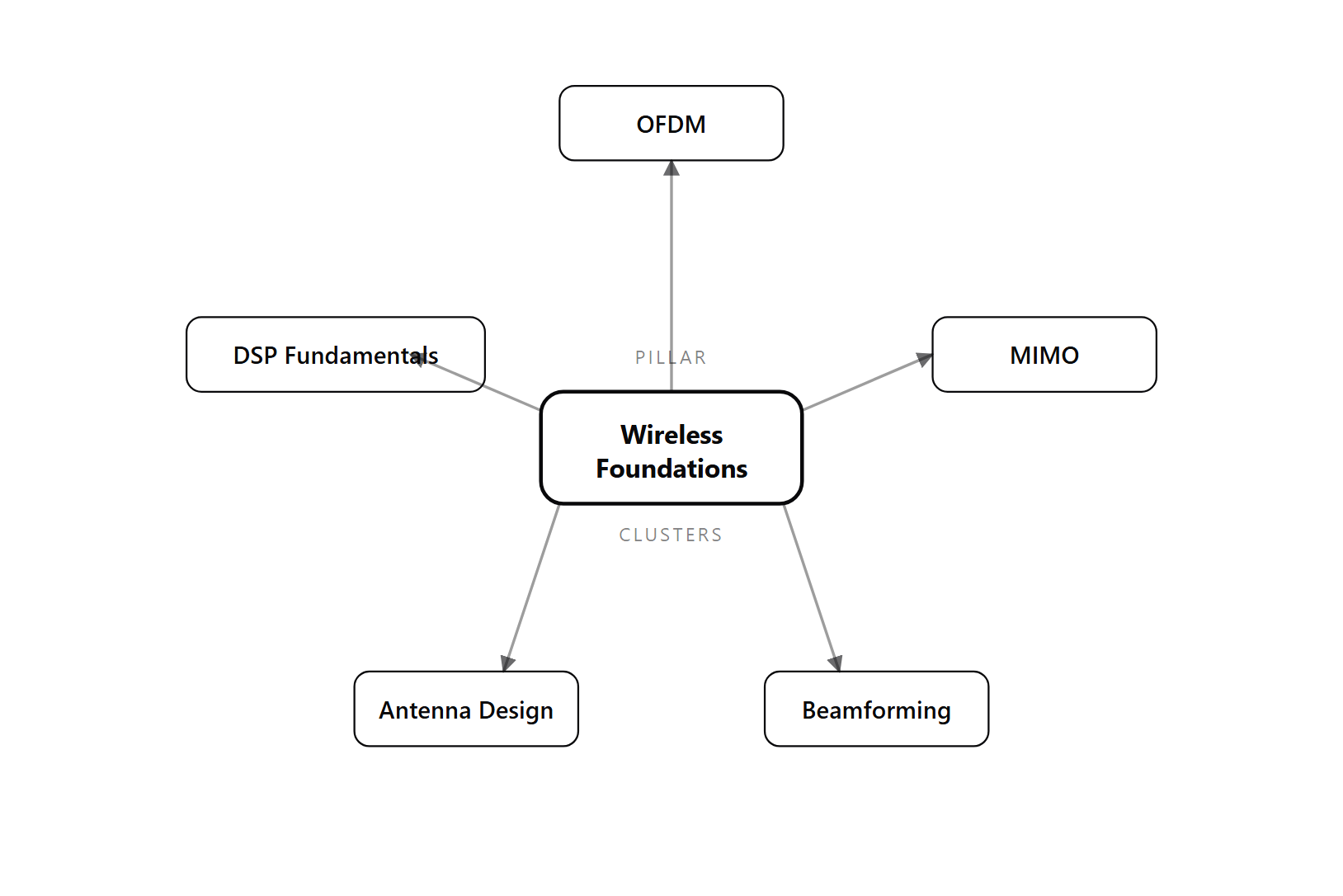
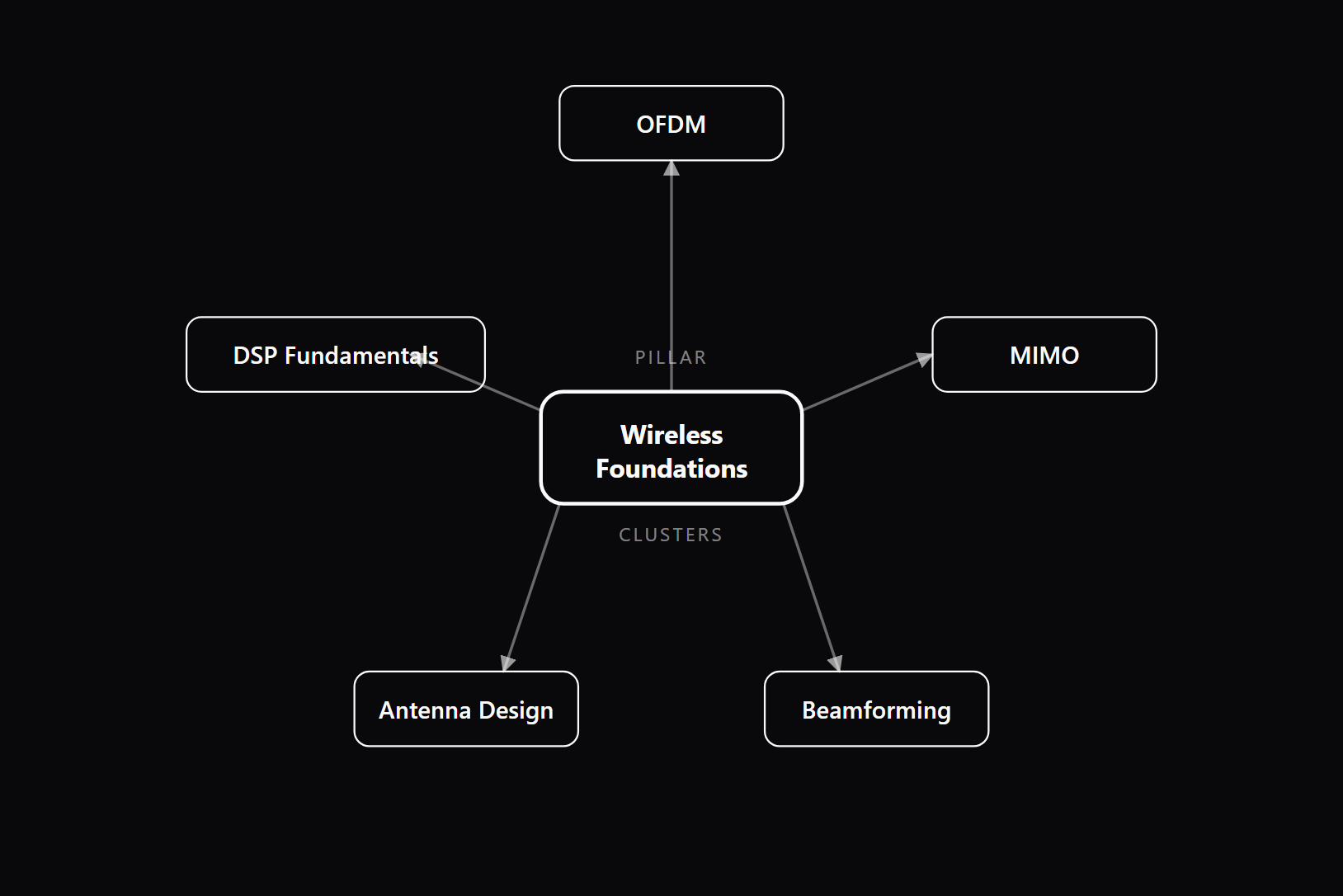
Wireless foundations is the curriculum-shaped union of the sub-areas a wireless or RF engineer is expected to integrate at interview: RF basics (link budget, path loss, noise figure), modulation (QAM, OFDM, single-carrier alternatives), channel models (multipath, Doppler, large-scale and small-scale fading), antenna theory (gain, beamwidth, polarization, array factor), beamforming intuition (analog vs digital vs hybrid, codebook vs reciprocity), and DSP for wireless (filtering, sampling, FFT-based equalization, synchronization). It is the pillar that maps to the topic cluster — each sub-area is a deep specialization on its own (OFDM, MIMO, Beamforming, Antenna Design, DSP Fundamentals, 5G NR, Wi-Fi 8) but a strong wireless engineer carries enough of the system view to reason across them under pressure. If you understand OFDM but not channel models, you cannot reason about why DFT-spread OFDM exists for the LTE uplink. If you understand MIMO precoding but not RF chain calibration, you cannot explain why implicit beamforming failed in 802.11n while explicit became the standard. Case study: a new graduate may know the OFDM equations, but a hiring team wants to hear how those equations survive in a live link budget with mobility, interference, and imperfect hardware. The useful answer is not just that OFDM has orthogonal subcarriers; it is that the waveform only delivers value when the channel estimate, timing recovery, and RF chain are all good enough for the theory to hold on a real device. A foundations interview is therefore explicitly cross-domain. It asks how OFDM, MIMO, and beamforming compose in a 5G NR mmWave cell; how the antenna front-end and the baseband interact across the FR1/FR2 boundary; how Shannon capacity, link budget, and beamforming gain combine to set practical throughput. The answer requires more than memorizing each sub-area in isolation — it requires the connective tissue between them.
Why interviewers ask
Foundations questions are gate questions. Interviewers use them to filter candidates who specialized in one sub-area without absorbing the system view. A candidate strong on MIMO precoding but weak on channel models cannot explain why FDD reciprocity fails. A candidate who memorized 5G NR numerology without grounding it in OFDM fundamentals cannot explain why 30 kHz subcarriers were chosen over 15 kHz for FR1 high-mobility scenarios. The typical interview opens with a system-level prompt that touches three or four sub-areas in one question. Example: "Walk me through how a 5G NR UE acquires a mmWave cell, finds the best beam, and stays connected as the user walks across an outdoor venue." A strong answer integrates OFDM (the waveform), MIMO and beamforming (acquisition via SSB sweep, refinement via CSI-RS, recovery via beam failure procedures), antenna and propagation theory (link budget, FR2 LOS-only propagation, body and foliage blockage), and standards mechanics (TCI states, beam reports, RACH). What reviewers reward is the ability to deliver a coherent architectural sketch in two minutes, then offer to drill into whichever sub-area the interviewer wants to test next. That signals breadth (the foundations pillar is solid) and depth (the candidate can go deeper on demand). What flunks is reciting a single sub-area at length without acknowledging the others — interviewers read that as specialization without integration, which is a hiring risk at any seniority above junior level.
Common mistakes
The classic failure is sub-area expertise without the system view. A candidate who has studied MIMO precoding deeply but cannot describe the OFDM cyclic prefix, or who can recite 5G NR numerology but cannot derive Shannon capacity, gives the interviewer immediate evidence of a foundations gap. The second failure is standards-level memorization without underlying math. Candidates quote "30 kHz subcarriers" without explaining that subcarrier spacing trades coherence-time tolerance (small SCS is bad at high Doppler) against cyclic-prefix overhead (small SCS gives longer symbols and proportionally more CP relative time spent on data). They name "256-QAM" without explaining the EVM headroom and link budget required to sustain it. Strong candidates ground every standards detail in the math or hardware that motivated the choice. The third failure is conflating OFDM (modulation), MIMO (spatial multiplexing), and beamforming (precoding). These three compose in modern systems but they are not the same idea. OFDM is the waveform — it converts a wideband stream into orthogonal subcarriers. MIMO is the spatial-domain layer — it uses multiple antennas to either send independent streams or boost SNR. Beamforming is a precoder choice — it focuses energy spatially. Mixing them up in an answer immediately signals shallow understanding. The fourth failure is carrying sub-6 intuition unmodified into mmWave answers. Candidates describe reciprocity-based MU-MIMO precoding as the default, miss that FR2 calibration tolerances are dramatically tighter, and fail to mention that codebook-based beam management (SSB sweep, CSI-RS refinement) is what FR2 actually uses. Naming both regimes precisely — sub-6 reciprocity, mmWave codebooks — is a strong-candidate signal that you have integrated the foundations.
Sample interview questions
- A 5G NR base station uses OFDM with 1024 subcarriers in the downlink, producing a PAPR of approximately 10-11 dB. The RF engineer needs to reduce the PAPR to allow the power amplifier to operate closer to saturation. Which technique reduces PAPR while preserving the transmitted data, and what is the trade-off?
- A. Increase the QAM modulation order from 64-QAM to 256-QAM. Higher-order modulation distributes constellation points more uniformly in the I/Q plane, reducing the probability of all subcarriers aligning in phase. The trade-off is increased sensitivity to noise.
- B. Decrease the FFT size from 1024 to 256 to reduce the number of subcarriers that can add coherently. With fewer subcarriers, the maximum peak is 10*log10(256) ~= 24 dB instead of 10*log10(1024) ~= 30 dB. The trade-off is reduced bandwidth and throughput.
- C. Apply forward error correction (FEC) with a low code rate (e.g., 1/3). The redundant parity bits statistically reduce the probability of high peaks by constraining the transmitted symbol sequences. PAPR reduction scales linearly with the amount of redundancy added.
- D. Tone reservation: dedicate a small set of subcarriers (typically 5-10% of total) as "peak reduction tones" that carry no data but are optimized to cancel signal peaks. The trade-off is reduced spectral efficiency — those subcarriers cannot carry user data, wasting bandwidth proportional to the reserved set size. ✓
Option D is correct because tone reservation is an established PAPR reduction technique. Reserve R subcarriers (out of N total) that carry no data. An optimization algorithm sets the reserved tones amplitudes and phases to create a signal that, when added to the data-bearing signal, cancels the largest peaks. The transmitted signal PAPR drops by 2-4 dB depending on R and the algorithm. The trade-off: the R reserved subcarriers waste spectral efficiency. Option A is incorrect because modulation order has minimal effect on PAPR. Option B reduces theoretical maximum PAPR but the practical PAPR drops only marginally and bandwidth would be quartered. Option C: standard FEC does not target PAPR reduction.
- In Wi-Fi 6 uplink OFDMA, the AP includes a target RSSI in the Trigger Frame for stations scheduled in a trigger-based PPDU. Why is this power target necessary?
- A. Force all stations in the trigger-based PPDU to use the same modulation and coding scheme for decoding simplicity.
- B. Align received signal powers at the AP so simultaneous RU transmissions avoid near–far distortion and ADC saturation. ✓
- C. Allow stations to decide whether to transmit by comparing detected energy with the target RSSI threshold.
- D. Provide a reference level so the AP can digitally rescale each RU after reception regardless of transmit power differences.
The second option is correct because UL OFDMA requires multiple stations to transmit simultaneously on different RUs. The AP must receive all signals with one AGC setting, so stations adjust transmit power to meet the target RSSI. This reduces near–far imbalance that could cause ADC saturation, spectral leakage, or loss of weaker RU signals. The first option is incorrect because UL OFDMA allows different MCS values per station. The Trigger Frame explicitly assigns MCS per user, so power alignment is unrelated to modulation uniformity. The third option is incorrect because trigger-based uplink transmissions do not rely on carrier sensing decisions by stations. The Trigger Frame already grants transmission permission. The fourth option is incorrect because digital gain at the receiver cannot recover signals clipped by ADC saturation or buried below the noise floor caused by large power disparities.
- An 8-antenna Wi-Fi 6 AP attempts DL MU-MIMO with eight single-stream clients but typically schedules only 3–4 together. What practical constraint limits larger MU-MIMO groups?
- A. 802.11ax limits MU-MIMO transmissions to four clients regardless of how many antennas the AP implements.
- B. Each MU-MIMO user consumes two AP antennas for beamforming and interference nulling, so an 8-antenna AP supports at most four users.
- C. Clients with highly correlated channels cannot be spatially separated effectively, so the AP schedules only subsets whose channel matrices allow low-interference precoding. ✓
- D. MU-MIMO grouping is largely random in commercial APs, so practical group size reflects statistical inefficiency rather than channel conditions.
The third option is correct because DL MU-MIMO relies on spatially separable channels. If users have highly correlated channel vectors (e.g., similar angles of arrival), the precoder cannot create independent beams without strong inter-user interference. Schedulers therefore select smaller subsets of spatially compatible clients even when more antennas exist. The first option is incorrect because 802.11ax supports up to eight DL MU-MIMO spatial streams; the standard does not impose a four-user limit. The second option is incorrect because MU-MIMO does not allocate two antennas per user. All AP antennas jointly form the precoding matrix that steers beams and suppresses interference. The fourth option is incorrect because modern APs explicitly evaluate channel state information from sounding and schedule groups based on spatial compatibility rather than random selection.
- A Wi-Fi 6 AP plans a DL MU-MIMO transmission to several clients. How does the AP obtain channel state information (CSI), and why can it not rely on uplink frames for accurate precoding?
- A. The AP performs explicit sounding by sending an NDPA followed by a Null Data Packet with HE-LTF training symbols. Each client measures the downlink channel and later returns a compressed beamforming report when polled. ✓
- B. The AP estimates the downlink channel from uplink data or ACK frames because Wi-Fi links are reciprocal in TDD systems, allowing the AP to reuse uplink channel measurements for MU-MIMO precoding.
- C. The AP broadcasts a beacon containing training symbols and all clients simultaneously return CSI using an OFDMA feedback slot so the sounding overhead stays constant regardless of the number of users.
- D. The AP avoids sounding entirely and cycles through predefined beamforming patterns, selecting the best one based on packet success rates reported in Block ACK frames.
The first option is correct because Wi-Fi MU-MIMO uses explicit sounding. The AP sends an NDPA to identify the stations being sounded, then transmits an NDP containing HE-LTF training symbols. Each client estimates the downlink channel and returns a compressed beamforming report when the AP polls it. These reports allow the AP to compute a multi-user precoding matrix. The second option is incorrect because practical Wi-Fi radios do not maintain calibrated transmit and receive RF chains. This breaks channel reciprocity, so uplink channel estimates cannot be used directly for downlink precoding. The third option is incorrect because CSI feedback is not returned simultaneously in a beacon-triggered OFDMA slot; stations typically respond sequentially after beamforming report polls. The fourth option is incorrect because MU-MIMO precoding requires accurate CSI. Cycling through fixed beams without channel feedback cannot reliably separate multiple users in the spatial domain.
- Wi-Fi 7 adds 4096-QAM on top of Wi-Fi 6 1024-QAM. What per-stream throughput increase results, and why is this modulation rarely sustained in typical deployments?
- A. 4096-QAM is responsible for most of Wi-Fi 7 peak throughput increase, contributing more gain than wider channels or additional spatial streams.
- B. 4096-QAM increases throughput by about 50% because the constellation grows from 1024 to 4096 points, and throughput scales linearly with constellation size.
- C. 4096-QAM is easier to maintain than 1024-QAM because the larger constellation provides additional redundancy that improves noise tolerance.
- D. The gain is about 20% because modulation increases from 10 to 12 bits per symbol. However, 4096-QAM requires extremely high SNR and tight EVM (around -38 dB), so it is typically usable only at short range with very clean RF conditions. ✓
The fourth option is correct because modulation efficiency grows with log2(M) bits per symbol. Moving from 1024-QAM (10 bits) to 4096-QAM (12 bits) increases throughput by 12/10 ~= 1.2, or about 20%. However, the constellation spacing becomes much tighter, requiring very high SNR (around 40 dB) and excellent transmitter linearity, phase noise, and EVM performance. These conditions typically occur only at short distances. The first option is incorrect because the largest Wi-Fi 7 throughput gains come primarily from 320 MHz channels and Multi-Link Operation (multi-link aggregation), together with the new efficiency features; the 4096-QAM modulation upgrade contributes only a modest ~1.2x (about 20%) per-stream factor. The second option is incorrect because throughput scales with log2(M), not with the raw constellation size. Although 4096 has four times as many points as 1024, the information increase is only two additional bits per symbol. The third option is incorrect because higher-order QAM reduces noise tolerance. The constellation points are closer together, tightening EVM requirements and making the modulation more sensitive to RF impairments.
Frequently asked questions
- What is the difference between baseband and passband processing?
- Baseband processing operates on the complex envelope of a signal — the in-phase (I) and quadrature (Q) components after the RF carrier has been removed by downconversion. Sampling rates are set by the signal bandwidth (Nyquist on the baseband), not the carrier frequency. Algorithms such as FFTs, equalizers, channel estimators, demappers, and FEC decoders all run on baseband samples. Passband processing operates on the RF signal as it exists on the air, including the carrier. The RF chain (PA, LNA, mixer, filter, antenna) shapes the passband; the analog front-end converts between passband and baseband. Mixing this distinction up is one of the most common early-career failure modes: candidates describe a wireless impairment without specifying whether it acts in passband (e.g. PA AM/AM distortion) or baseband (e.g. ADC quantization), so they cannot explain where the mitigation belongs in the signal chain.
- Why does Shannon capacity matter for wireless link design?
- Shannon capacity C = B * log2(1 + SNR) sets a fundamental upper bound on the bit rate any practical code can achieve on a noise-limited link with bandwidth B and signal-to-noise ratio SNR. Wireless link design is a continuous battle to get close to it: more bandwidth (sub-6 to mmWave to FR3), higher SNR (link budget, antenna gain, beamforming), and better coding (LDPC, Polar, BICM) push real throughput toward the bound. The shape of the formula matters too — capacity grows linearly in B but only logarithmically in SNR, which is why 5G NR chose to scale up channel bandwidth and spatial streams rather than chasing diminishing returns from higher modulation alone. The expression also generalizes to MIMO (sum of log2(1 + SNR_i) over eigenmodes), giving you the multiplicative throughput gain that MU-MIMO and massive MIMO chase. A candidate who cannot derive or apply this formula will struggle with any link-budget or capacity-planning question.
- What is the relationship between OFDM, MIMO, and beamforming?
- OFDM is a modulation scheme — it converts a wideband stream into many narrowband subcarriers and uses a cyclic prefix to turn multipath into a per-subcarrier complex divide. MIMO is a spatial-domain technique — it uses multiple antennas at transmitter and receiver to either send independent streams (spatial multiplexing) or boost SNR (diversity). Beamforming is a precoding choice — it focuses energy spatially by applying weights across array elements. The three compose: 5G NR uses OFDM as the waveform, MIMO at the spatial layer to multiplex users or streams, and beamforming as the precoder that steers energy across the array. A common candidate failure is to conflate them — for example, claiming that "MIMO improves SNR" without distinguishing diversity (which does) from multiplexing (which trades SNR for capacity), or claiming that "beamforming is just MIMO" without acknowledging that single-stream beamforming and multi-stream MU-MIMO are different precoder designs. Naming each tool separately and explaining how they compose is what a depth interview rewards.
- When does sub-6 GHz physics stop applying at mmWave?
- Three things break at FR2. First, free-space path loss is 15-25 dB higher at 28 GHz than at 3.5 GHz over the same range, because FSPL scales as 20*log10(f). Second, building penetration loss jumps from a few dB at sub-6 to 20-40+ dB at mmWave (concrete and modern coated glass become near-opaque), so propagation is effectively line-of-sight only. Third, atmospheric absorption — negligible at sub-6 — becomes measurable: rain fade of 5-10 dB/km at heavy rain, and the oxygen-absorption peak around 60 GHz makes that band useful only for short-range or intentional-isolation links. Architectural consequences ripple through every layer: omnidirectional control channels are infeasible (SSB beam sweeping replaces them), reciprocity-based MU-MIMO becomes calibration-bound (codebook-based beam management dominates), and cell radii drop from kilometers to hundreds of meters (dense small-cell deployments). Candidates who carry sub-6 intuition unmodified into mmWave answers fail this layer fast.
- Why do interviewers ask system-level wireless questions before drill-down questions?
- System-level questions filter for candidates who carry the cross-cluster picture, not just the sub-area details. The classic gate question is something like "explain how a 5G NR mmWave UE acquires a cell, finds the best beam, and stays connected as it walks across an outdoor venue" — answering well requires fluency in OFDM (the waveform), MIMO and beamforming (acquisition, refinement, recovery), antenna and propagation theory (link budget, path loss), and standards mechanics (SSB, CSI-RS, TCI states, beam failure recovery). A candidate strong on MIMO precoding but weak on channel models cannot explain why FDD reciprocity fails; a candidate who memorized 5G NR numerology but never derived a Shannon bound cannot explain why 30 kHz subcarriers were chosen. Interviewers use the system question to decide whether to invest the next 45 minutes drilling into your strongest area or whether you have a foundational gap that no amount of specialization can paper over. Strong candidates answer the system question with a one-paragraph architectural sketch and then offer to drill into any layer the interviewer wants to test — that signals confidence and breadth simultaneously.
Related topics
Essential AI-Native Skills for Wireless Foundations
Modern engineering work increasingly uses AI tools for design and code review, debugging, documentation, test and testbench generation, and workflow automation. The goal is not to let AI replace engineering judgment — it is to move faster while keeping verification discipline.
- Use AI to explain unfamiliar code, logs, waveforms, datasheets, or test failures.
- Break large problems into small, reviewable steps you can verify independently.
- Ask AI for hypotheses, then validate them against tests, measurements, simulations, or lab data.
- Version-control your analysis scripts, testbenches, and configs — keep changes small and reviewable.
- Document your assumptions, design tradeoffs, and debugging decisions.
- Verify AI output before trusting it: run the checks that fit the domain — unit tests, linters, simulations, or bench/lab measurements.
- Review AI output for correctness, edge cases, and real-world consequences.